

The bottleneck in Alzheimer's disease may not be production of amyloid-beta but its removal. Soluble proteins made in the brain have to leave through cerebrospinal fluid and the drainage routes around it, and impaired clearance has been linked to the earliest stages of neurodegeneration, years before neurons are lost. In rodents, two levers move that traffic: drugs that release nitric oxide and lower blood pressure, and gentle mechanical stimulation of Piezo1, a pressure-sensing channel in the lining of blood and lymphatic vessels. Whether either lever does anything measurable in a living human brain has been an open question.
A Finnish trial now reports that pulling both levers at once in healthy adults was followed by roughly 30% more amyloid-beta and GFAP, an astrocyte protein, in their blood, alongside MRI changes the authors read as fluid and protein shifting out of the brain. The intervention was two standard 0.5 mg nitroglycerin tablets under the tongue, the angina drug, taken about 20 minutes apart during a session on a vibrating mattress. The blood result, however, rests on a before-and-after comparison within a single session, with no placebo arm for the blood tests.
Why it matters: If brain protein efflux can be nudged with a cheap, approved drug and a device, and tracked with ordinary clinical MRI, it becomes testable in people at risk of Alzheimer's. Nothing here yet shows that moving amyloid into the blood protects anyone's brain.
The study, by Tuunanen et al. at the University of Oulu and Oulu University Hospital in Finland, appears in Nature Communications. It is registered as EudraCT 2021-000625-27 with pre-specified primary endpoints, data were collected between November 2021 and October 2023, and the authors declare no competing interests. The vibration was delivered by a commercially available mattress from a Finnish company.
Two levers pulling in opposite directions
The logic is deliberately paired. Nitroglycerin releases nitric oxide, which relaxes vascular smooth muscle; in the combined session blood pressure fell from 134/79 mmHg to a nadir of 114/67, a fall of about 15%. The vibration, modulated between 22 and 50 Hz so that Piezo1 would not desensitise, pushed the other way, raising mean arterial pressure and lowering blood volume measured at the forehead, consistent with reactive vasoconstriction. The aim was oscillating constriction resembling the slow vasomotor waves that, during sleep, are thought to drive fluid through the brain.
Twenty-nine volunteers aged 27 to 61 completed a randomised crossover: one visit of nitroglycerin plus vibration (26 participants analysed) and one of vibration alone (27), at least seven days apart. A nitroglycerin-only session in 12 participants and a sham cohort of 13 who simply lay still for 45 minutes were added; the authors label the first exploratory and treat the second as a supplementary cohort outside the randomised comparison.
What rose in the blood, and what did not
After the combined session, serum Aβ40 rose from 38.2 to 50.5 pg/ml (22 participants, P = 0.03), Aβ42 from 2.6 to 3.5 pg/ml (23, P = 0.03) and median GFAP from 65.2 to 85.1 pg/ml (25, P < 0.0001), with false discovery rate correction applied. The useful benchmark is dilution: nitroglycerin draws water into the blood, and blood counts implied about 5.2% dilution, which should lower protein concentrations, not raise them. The post-session values are corrected for that, but an increase of around 30% is several times the correction applied.
Size appears to matter. The larger proteins neurofilament light and phosphorylated tau-181 did not change (P = 0.67 and 0.75), which the authors take as a hint of a molecular-weight cut-off below 68 kDa. The rises also scaled with how far blood pressure fell, with correlations of r = −0.63, −0.57 and −0.49 in 19 to 24 people, although outliers beyond 2.5 standard deviations were removed before those correlations were run.
GFAP needs a second reading. It is an astrocyte protein whose blood levels climb after brain injury, so a rise could reflect leakage rather than clearance. The authors note the post-session levels sit far below those after traumatic brain injury, a median of 1,924 pg/ml in severe cases, and they raise the possibility of a transient increase in blood-brain barrier permeability themselves. Low against injury does not establish clearance.
What the MRI adds
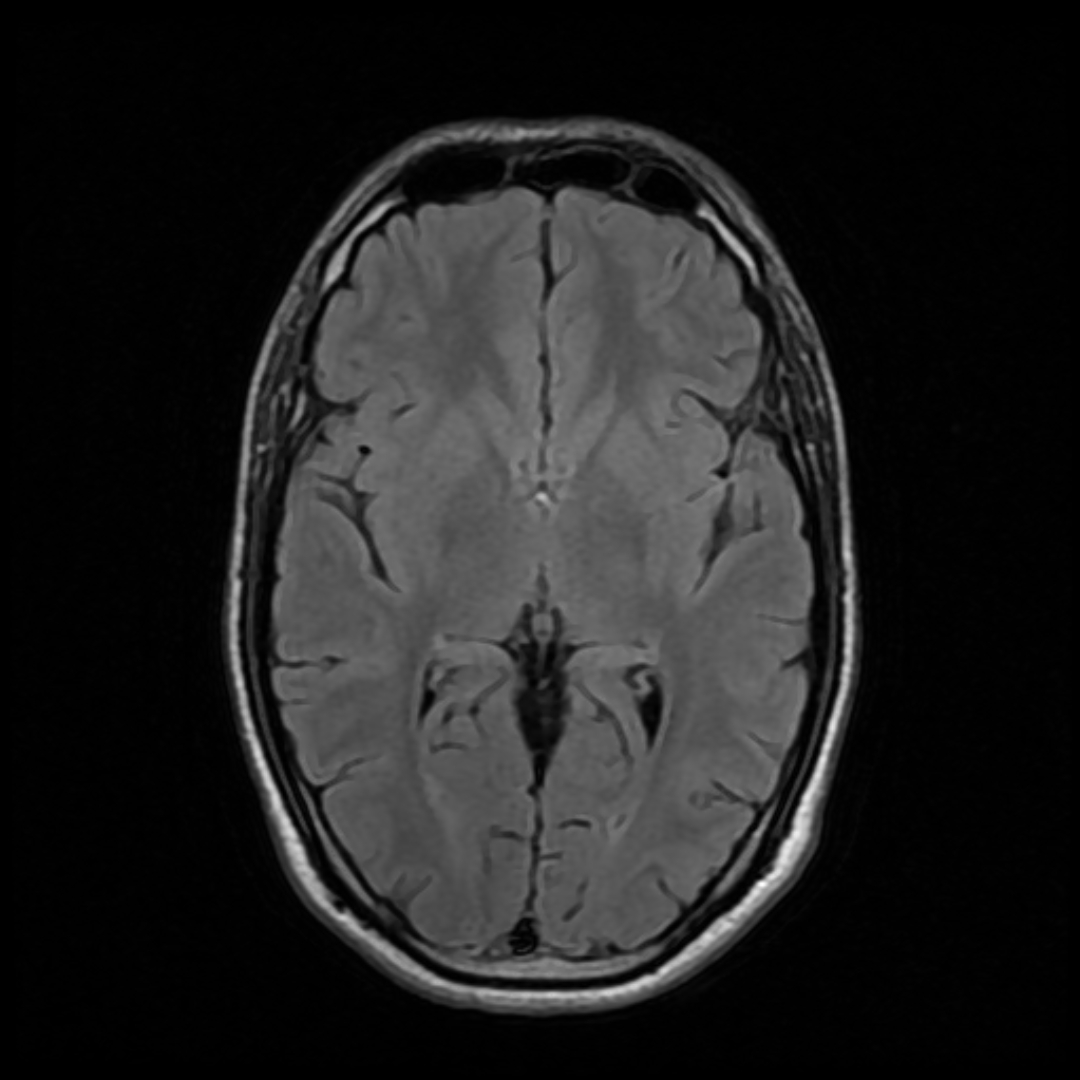
The imaging used T2 dark-fluid MRI, the FLAIR-type sequence clinicians use to spot oedema, whose brightness rises with protein content in fluid. Whole-brain signal fell by 4.6% after the combined session, extracerebral fluid volume grew by 6.5 ml, and signal rose in posterior venous sinuses, the large veins draining the skull, from 17.3 to 19.9 arbitrary units in the sinus rectus. In a pooled analysis, posterior sinus signal correlated with plasma Aβ40 at r = 0.32. These are indirect proxies; no one measured protein inside the sinuses.
What the study can't say yet
The central weakness is the comparator. The paper reports blood draws only before and after the combined session, the second roughly 1.5 hours after nitroglycerin was first given, so the randomised vibration-only arm does not act as a control for the headline biomarker result, and the sham cohort was used only for imaging. Time, posture and handling cannot be separated from the intervention, and the paper does not report blinding. The participants were healthy, received one session, and nobody measured brain amyloid or cognition afterwards. Side effects were not trivial: four headaches, three cases of nausea and one discontinuation for vomiting. Of their own findings, the authors write that they should be interpreted cautiously in light of our currently limited mechanistic knowledge of the solute clearance pathway.
Quick questions
Should anyone try nitroglycerin and a vibration plate at home? No. Nitroglycerin lowers blood pressure sharply, people with migraine or on erectile-dysfunction drugs were excluded, and no benefit to the brain has been shown.
Does more amyloid in the blood mean less in the brain? Not established. The study shows higher blood concentrations after one session, not reduced brain amyloid, and the proteins measured are soluble forms rather than plaques.
What is the one-line takeaway? In 29 healthy adults, nitroglycerin plus modulated vibration was followed by roughly 30% higher blood amyloid-beta and GFAP and consistent MRI changes, but without a blood-sampled control the result is a promising signal of brain clearance, not proof of it.
Tuunanen et al. "Vasomechanic treatment is associated with increased efflux of human brain proteins." Nature Communications, 2026. doi.org/10.1038/s41467-026-78894-y
PubMed PMID: 42977753.
Image: axial FLAIR MRI of the brain. 511KeV, CC BY-SA 4.0, via Wikimedia Commons.
Comments