
The obstacle in enzymatic plastic recycling is not finding an enzyme that cuts PET. One was reported in 2005, a hydrolase from Thermobifida fusca, and many more have been found or engineered since. The obstacle is that an industrial process demands several properties at once: tolerance of heat, activity at acidic pH, and useful bite on crystalline plastic rather than soft film. Protein function is brittle under that kind of multivariate pressure, since one unhelpful substitution can switch an enzyme off, which is why directed evolution and structure-guided design both advance in small mutational steps.
A team working at the National Laboratory of the Rockies and Harvard Medical School tried the opposite: rewrite dozens of positions at once, guided by the covariation patterns of related enzymes rather than by structural intuition about any one of them. They synthesised, purified and assayed 603 designs derived from eight parent PET hydrolases. More than 400 variants, carrying between 12 and 68 amino acid substitutions, still depolymerised PET, nearly all of them outperforming the enzyme they were built from, and in 15 of the 16 assay conditions at least one design matched or exceeded the product release of the field's benchmark enzyme.
Why it matters: Enzymes break PET back into its monomers, which is what makes closed-loop recycling possible rather than the downgrade mechanical recycling delivers. The barrier is cost, set largely by how well the enzyme survives heat and acid in an uncontrolled reactor, and a method yielding hundreds of working variants rather than one per campaign changes what can be screened.
The study, by Norton-Baker et al. at the National Laboratory of the Rockies in Golden, Colorado, with co-authors at Harvard Medical School, appears in Nature Communications. It was funded by the U.S. Department of Energy; the authors declare no competing interests, although three list present addresses at biotechnology companies.
What a forty-mutation jump buys
The method, which the authors call EVdesign, learns a statistical model of which positions vary together across a large alignment of homologous proteins, then samples sequences that maximise predicted fitness under it while differing from the parent by a set fraction of positions. Because it encodes pairwise dependencies, it can propose substitutions that are individually unusual but jointly consistent, which is what makes large simultaneous jumps survivable.
The first round applied the pipeline to eight natural PET hydrolases, mutating 5 to 20 percent of each. Results were strongly parent-dependent: designs from five parents showed measurable activity, those from two showed none, and one set could not be purified. TfCut2 was the standout, with a mean 3-fold and maximum 14-fold activity increase, and every one of its 16 active designs beat the parent in at least one condition.
The diversity dial moves the mean and the maximum in opposite directions
The second round asked what diversity within a design set does to outcomes, generating four sets on TfCut2. Average activity relative to wild type fell monotonically: 2.33-fold, 1.57-fold, 1.02-fold and 0.19-fold from the least to the most diverse set, and the share of conditions in which a design beat wild type fell from 70 percent to 8 percent. Variance went the other way, with the variance in melting temperature rising from 15.5 to 63.4 squared degrees across the same four sets.
That is a design choice rather than a ranking. The best variant of the round, 5.4-fold more active than TfCut2 on average and top-ranked in 10 of 16 conditions, came from the second most diverse set, which held only 30 designs against 95 in the conservative one. For a high hit rate under limited screening capacity, stay conservative; for one exceptional enzyme, buy variance.
Hand-placed mutations, then more machine design on top
Most designs lost thermostability, which matters because the assays run at 50 and 70 degrees Celsius. The fix was four substitutions transplanted by structural alignment from an engineered variant of a different PET hydrolase. Added to TfCut2 they raised its melting temperature by 18.3 degrees Celsius and, in one validation round, its average activity 16-fold; in designs the gain ran from 2.4-fold to 20.3-fold. The stabilised scaffold stayed designable even though those residues barely occur in the natural alignment: of 80 designs built on it, the 74 that yielded enough protein to test all kept activity in at least one condition.
Iterating the cycle to four generations produced the best enzymes: the top designs averaged 34.5-fold the activity of wild-type TfCut2 and 3.3-fold that of the hand-stabilised version, the largest individual value being 206.5-fold. Against the benchmark LCC-ICCG at identical loading, buffer, substrate and temperature, the top design in each condition averaged 1.48 times its 48-hour product release. The largest margins came at pH 4.5 and 70 degrees Celsius, roughly 2.2 times on crystalline powder and 3.3 times on film, though absolute activities at the lowest pH remained low.
What the study can't say yet
Every activity number comes from a 48-hour endpoint assay on 0.7 percent solids at fixed enzyme loading, in small buffered reactions taken only to partial conversion. That is a screening format, not a process, and the authors bound the benchmark claim accordingly: a considerable number are competitive with the benchmark enzyme LCC-ICCG in the assay conditions tested here, with the recognition that pH-controlled reactions at high solids loadings and high extents of conversion are ultimately necessary.
Two caveats sit inside the fold-change numbers. Wild-type TfCut2 had no detectable activity at 70 degrees and pH 4.5, so those conditions were dropped from the improvement calculation rather than scored as unbounded gains. And with no time-resolved kinetics, the gains cannot yet be split between faster catalysis, better survival at temperature and longer residence on the polymer, which the authors list as future work. Three parent enzymes purified successfully at larger scale in a previous study also yielded too little protein here to test, so an absent result sometimes means absent protein.
Quick questions
Does this mean plastic waste can now be digested? No. These are purified enzymes acting on clean, characterised PET film and powder, not on mixed post-consumer waste.
Why does low-pH activity matter? Holding an industrial reactor at a chosen pH costs money and chemicals, so an enzyme that works as the reaction acidifies removes a real process expense.
What is the one-line takeaway? Rewriting dozens of positions in a PET-degrading enzyme at once, guided by evolutionary covariation and paired with four hand-chosen stabilising mutations, yielded hundreds of working variants that beat their parents and, in a 48-hour partial-conversion assay, often matched the field's benchmark.
Norton-Baker et al. "Iterative computational and rational design generates diverse PET hydrolases for plastic depolymerization." Nature Communications, 2026. doi.org/10.1038/s41467-026-78471-3
PubMed PMID: 42977755.
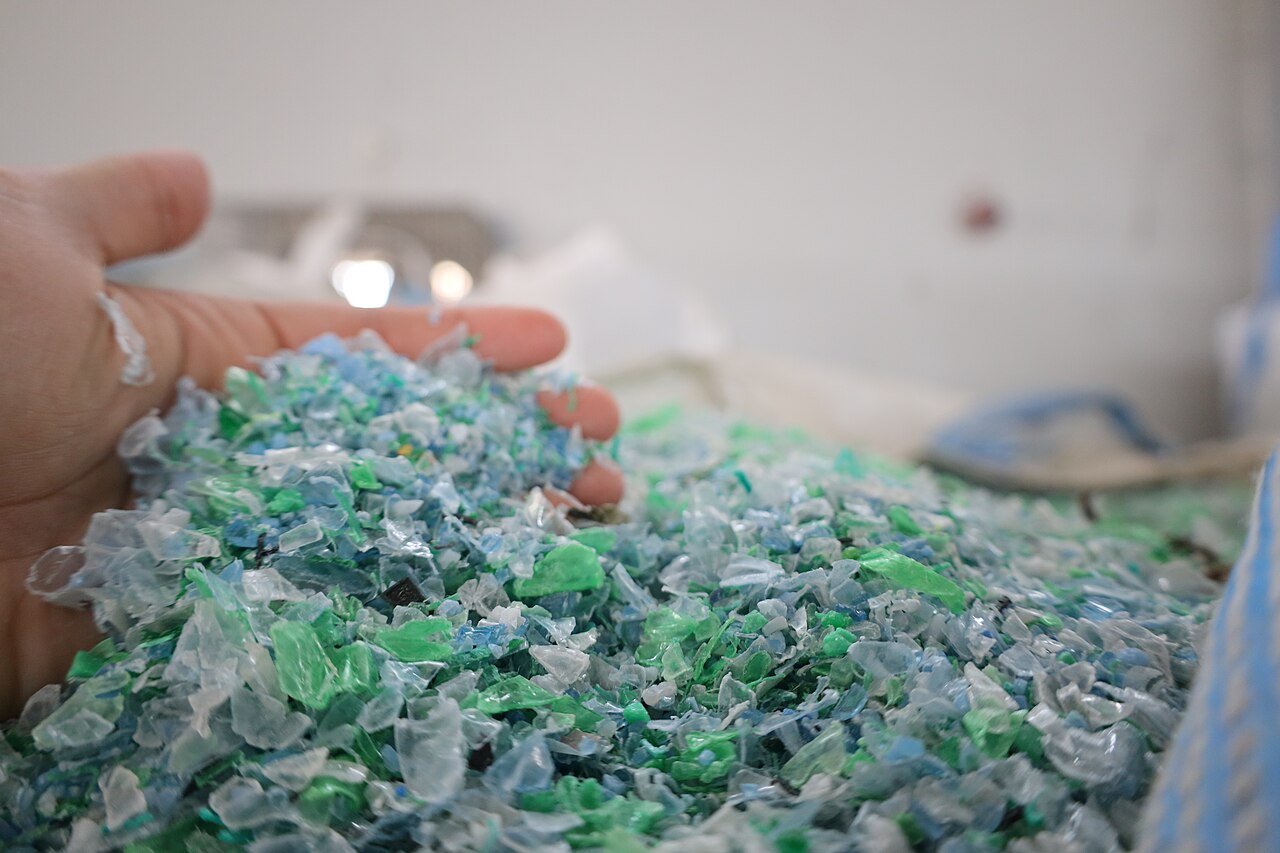
Image: recycled PET flakes. TOP PLASTIC, CC BY-SA 4.0, via Wikimedia Commons.
Comments