
Almost every version of CRISPR that has reached a clinic works by breaking the DNA double helix clean through. The editing protein finds its address in the genome, cuts both strands, and then steps back. What happens next is not really up to the engineer. The cell notices a severed chromosome, panics, and throws its emergency repair machinery at the gap. Sometimes that machinery stitches in the new sequence the researchers supplied. Often it just glues the ends back together and loses or gains a few letters in the process.
That gamble is the reason gene editing has been far better at switching genes off than at putting whole new ones in. A team at Tsinghua University has now built a system that inserts genes without making that break at all. Their method, called KNIT, threads DNA fragments ranging from under a kilobase to more than ten kilobases into chosen sites in the genome while cutting only one strand of the helix, reaching efficiencies as high as 89 percent.
Why it matters: Inserting a working copy of a gene is what most inherited diseases actually need, and it is the step that has been hardest to do cleanly. A method that adds kilobase-scale sequences without a double-strand break removes the main source of collateral damage standing between gene insertion and the clinic.
Why breaking both strands is the problem
A double-strand break is the most dangerous lesion a chromosome can suffer, and cells treat it that way. The repair pathway that dominates simply rejoins the loose ends, which is fast but sloppy, and routinely leaves small insertions or deletions at the site. The pathway that can faithfully copy in a supplied template is slower, fussier about the phase of the cell cycle, and much less common. Editing has therefore depended on winning a race the cell is not running on your behalf.
The failures are not confined to the target either. When two breaks occur in the same cell, the ends can be rejoined to the wrong partner, fusing chromosomes that were never meant to touch. Those translocations are precisely the sort of event oncologists spend their careers worrying about, which is why the risk has weighed so heavily on any therapy that needs to edit more than one site.
Nicking instead of cutting
KNIT, which stands for kilobase-scale nickase-targeting, uses a modified version of the Cas9 protein called a nickase. It cuts one strand of the double helix and leaves the other intact, a far gentler lesion the cell repairs routinely. On its own a nick is not enough to drive a large insertion, so the team coupled the nickase to a system that physically recruits the donor DNA to the site, holding the new sequence where it is needed.
The reported numbers are strong. Insertions ran from 0.7 kilobases to over ten, worked across different genomic locations and cell types, and reached up to 89 percent efficiency. As Gao and colleagues report in Nature, the approach also markedly reduces unintended insertion-deletion mutation (indels) rates, translocations and off-target editing. The system tolerated repeated edits and insertions at several sites at once, which is where translocation risk normally climbs fastest.
Two demonstrations show what it is for. In cells carrying a disease-causing mutation, the team restored normal gene expression by inserting a therapeutic gene, either at the gene's own location or at a designated safe harbour site. They then built CAR-T cells, the engineered immune cells used against blood cancers, without viruses and without double-strand breaks, at what they describe as clinically relevant efficiencies. Those cells killed tumour cells in culture and in mice.
What the study can't say yet
This is cell-culture and mouse work, and the distance from there to a treatment is long and littered with methods that did not survive it. The 89 percent figure is an upper bound, quoted as "up to", and efficiency varied across the sites and cell types tested. Nothing here establishes what the method achieves at an arbitrary new target, which is the number that matters when a specific disease is chosen.
Reduced off-target editing is also not the same as none, and the abstract does not quantify the residual rate. Nicking is gentler than cutting, but single-strand breaks are not biologically free, and long-term consequences in a living human are not something a mouse experiment settles. The CAR-T results are a proof of principle in animals rather than evidence of benefit in patients.
Quick questions
How is this different from ordinary CRISPR? Standard CRISPR severs both strands of DNA and depends on the cell's error-prone repair. KNIT cuts only one strand and brings the new DNA to the site itself, so the risky break never happens.
Why does inserting a whole gene matter more than switching one off? Many inherited conditions are caused by a gene that does not work, so the fix is supplying a functioning copy. Deleting or disabling sequence, which editing already does well, cannot achieve that.
What's the one-line takeaway? A Tsinghua team inserted genes from 0.7 to over ten kilobases at up to 89 percent efficiency without breaking both strands of DNA, and used it to build virus-free CAR-T cells that cleared tumours in mice.
Gao et al. "Efficient and precise programmable DNA knock-in without double-strand breaks." Nature, 2026. doi.org/10.1038/s41586-026-10819-7
PubMed PMID: 42486986.
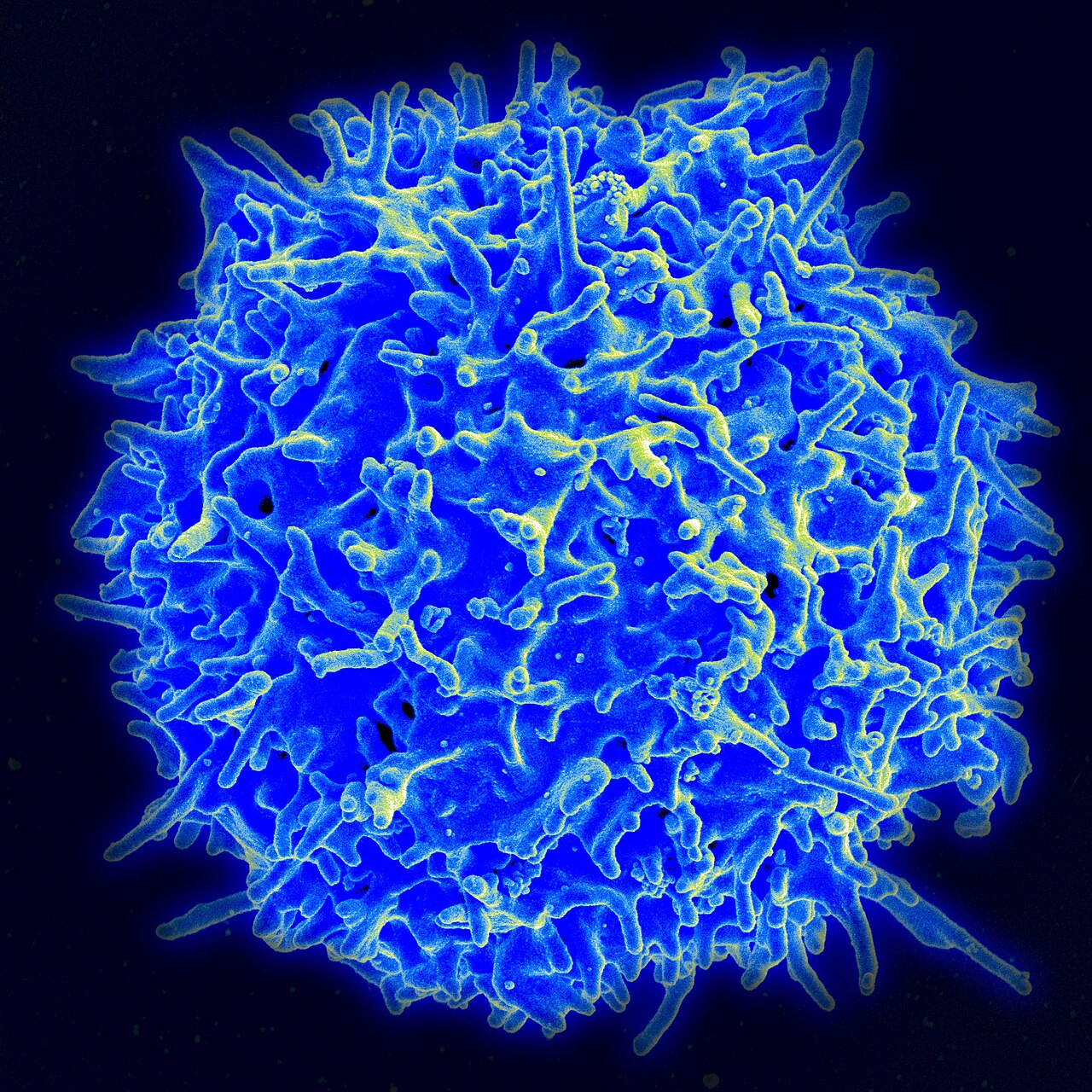
Image: Healthy human T cell, scanning electron micrograph by NIAID/NIH, public domain, via Wikimedia Commons.
Comments