

Scientists have known for a few years that psilocybin makes neurons grow. Give a mouse one dose and the dendritic spines in its frontal cortex, the tiny knobs where synapses land, sprout in bloom over the next day. That much was clear. What nobody could see was the other half of the wiring diagram. A spine is only useful if some other neuron plugs into it. So where were the new connections coming from, and were they landing anywhere in particular?
A team led by Alex Kwan at Cornell went looking for the presynaptic side of the story. Writing in Cell, they used monosynaptic rabies tracing, a technique that hops exactly one synapse backward from a defined starting population, to map every region across the mouse brain that feeds into frontal cortical pyramidal neurons. Then they asked a simple question. After psilocybin, does that input map change, and does it change at random or with a pattern?
The new connections pick sides
The rewiring was not uniform. Psilocybin strengthened the routing of inputs coming from perceptual and medial brain regions, the mouse homolog of the default mode network, toward subcortical targets. At the same time it weakened inputs that belong to cortico-cortical recurrent loops, the circuits where the cortex mostly talks to itself. In other words, the drug did not just add wiring everywhere. It shifted the balance of who was talking to the frontal cortex, favoring some pathways and pruning others.
That network specificity matters because the default mode network keeps coming up in human psychedelic research, usually in the context of ego dissolution and the loosening of rigid thought patterns. Here, in a mouse, the same broad circuit shows up at the level of physical synaptic remodeling. It is a rough bridge between the human imaging story and the cellular one, built out of traced axons rather than blood-flow signals.
Firing is the sculptor
The more striking result is about cause. The authors reasoned that if the rewiring depended on the electrical activity psilocybin evokes, then silencing a source region during dosing should block the remodeling from that region. So they did exactly that. When they silenced a presynaptic area while the drug was on board, the rewiring of its connection to the frontal cortex fell apart.
This flips the usual framing. The molecule is not acting as a lone architect that dictates where every new wire goes. Instead, psilocybin sets off a storm of spiking, and it is that pattern of activity that decides which connections get reinforced. The drug lowers the activation energy, and the neural activity does the carving. The researchers make the point plainly, showing that modulating neural activity is a way to steer where psychedelic-evoked plasticity ends up.
That is a lever worth having. If the plasticity follows the firing, then in principle you could combine a psychedelic with a behavioral task or a targeted stimulation and bias the rewiring toward useful circuits and away from useless ones. It reframes the compound less as a fixed treatment and more as a plasticity window that something else gets to shape.
What this does and does not show
The obvious limit is species. This is a mouse study, and a mouse does not have a therapeutic depression trial riding on it. The tracing captures anatomical inputs and their relative strengths, not the moment-to-moment function of those circuits during behavior, and rabies tracing has its own quirks in how efficiently it jumps between cell types. The work also stops at connectivity. It does not claim that any particular rewired pathway produces any particular change in mood or behavior, and reading a clinical benefit into these maps would be getting ahead of the data.
Still, the core finding is clean and a little surprising. Psilocybin's effect on brain wiring is network specific, and it is written by the very activity the drug provokes. If the goal is to turn psychedelics into precise tools rather than blunt ones, knowing that the rewiring listens to the firing is a good place to start.
Jiang, Q. et al. "Psilocybin triggers an activity-dependent rewiring of large-scale cortical networks." Cell, 2026. doi.org/10.1016/j.cell.2025.11.009
PubMed PMID: 41352354.
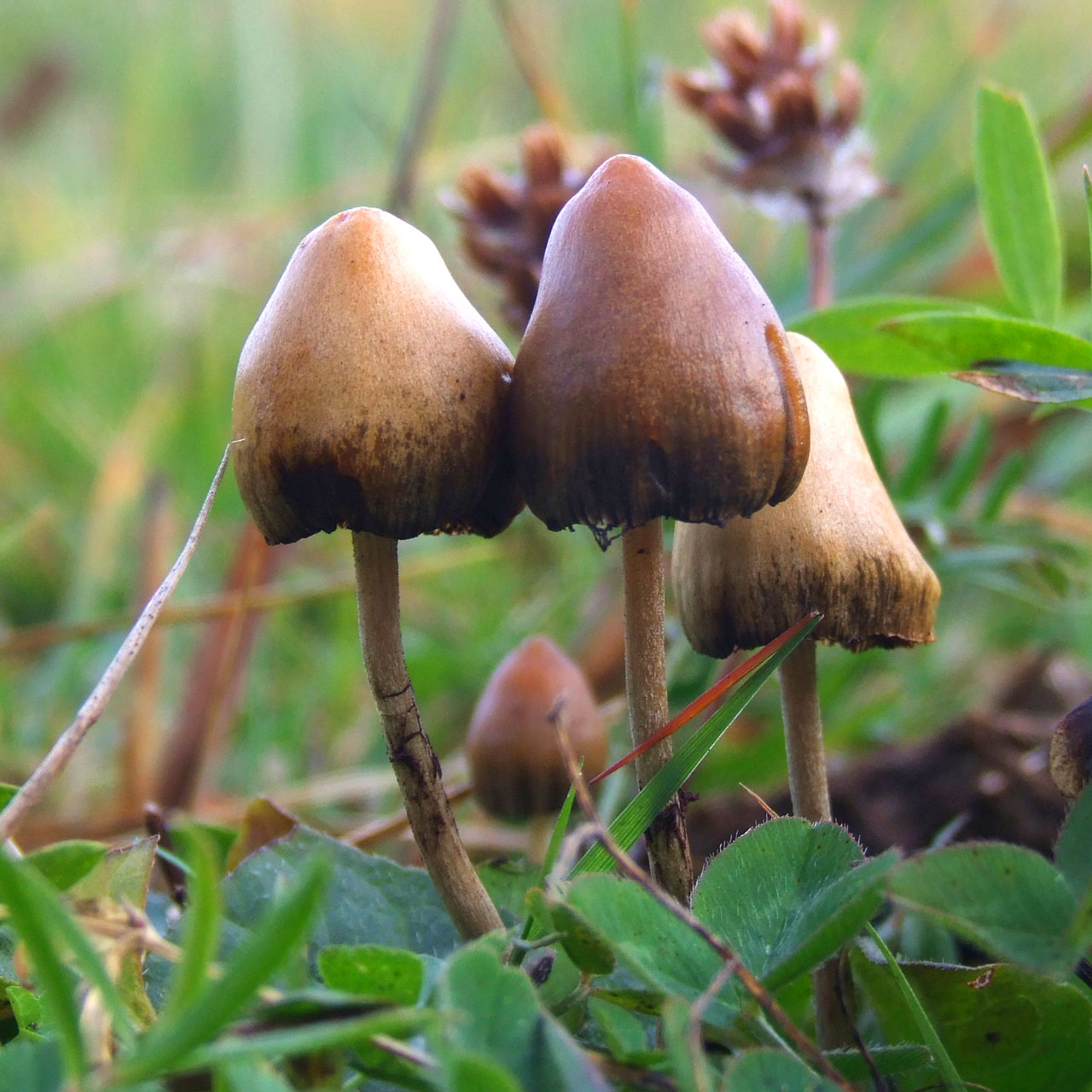
Photograph: Arp, CC BY-SA 3.0, via Wikimedia Commons.
Comments