


Generations of medical students have memorized the homunculus. It is the little cartoon man draped across a slice of the motor cortex, with an oversized hand and lips, feet dangling near the midline, each body part parked in its own neat district. It is one of the most reproduced images in neuroscience. And according to a study published this week in Nature, it is, at the fine scale, wrong.
A team spanning Stanford, UC Davis, Massachusetts General Hospital, Brown, Emory and the University of Chicago recorded from individual neurons in the brains of eight people who are paralyzed from spinal cord injury, ALS or brainstem stroke. All of them are enrolled in brain-computer interface clinical trials, which means they already had microelectrode arrays implanted in their motor cortex. The researchers used that access to build the most detailed map yet of how the human body is laid out on the brain's surface.
Everything, everywhere
The dataset is unusual. It covers 20 electrode arrays across the 8 individuals, all sampling the crown of the precentral gyrus, the ridge of tissue long considered command central for voluntary movement. Instead of finding a hand zone here and a foot zone there, the team found the entire body represented at every location they recorded from. Ask a participant to curl a toe, close a hand, move the shoulder, speak. Neurons in the same patch of cortex responded to all of it.
The old map was not entirely a fiction. The relative strength of the signals still roughly tracked the classic homunculus, so a region biased toward the hand really did lean toward the hand. But that bias sat on top of a background where the whole body was present. Think of it less as separate neighborhoods and more as one crowded room where everyone lives together, some voices just louder in some corners.
Speech has its own real estate
Two things stood out. The researchers found two speech-preferential areas, with a broadly tuned patch dominated by mouth and face movement sitting in between them. That matters for engineers trying to build devices that turn intended speech into text, because it tells them where to aim.
The second finding is about how the limbs relate to one another. Movements that are mechanically similar across different limbs turned out to share similar neural representations. Curling a toe and closing a hand, for instance, looked alike in the cortex even though they involve completely different muscles. The body's map, in other words, seems organized less around anatomy and more around what the movements actually do. Limbs are wired together, not filed apart.
Why a BCI cares about a map
This is not only a textbook correction. Brain-computer interfaces work by reading neural activity and translating it into cursor movements, robotic arm control or synthesized speech. If the whole body is legible from almost anywhere on the precentral gyrus, that is genuinely good news for people designing implants. A single well-placed array might carry information about far more than the one function it was meant to capture. The authors frame their map as targeting information for exactly that purpose.
There is a reason this took so long to see in humans. Animal motor cortex has been mapped neuron by neuron for decades. Human work has mostly relied on coarse tools such as electrical stimulation during surgery or functional imaging, neither of which resolves single cells. The BCI trials created a rare window: people willing and equipped to let scientists listen to individual neurons while they tried to move.
Some caveats are worth stating plainly. Eight participants is a small group, and all of them have paralysis, so a cortex reshaped by injury or disease may not look identical to a healthy one. The arrays sampled the crown of the gyrus, not its walls or depths, so this is a map of one surface rather than the whole structure. And recording during attempted movement in people who cannot fully execute those movements is not the same as recording during movement itself. The study describes organization; it does not settle how that organization forms or how much it can be reshaped.
Still, the picture it paints is coherent. The motor cortex looks less like a filing cabinet and more like a mosaic, where representations of the whole body are intermixed and interlinked. The little man on the wall was a useful lie. The real thing is more tangled, and probably more useful for the machines we are now wiring into it.
Deo, D. R. et al. "A mosaic of whole-body representations on the human precentral gyrus." Nature, 2026. doi.org/10.1038/s41586-026-10653-x
PubMed PMID: 42310450.
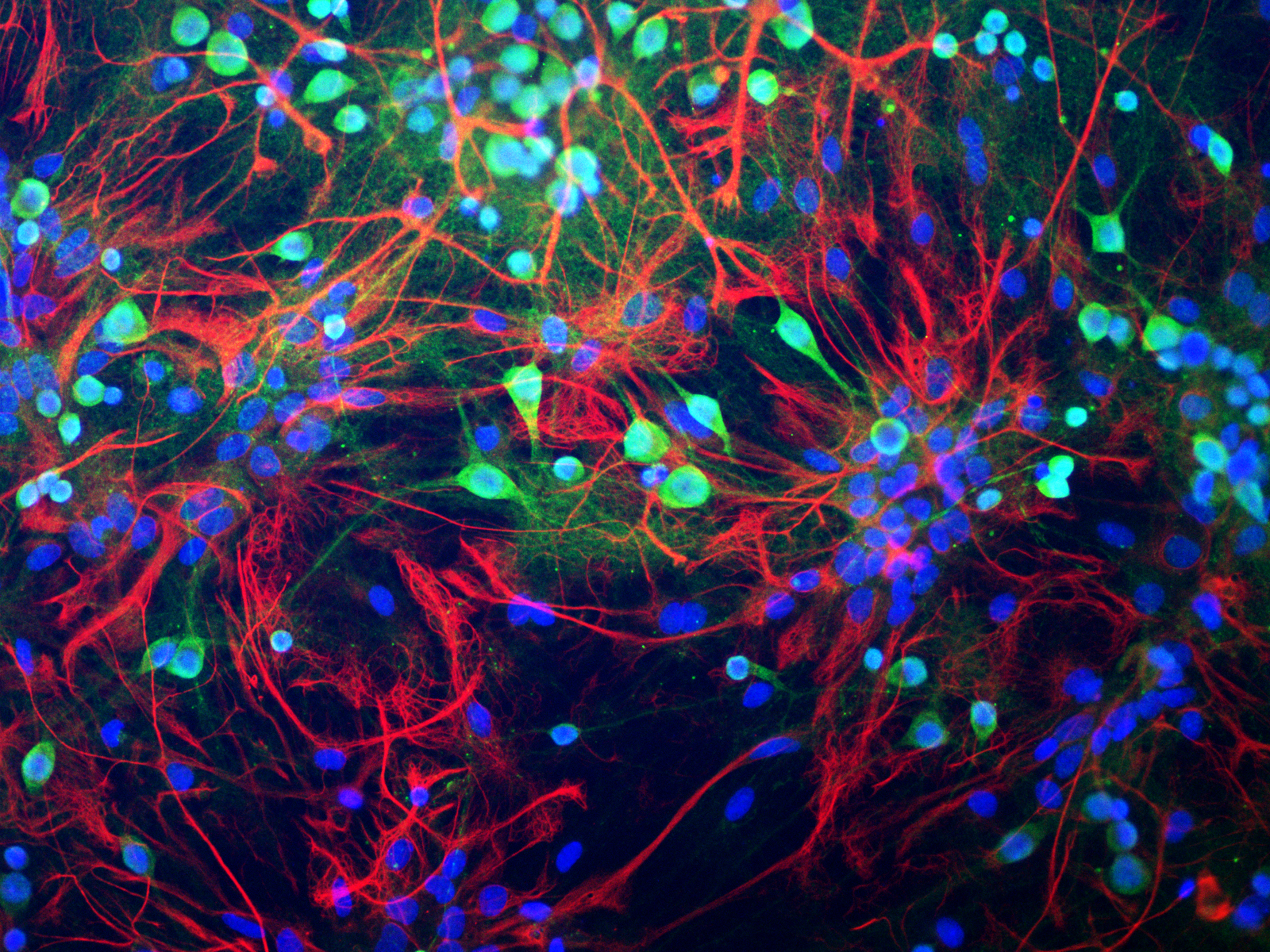
Micrograph: GerryShaw, CC BY-SA 4.0, via Wikimedia Commons.
Comments