


Push a standard optical fiber into a mouse brain and you get light out of one place: the tip. That single point has carried a lot of neuroscience. Optogenetics, the trick of making neurons fire or fall silent with a flash of light, has mapped fear, reward, movement, and much else by delivering that flash through a fiber. But a brain region is not a point. Neurons that do very different jobs can sit a millimeter apart, or stacked at different depths, and a tip only ever talks to whatever happens to be right in front of it. Move the target and you move the fiber, which means another surgery or a compromise.
A team led by Shuo Yang at Washington University in St. Louis has now packed that flexibility into a single strand. Their device, called PRIME, is a 160-micrometer multicore fiber, roughly twice the width of a human hair, with more than a thousand separate light-emitting sites spread along its length and around its circumference. The work appeared in Nature Neuroscience.
Etching a thousand windows into glass
The trick is in how the light gets out. Instead of one open tip, the researchers used a laser to carve tiny grating structures at chosen spots along the fiber. Each grating acts like a little window that peels a bit of light off one of the fiber's internal cores and sends it sideways into the tissue. Because the cores run in parallel and the gratings sit at specific axial and radial positions, the team can decide in advance exactly where on the fiber light will appear.
Then they steer it. By changing the pattern of light fed into the fiber from outside the brain, PRIME switches which sites are lit, cycling through 1,200 positions at 60 times per second. Those sites span 5 millimeters along the fiber and wrap a full 360 degrees around it. So a single implant that never moves can, moment to moment, illuminate a different depth or a different side of the surrounding tissue. No second surgery, no repositioning.
Different depths, different fears
To show the fiber does real work, the group paired it with high-density recording arrays, including Neuropixels probes, so they could stimulate neurons and listen to them at the same time. That combination is harder than it sounds, since the light used to drive cells often swamps the electrodes trying to record them.
The behavioral test is the part that sticks. The researchers targeted the superior colliculus, a midbrain structure involved in reactions to threat, in freely moving mice. Stimulating at different depths and locations within that one region did not just produce more or less of the same response. It evoked distinct defensive behaviors. In other words, the specific spot the light hit changed what the animal did, and the fiber could hop between those spots without anyone touching the mouse.
That is the argument for the whole design. A fixed tip forces you to pick your target before the experiment and live with it. A reconfigurable fiber lets the target become a variable you test.
Reasons for restraint
Some caution is worth keeping. This is a demonstration of a tool, run in mice, and the flashiest result covers one brain region and a set of defensive responses. Whether the fiber holds up over long implants, whether the carved gratings deliver enough light evenly across all thousand-plus sites deep in tissue, and how it behaves in larger brains are open questions the paper does not fully settle. Any move toward primates or clinical use would be a long way off.
Still, the direction matters. For years the bottleneck in optogenetics has not been the light-sensitive proteins but the plumbing that carries light to them. A fiber that can rewire where it shines, on the fly, from one implant, loosens that bottleneck. It turns a fixed pipe into something closer to an addressable grid, and it does so with a manufacturing step, laser-etched gratings, that could in principle scale. The neurons have been ready to be switched for a while. The hardware is starting to catch up.
Yang, S. et al. "Laser-engineered PRIME fiber for panoramic reconfigurable control of neural activity." Nature Neuroscience, 2025. doi.org/10.1038/s41593-025-02106-x
PubMed PMID: 41174171.
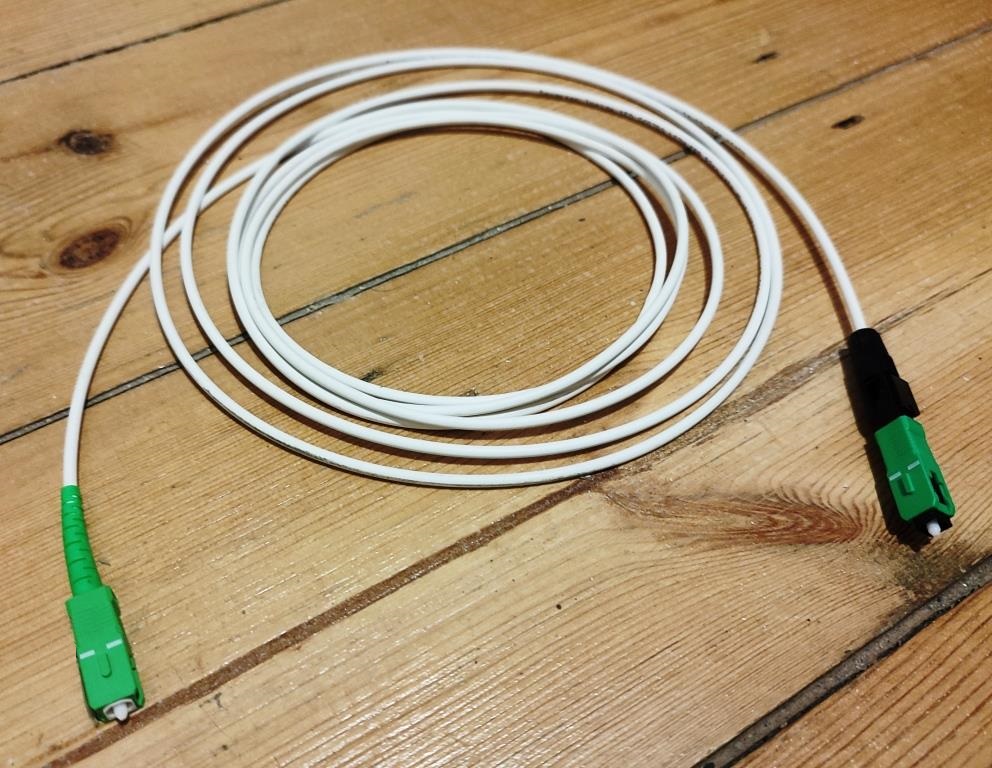
Photograph: Alexceltare2, CC BY-SA 4.0, via Wikimedia Commons.
Comments