


The surgical targets used to treat Parkinson's disease were not deduced from a theory. They were found. Over decades, neurosurgeons established that stimulating the subthalamic nucleus, the globus pallidus or the ventral intermediate thalamus relieves symptoms, and the field accumulated three effective targets without a settled account of what they have in common. Any such account has to explain why three anatomically distinct structures work, and why the disease produces sleep disturbance and cognitive symptoms alongside tremor.
A consortium spanning Changping Laboratory in Beijing, Washington University and Massachusetts General Hospital proposes one, built on a network described only recently. The somato-cognitive action network, or SCAN, is interleaved among the limb-specific strips of motor cortex but does not control any single limb. It is thought to coordinate arousal, internal organ physiology and whole-body movement plans with motivation. Assembling imaging from 863 people, the group reports that the substantia nigra and all three established stimulation targets connect selectively to this network rather than to the limb-specific regions between which it sits.
Why it matters: If the targets that work share one network, that network is a target in itself, and it can be located in an individual patient by imaging rather than by anatomy alone.
The study, by Ren et al., appears in Nature and reports that Parkinson's is marked by excess connectivity between this network and the subcortex, and that treatments which work reduce it. Levodopa, deep brain stimulation, focused ultrasound and magnetic stimulation all moved the same measure.
The part that is a real experiment
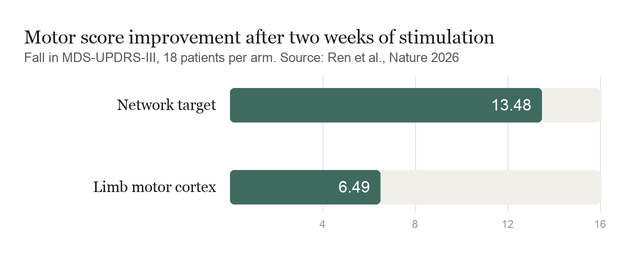
Most of this is observational, so the transcranial magnetic stimulation arm carries the weight. Thirty-six patients were randomised one to one, with allocation concealed in sealed envelopes prepared by an independent assistant, to receive stimulation either over the network or over limb-specific motor cortex, for 14 consecutive days.
Both groups improved. On the standard motor scale, the network group fell 13.48 points by week two, against 6.49 for the group stimulated over motor cortex, with confidence intervals that do not overlap and a group-by-time interaction below 0.001. The authors summarise it as follows: Targeting the SCAN instead of effector regions doubled the efficacy of TMS treatments. The comparison is unusually clean because the control arm received real stimulation at the site the field would otherwise have chosen. This is not a drug against placebo; it is a target against the incumbent target, which is the question a clinician actually faces.
The focused ultrasound result points the same way by a different route. Benefit increased the closer the lesion fell to the network's thalamic hotspot, a dose-response in space rather than in intensity.
Where the evidence is thinner than the framing
The correlations tying network connectivity to symptoms are weak. Connectivity between subcortex and network tracked motor severity at a correlation of 0.162, cognition at 0.161, anxiety at 0.186 and depression at 0.177, with p values between 0.017 and 0.038. Correlations near 0.16 explain under 3% of the variance, and p values sitting just below 0.05 across four related measures are the pattern that replicates least well. These associations are consistent with the network account without doing much to establish it. The randomised trial does the establishing; the correlations decorate it.
The deep brain stimulation cohort is small, 14 patients, and its improvements were tested with one-tailed paired t-tests. A one-tailed test assumes the direction of the effect in advance, which is defensible when the treatment is already known to work, and it does make the reported p values easier to reach than a two-sided test would. Readers should price that in.
What the study can't say yet
Thirty-six patients over two weeks is a pilot. It shows a target difference, not durability, and says nothing about whether the advantage persists past a fortnight, how often stimulation must be repeated, or whether it slows the disease rather than easing symptoms. Nothing here is disease-modifying evidence.
The direction of causation is also open. Excess network connectivity falls when treatment works, which is compatible with hyperconnectivity driving symptoms and equally compatible with it being a downstream readout that improves when symptoms do. A marker that tracks treatment response is useful either way, but the paper's framing implies the first reading while the design supports both.
The specificity claim rests on comparison cohorts of essential tremor, dystonia and amyotrophic lateral sclerosis that are modest in size, 45 and 42 patients for the first two. Locating the network in an individual requires precision imaging of a quality not routinely available in clinics, which is the practical barrier to translating any of this.
The authors' conclusion is appropriately staged: SCAN hyperconnectivity is central to PD pathophysiology and its alleviation is a hallmark of successful neuromodulation. A hallmark of successful treatment is a claim about correlation with response. Whether the network is where the disease does its damage is a stronger claim, and this work does not close it.
Quick questions
What is the somato-cognitive action network? A recently described set of cortical regions sitting between the limb-specific strips of motor cortex. Rather than moving one body part, it appears to coordinate whole-body action with arousal and internal state.
Why would that explain non-motor symptoms? Because the network is not purely motor. If it is disrupted, symptoms spanning sleep, autonomic function and motivation would be expected alongside tremor and slowness, which is what Parkinson's looks like.
What's the one-line takeaway? The three established surgical targets for Parkinson's all connect to one network rather than to limb motor cortex, and in 36 randomised patients, aiming magnetic stimulation at that network instead produced roughly twice the two-week improvement.
Ren J, Zhang W, Dahmani L, et al. "Parkinson's disease as a somato-cognitive action network disorder." Nature, 2026;651(8107):1030-1038. doi.org/10.1038/s41586-025-10059-1
PubMed PMID: 41639440.
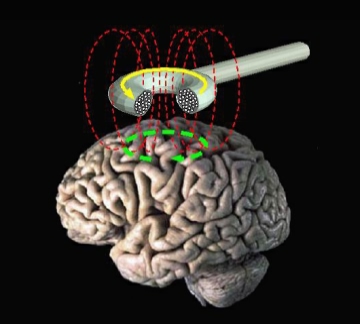
Image: human brain MRI. Via Wikimedia Commons.
Comments