The hard part of asking whether the biodiversity crisis reaches the deep sea is not the asking. It is holding a sampling programme steady long enough, in one region with one set of gear, that a trend separates from a bad year. The animals of the mesopelagic zone, the lanternfishes and shrimps living between 200 and 1000 metres, have largely been excused from the question by assumption. Their habitat is the largest on the planet, their numbers are enormous, they spawn into open water, and their populations were presumed to mix across ocean basins. Each of those traits predicts a very large effective population size, the number of individuals actually passing on genes, and a deep buffer against genetic erosion.
A new analysis of five Gulf of Mexico species, resampled between 2011 and 2023, reports the opposite. Across three temporal estimators, none of the five had a contemporary effective population size above 500, the threshold for long-term viability used by the Global Biodiversity Framework, and every species produced estimates near or below the short-term threshold of 50. One lanternfish also lost genomic diversity across the decade at a magnitude larger than published losses for several formally threatened species.
Why it matters: Deep-sea ecosystems make up 90 per cent of the ocean, and whether the biodiversity crisis extends into them is still an open question. The Gulf's mesopelagic zone alone has more than 1000 documented species whose conservation status is poorly understood, while climate change, commercial fishing and deep-sea mining all press on it.
The study is by Peres et al. at the Institute of Environment, Florida International University, with a co-author at Nova Southeastern University, in Nature Communications. The specimens come from the DEEPEND consortium's repeated cruises aboard the R/V Point Sur, with nets opening and closing at discrete depths down to 1500 metres. The team built ddRAD sequencing libraries for 432 individuals and combined them with 158 published earlier, for 590 in total, of which 486 survived filtering. Three lanternfishes were followed across 2011, 2015, 2016, 2018, 2021 and 2023, and two sergestid shrimps from 2015 onward, with between 2355 and 6047 loci analysed per species. The work was funded by NOAA's RESTORE Science Program, and the authors declare no competing interests.
What a small effective population size does and does not mean
Effective population size is not a headcount. It is the size of an idealised population that would lose genetic variation as fast as the real one does. The Global Biodiversity Framework uses it as a conservation indicator, with 50 as a short-term and 500 as a long-term viability threshold, and the authors note a proposed revision of those numbers to 100 and 1000. One standing explanation for low values in marine species is sweepstakes reproduction, in which extreme variance in breeding success detaches the genetic number from the census one; the authors raise it and judge it insufficient here, since they see no dramatic swings in recent generations. What makes the result hard to wave away is that three temporal estimators with different assumptions, run at two minor-allele-frequency cutoffs, agree. The paper is candid where they do not: a single-sample linkage-disequilibrium method returned values from 37.8 to infinite, and the authors treat the infinite estimates as unreliable, while a negative estimate for one shrimp between 2018 and 2021 was dropped as a likely artefact of low sample size.
One lanternfish lost ground the others did not
The erosion is not uniform. Diaphus dumerilii declined most sharply between 2011 and 2016, by 10.9 to 13.1 per cent across three diversity metrics, then partially recovered without returning to its starting point, for a net loss of roughly 8 per cent. Ceratoscopelus warmingii dipped 3 to 5 per cent and came back, one shrimp moved 1.6 to 3 per cent, and the other two changed in ways the authors judged statistically supported but biologically trivial. The benchmarks they offer are what make the first number uncomfortable. Atlantic bluefin tuna lost 1.5 per cent comparing pre-1941 with 2013 and 2018 samples; mountain gorillas lost 3 per cent over a century; a meta-analysis puts the average loss in natural populations since the industrial revolution at 5.4 to 6.5 per cent. Diaphus dumerilii is also the species with limited vertical migration and a bottom-associated adult phase, and the one previously reported to carry higher contaminant loads than its neighbours; a deep plume from the Deepwater Horizon spill persisted around 1000 to 1300 metres for at least six months.
The modelled future is mostly worse
Three niche-modelling algorithms, projected to 2050 and 2100 under four emissions pathways, make Gulf conditions less favourable for four of the five species, with suitable area falling between 5.2 and 70 per cent depending on species and scenario. The exception, the shrimp Phorcosergia grandis, gains habitat, though the models disagree there and some of them show a decrease; the authors flag that it also had the lowest model performance of the five.
What the study can't say yet
No cause is established. There is no pre-spill genomic baseline, and the authors write that While a direct link between the Deepwater Horizon oil spill and our findings cannot be definitively established due to the dearth of pre-spill data, what remains is a pattern, not an attribution. The two demographic reconstructions also disagree about timing, one describing a gradual slide beginning thousands of generations ago and the other an abrupt recent collapse within the last 91 to 14 generations, and both rest on an assumed mutation rate and an assumed generation time of one year. Whether neighbouring populations could replenish these is unknown; the paper calls its own reasoning here speculation because connectivity has barely been measured. Two of the five species show essentially no diversity loss, and effective population size is an indicator of risk, not a count of animals.
Quick questions
Does this mean lanternfish are about to disappear? No. It means five populations sit below the genetic thresholds conservation bodies use to flag risk, which is a warning about capacity to adapt rather than an extinction forecast.
Why does it matter that the numbers come from the Gulf? Because it carries the longest mesopelagic time series anywhere, built after Deepwater Horizon, and is one of the few places the question can be asked with repeated samples.
What is the one-line takeaway? The ocean's largest habitat is not automatically buffered by its size, and the first place that shows is in the genomes.
Peres et al. "Extinction risks in deep-sea populations revealed by genomic data and ecological niche modeling." Nature Communications, 2026. doi.org/10.1038/s41467-026-79098-0
PubMed PMID: 43020802.
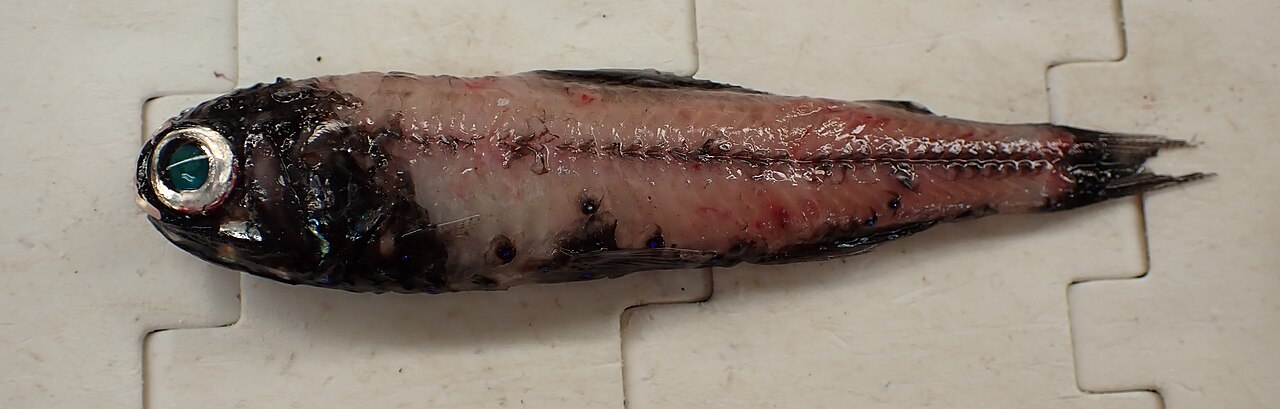
Image: a Diaphus lanternfish specimen. HulloThere, CC BY-SA 4.0, via Wikimedia Commons.
Comments