
The number that sets when Huntington's disease begins is not only the one a person inherits. The CAG repeat in the HTT gene is unstable, and in vulnerable neurons it keeps lengthening across a lifetime, a process called somatic instability; post-mortem work cited in this paper found striatal neurons carrying expansions of up to 1000 CAG repeats. Human genetics therefore points at the machinery doing the lengthening rather than at the mutant protein it eventually makes: variants in MSH3, part of the mismatch repair complex MutS-beta, shift both age at motor onset and rate of progression.
A new preclinical study goes at that target directly, then does something unusual with the result. An artificial microRNA against MSH3, carried by an AAV capsid engineered to enter medium spiny neurons, lowered MSH3 messenger RNA inside those neurons by 48 to 94 percent across three doses in rhesus macaques, and cut a measure of repeat expansion by up to 46 percent in a Huntington's mouse model. The years of patient benefit in the paper's conclusion were not observed in any animal. They are the output of a computer model the same team built.
Why it matters: Huntington's disease is fatal and still untreatable at its root, and a therapy aimed at slowing repeat growth rather than at the mutant protein could in principle be given before symptoms start. Whether that works is a separate question from whether it can be simulated.
The work comes from Simpson et al. at Latus Bio in Philadelphia, with co-authors at the Children's Hospital of Philadelphia and the University of Pennsylvania, and is published in Nature Communications. The declared interests are material: three authors founded Latus Bio, most of the author list are its employees, one sits on its board, and the candidate under test is the company's own. The model's code and a public web app are posted.
Why the repair machinery is the target
MSH3 pairs with MSH2 to form MutS-beta, which corrects the insertion and deletion loops that arise during DNA replication. On a long CAG tract, that repair activity is what ratchets the repeat longer. The human evidence is quantitative: the authors cite a polymorphism lowering MSH3 expression by about 10 percent that reduced instability, slowed progression and delayed onset by one year, and heterozygous loss-of-function mutations, which halve MSH3 from birth and delayed average age at motor onset by 10.6 years. In neurons grown from patient stem cells, an antisense oligonucleotide knocking MSH3 down by 41 percent reduced instability proportionally, while 83 percent knockdown roughly halted it. Those are the benchmarks a new agent has to beat.
What was actually measured
In rhesus macaques, a four-week dose-ranging study infused the vector into the globus pallidus. In bulk tissue, MSH3 messenger RNA fell by 31, 52 and 47 percent there at low, mid and high dose, and by less in the caudate and putamen, which were not the infusion site. Bulk tissue understates the effect on the cells that matter, since medium spiny neurons are 85 percent of striatal neurons but only 34.4 percent of all striatal cells; counting MSH3 transcripts inside those neurons gave reductions of 48, 65 and 94 percent. Those three figures are what the model was fed.
The second experiment used HdhQ111 knock-in mice, injected at 8 weeks of age and examined 16 weeks later. Bulk Msh3 messenger RNA plateaued across four ascending doses at 13, 27, 25 and 23 percent, while Msh3 protein kept falling, at 6, 20, 26 and 40 percent. The instability index tracked protein rather than transcript, at 8, 15, 34 and 46 percent, and only the two highest doses lowered it significantly. That divergence is the most informative detail here: on messenger RNA the therapy looks saturated, on protein it is still climbing.
Where the years come from
The model treats individual medium spiny neurons as objects that gain or lose CAG repeats each year, using a two-phase expansion rate taken from published single-cell work. Neurons count as healthy below 150 repeats, dysregulated between 150 and 300, and dead above 300; a simulated patient is a population of such neurons aged forward against landmarks drawn from longitudinal cohorts. Five years of delay was set as the minimum worth pursuing. With the macaque knockdown values entered, every dose cleared that bar, and for one simulated patient carrying 42 repeats and treated at 46, the model returned a reduction in decline on the composite Unified Huntington Disease Rating Scale of between 53 and 126 percent against untreated natural history at three years. The abstract states the predicted slowing as 50 to 120 percent. A figure above 100 percent is a modelled ratio, not an observed recovery.
What the study can't say yet
No person was treated and no animal was assessed for symptoms. The macaques are not a disease model, so that arm demonstrates target engagement only; repeat instability was never measured in them. In mice the endpoint is an instability index from fragment analysis of striatal DNA, not neuron survival, motor behaviour or lifespan, and follow-up ran sixteen weeks. The macaque study is also small, and the authors say so: A limitation of this dose range-finding study was the use of n = 2 NHPs per dose group, which precludes formal statistical analysis and limits assessment of biological variability. Lowering a mismatch repair gene carries an obvious theoretical cost; no significant change appeared in mismatch repair or cancer-signalling transcripts in patient-derived neurons at 52 percent knockdown, but that is a transcriptome in a dish rather than a safety study. One month after infusion, high-dose macaques showed a three-fold rise in the microglial marker AIF1 in the globus pallidus, which the authors attribute to surgery and vector.
Quick questions
Does this slow Huntington's disease? Nothing here measures disease. It measures how much MSH3 the therapy removes, and in mice how much that slows repeat expansion; the years of benefit are model output calibrated on patient data.
Why target MSH3 instead of huntingtin itself? Because the repeat keeps growing after birth and MSH3 drives that growth. The authors note the two approaches are not exclusive and may do more combined.
What is the one line to take away? A target with unusually strong human genetics behind it, real knockdown in two monkeys per dose and real slowing of expansion in mice, and a clinical benefit that so far exists only in simulation.
Simpson et al. "Computational modeling and preclinical evaluation support targeting somatic instability for Huntington's disease treatment." Nature Communications, 2026. doi.org/10.1038/s41467-026-78769-2
PubMed PMID: 42951910.
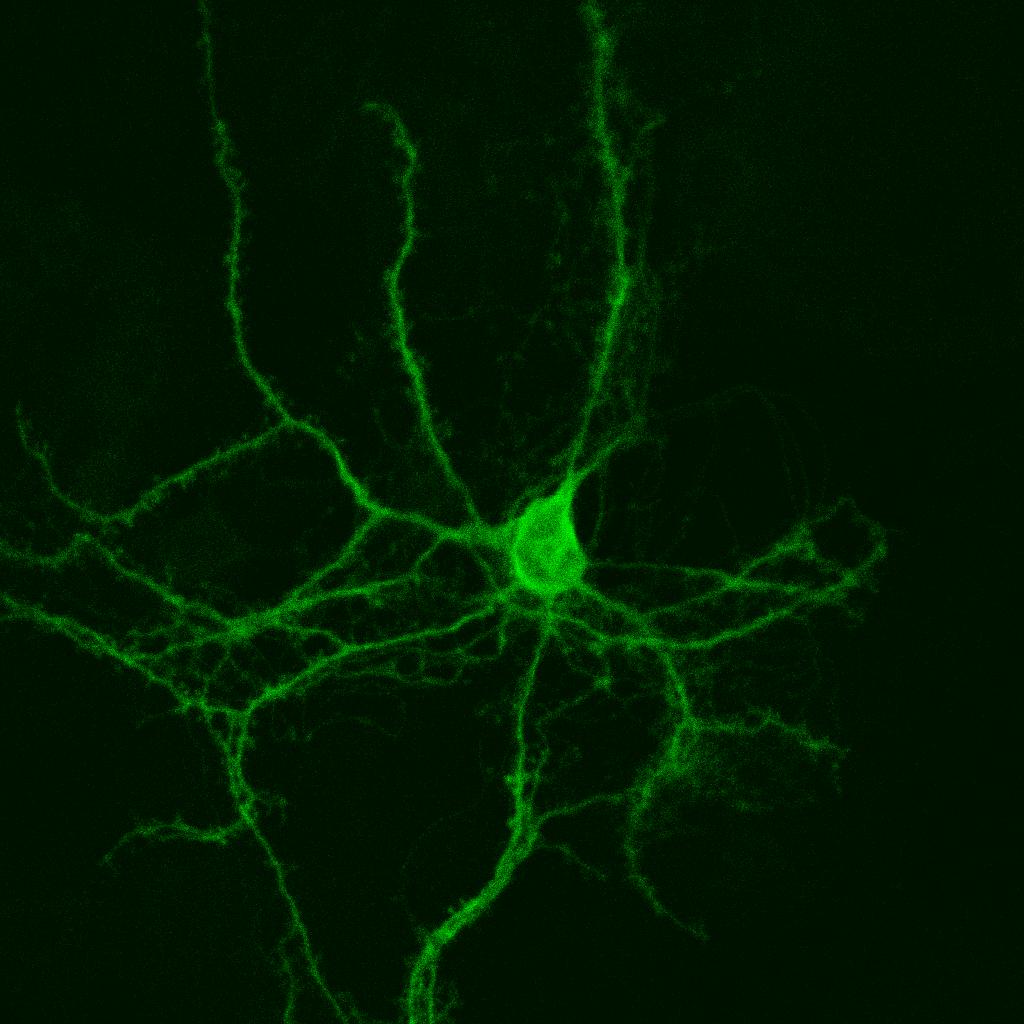
Image: a striatal medium spiny neuron in culture. Sergb95, CC BY-SA 4.0, via Wikimedia Commons.
Comments