
An atoll island is not a rock. It is a bank of sand and rubble resting on a reef, and nearly every grain of it was manufactured by something alive: corals and coralline algae laying down limestone, parrotfish grinding that limestone into sediment. What holds the pile together is plant roots. This is why the familiar image of rising seas simply drowning such islands is incomplete. Whether an atoll keeps its head above water depends on rates of biological production, and rates of biological production are the sort of thing that can be managed.
A team led from Lancaster University has put numbers on how much that management might be worth. Across 28 islands in the inner Seychelles, the Chagos Archipelago and Teti'aroa in French Polynesia, they compared islands with and without invasive rats, which eat seabird eggs and chicks and therefore decide whether an island carries a colony at all, and islands still under native forest against those taken over by coconut. Rat-free islands held a median of 2,895 birds per hectare. Rat-infested islands held half a bird. Nitrogen delivered onto the land by seabirds ranged from essentially nothing to 366 kilograms per hectare per year.
Why it matters: Clearing rats and replanting native forest are already routine conservation measures, funded and justified as biodiversity work. Coconut plantations are estimated to dominate 60% of Pacific atoll forests. If those same interventions also raise the rate at which the surrounding reef grows upward, they stop being only about birds and become climate adaptation for countries whose entire national territory is atoll.
The study, by Graham et al. at Lancaster University, appears in Science Advances. It is observational, comparing islands along gradients that already exist rather than restoring any island and measuring what changed.
The chain from bird to limestone
The mechanism runs offshore to onshore and back again. Seabirds feed in open water, return to the island, and deposit nitrogen. Some of that nitrogen reaches the surrounding reef, where it raises coral and algal productivity, which means more limestone laid down and more sediment available once parrotfish have worked on it. On land, better-fed native forest produces greater fine root length, which binds sediment against wave and storm erosion. The paper's framing device is to treat all of this as energy flow through one connected system.
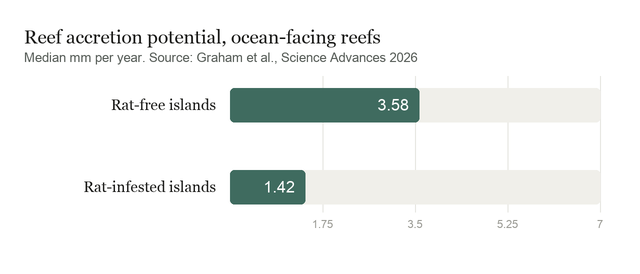
On lagoonal reefs around rat-free islands, accretion ran at a median 5.92 millimetres per year, roughly 1.8 times the rate around rat-infested islands. The comparison the authors then draw is the one that matters: projected sea-level rise for the study region through to 2100 under a 2 degree warming scenario is about 6 millimetres per year, so reefs at that rate would closely track it. Reefs beside rat-infested islands, by contrast, are judged to have limited capacity to keep pace with even the current regional rate of about 3.3 millimetres per year. As the authors put it, The difference in reef accretion potential, especially on lagoonal reefs, is meaningful in the context of projected rates of future sea-level rise.
What the study can't say yet
The headline comparison has a gap in it that the authors disclose in the methods rather than the abstract. Their accretion figures count what is built and not what is lost: Due to the absence of empirical data on rates of physical reef framework removal or chemical dissolution per unit area of reef surface over time, we did not factor in physical loss rates or chemical dissolution of the substrate. Reefs erode and dissolve continuously, and ocean acidification is expected to accelerate the dissolving. So a gross production estimate is being held against a net requirement, and the true margin against six millimetres a year is smaller than 5.92 by an amount nobody here measured.
The design is the second constraint. No island was cleared of rats and then re-surveyed; these are present-day contrasts between islands that differ in rat status, forest cover and much else, with rat presence standing in for seabird density. The uncertainty is wide enough to matter: on ocean-facing reefs the credible interval around the rat-infested estimate runs from below zero to 4.37 millimetres per year, which means the direction of that particular difference is not firmly established. The study islands were also uninhabited or nearly so, with negligible fishing, so they are not a model of a populated atoll.
Smaller things cut against the tidy version too. The authors report that Root lifetime did not decrease in more productive forests despite the likelihood that the roots adopt more acquisitive traits, which is not what the simple nutrient story would predict, and their fish energy calculations deliberately leave out the cost of growth to stay comparable with other groups.
Quick questions
So would killing the rats save these islands? It would plausibly improve their odds, which is a weaker and more useful claim. Nothing here shows an island gaining elevation, and the accretion estimates exclude erosion and dissolution.
How can seabirds affect a coral reef? They feed in open water and excrete on land, importing nutrients from a much larger area than the island itself. Some reaches the reef, and reef productivity responds to nutrient supply.
What is the one-line takeaway? Across 28 Indo-Pacific islands, reefs beside rat-free, seabird-rich islands were building upward fast enough to track sea-level rise under two degrees of warming while reefs beside rat-infested islands were not, on gross production figures that leave erosion and dissolution out and on comparisons between islands rather than before-and-after restoration.
Graham et al. "Seabirds and native vegetation drive ecosystem processes that support atoll island resilience." Science Advances, 2026. doi.org/10.1126/sciadv.aei1145
PubMed PMID: 42873883. Full text: PMC13665944.
Chart: BioDaily, from the median accretion rates reported in the paper.
Image: sooty tern on Midway Atoll. Dan Rapp / USFWS, public domain, via Wikimedia Commons.
Comments