

The open question in coral biology is not whether warming bleaches corals. It is what the surviving partnership looks like afterwards. Reef-building corals live on sugars made by single-celled algae in the family Symbiodiniaceae, and some of those algae tolerate heat far better than others do. The adaptive bleaching hypothesis holds that losing symbionts frees niche space a coral can refill with tougher types, making bleaching partly a restocking opportunity. The competing idea, named after the opening line of Anna Karenina, holds that stress loosens the host's grip, so each stressed colony comes apart in its own direction. Both have published counterexamples, which is why neither has won.
A long-running mesocosm experiment in Hawaiʻi has now put both hypotheses to the same corals at once, and finds both patterns running side by side. Eight species held for about two and a half years under warming, acidification or both re-sorted their algae in opposite directions depending on which species they were and which reef they had been cut from. Warming drove nearly all of the change; acidification, measured this way, was close to undetectable.
Why it matters: Reef restoration increasingly leans on the premise that corals can be given, or can pick up, heat-tolerant algae. These results suggest that capacity is not a general property of reef-building corals but varies sharply by species and by the reef a colony grew up on.
The work comes from de Souza et al. at the Hawaiʻi Institute of Marine Biology, University of Hawaiʻi at Mānoa, writing in Science Advances. The authors declare no competing interests; funders include the National Science Foundation and the Paul G. Allen Family Foundation.
One clone in every tank
The experiment ran in a 48-tank outdoor flow-through system on Moku o Loʻe in Kāneʻohe Bay, fed by unfiltered seawater from the adjacent reef slope. Four treatments, ten mesocosms each: present-day conditions, acidification at 0.2 pH units below present day, warming of 2°C, and both together, which the authors tie to year-2075 under a high-emissions path. The eight species came from six sites around Oʻahu and account for over 95% of Hawaiian coral cover.
What makes the comparison readable is that each genetically distinct colony contributed clonal fragments to all four treatments, so divergence between a stressed fragment and its control twin cannot be written off to host genetics. The heat was not gentle: heated tanks sat above the nominal bleaching threshold for 3.5 months a year, accumulating roughly 24 degree heating weeks annually, slightly more than the roughly 22 that Florida Keys reefs absorbed during the 2023 marine heat wave. Of the original 1,184 fragments, harvested in November 2018, 902 (76.2%) yielded usable DNA, and about 65% of corals survived the combined treatment, far better than projected. No Pocillopora meandrina fragment survived either heated treatment.
Heat reorganised the algae; acid did not
ITS2 sequencing recovered 1,246 Symbiodiniaceae types, 69% of them Cladocopium and 20% Durusdinium. Communities differed significantly among treatments (PERMANOVA, F = 5.816, P = 0.001), but the pairwise tests localise the effect: the two heated treatments differed from everything else, while the acidified treatment differed from neither the control nor the field collection. Both heated treatments also reduced symbiont diversity, and most corals in heated tanks ended up dominated by Durusdinium types and C15, lineages already linked to thermal resilience.
One figure deserves more attention than the headline: 20.7% of the symbiont diversity was unique to the initial field collection, against 16.5% shared across all treatments. A fifth of what the corals carried in from the reef never reappeared in a tank, for reasons the authors cannot pin down.
A majority, not a rule
To grade each fragment, the team took the difference in Hill number at diversity order two, which weights dominant symbionts, between a treated fragment and its control clone. Negative values mean directional restructuring, the adaptive-bleaching pattern; positive values mean stressed fragments diverged, the Anna Karenina pattern. Under the combined and heated treatments, 61% and 63% of colonies were negative. Under acidification about 75% sat within 0.9 of zero, neither pattern, just a community that barely moved.
Species did not agree. Porites lobata and Montipora flabellata stayed negative across all treatments; Montipora capitata, Montipora patula and Porites evermanni stayed positive across all of them. Treatment, site and species all contributed significantly, but species, and its interaction with site, explained the most. The sharpest check on the headline is a test that came back null: among survivors, the proportions following each pattern did not differ significantly across treatments (P = 0.16). The claim that heat promotes predictable restructuring rests on the drop in diversity and the ordination shift, not on heat pushing more colonies one way.
What the study can't say yet
The largest gap is one the authors raise themselves: they cannot tell whether a heat-shifted community reflects rare symbionts already inside the coral multiplying up, or new ones taken in from the water. That is what restoration schemes proposing to seed reefs with cultured heat-tolerant algae assume, and this experiment does not test it. Symbionts also could not be typed in fragments that died, so every classification describes survivors; if the most destabilised colonies were the ones that died, the divergent pattern is under-counted by design. No growth measure was paired with the symbiont data, so nothing here shows that re-sorting helped any coral. The authors are blunt about that limit: Directional community change is not necessarily adaptive, and increased variability is not necessarily dysbiotic. Hawaiian corals also mostly pass symbionts straight to their offspring rather than taking them from seawater, so the scope for re-sorting may be narrow here.
Quick questions
Does this mean corals can adapt their way through warming? No. Some colonies restructured their algae under heat and others diverged, with no evidence about whether either group then fared better.
Why did acidification do so little? On this measure it did almost nothing: 0.2 pH units below present day for two and a half years left symbiont communities indistinguishable from controls. That is no verdict on acidification generally, which acts on calcification and reproduction, neither measured here.
What is the one-line takeaway? In a simulated future ocean, heat rather than acid reorganised corals' algal partners, and which way a colony moved depended more on its species and home reef than on the treatment.
de Souza et al. "Stony coral symbioses show variable responses to future ocean conditions." Science Advances, 2026. doi.org/10.1126/sciadv.aed4599
PubMed PMID: 42981424.
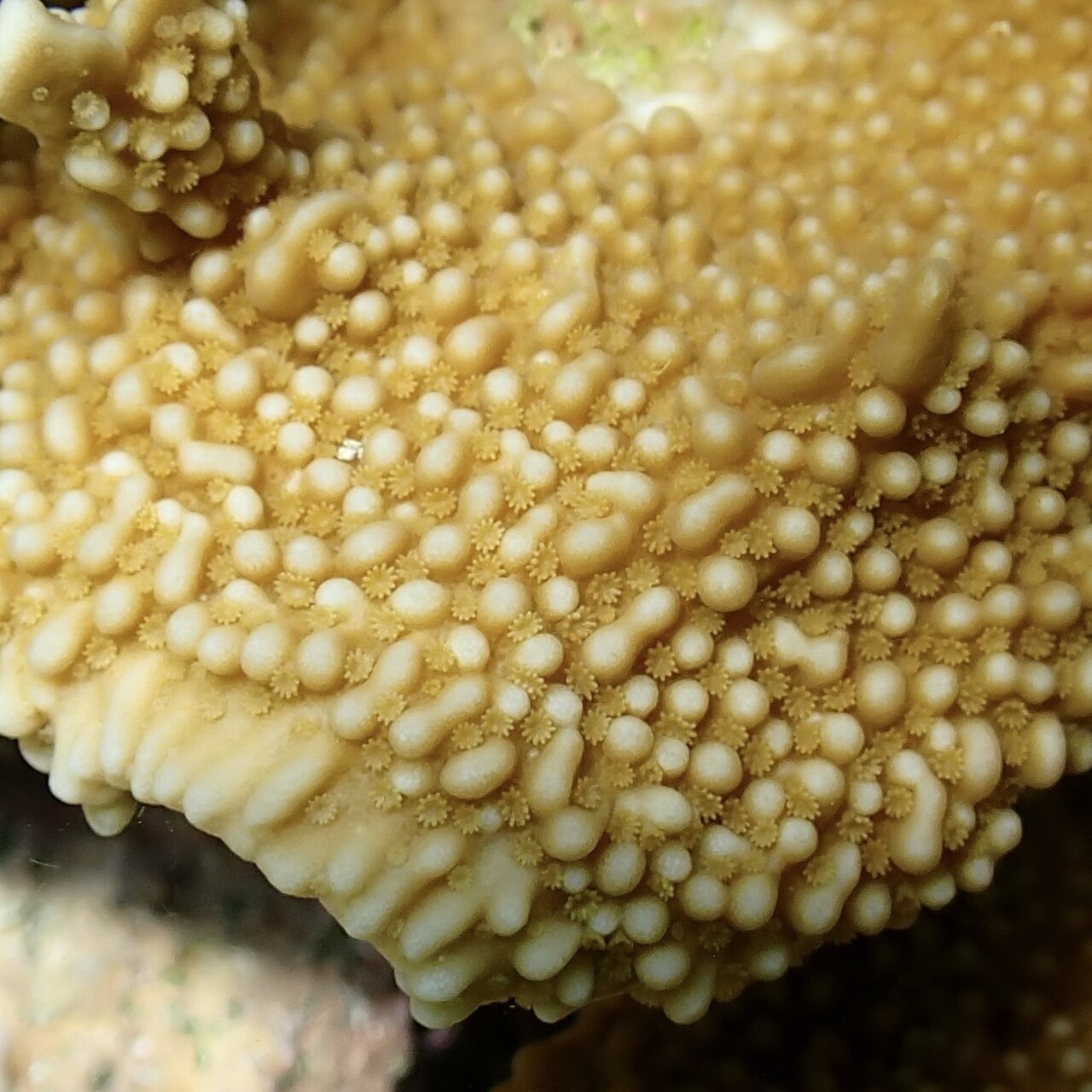
Image: Montipora capitata, one of the eight species in the experiment. Thomas Irvine, CC BY 4.0, via Wikimedia Commons.
Comments