


Lecanemab is the Alzheimer's drug that finally cleared amyloid from patients' brains and, in doing so, reignited a decade of argument about whether that even matters. It is usually explained in one sentence: an antibody that latches onto sticky amyloid-beta plaques and hauls them away. A study out in Nature Neuroscience says that sentence is wrong in an important way. The antibody itself removes very little. The removal is carried out by the brain's own immune cells, and only when the antibody is built in a way that lets it summon them.
The group, led by Giulia Albertini and Bart De Strooper at VIB and KU Leuven in Belgium, wanted to know the actual mechanism rather than assume it. To test a human drug on human cells, they used a xenograft model: mice whose brains had been seeded with human microglia, the resident immune cells that patrol neural tissue. Then they gave the animals Lecanemab and watched what happened to the plaques.
Take away the immune cells and the drug stops working
In mice with functioning human microglia, Lecanemab did what it is supposed to do. Amyloid pathology dropped, and the damage to nearby neurites, the fine projections of neurons, eased. Then the researchers ran two versions of the same experiment designed to strip the immune component out.
First they used a modified Lecanemab with a silenced Fc fragment. The Fc region is the tail end of an antibody, the part that immune cells grab onto. This silenced version still bound to plaques perfectly well. It just could not clear them. Second, they removed the microglia from the equation. Same result: the plaques stayed put even though the antibody was stuck to them. Binding, on its own, does almost nothing. The clearance depends on the antibody handing the plaque off to a microglial cell through that Fc tail.
So the antibody is less a garbage truck and more a set of instructions. It marks the target and issues an order. The microglia do the hauling.
A specific program switched on inside the cell
To see what that order actually does, the team read out gene activity in individual cells using single-cell RNA sequencing and spatial transcriptomics, which keeps track of where each cell sits in the tissue. Lecanemab flipped on a focused set of microglial functions rather than a broad, indiscriminate activation. The cells ramped up phagocytosis, the physical engulfing of debris. They boosted lysosomal degradation, the internal machinery for breaking down what they swallow. Their metabolism shifted. Interferon-gamma genes and antigen-presentation machinery came online too.
One molecule stood out. The researchers pinned SPP1, also called osteopontin, as a major factor the drug induces, and showed it helps drive amyloid clearance rather than just tagging along. That gives a concrete handle on the pathway, and a candidate to probe if anyone wants to make the microglial response stronger or cleaner.
Why the plumbing matters here
Anti-amyloid immunotherapy has been bruising to talk about. The clinical benefit is modest, the drugs carry a real risk of brain swelling and bleeding, and critics have questioned whether chasing plaques is the right target at all. Knowing that the effect runs through Fc-driven microglial engagement is not an abstract detail. It suggests that how well these drugs work, and possibly how much collateral inflammation they cause, may hinge on the immune response they provoke rather than on binding affinity alone. That is a lever you could try to tune.
The usual restraints apply. This is a mouse model, even if the microglia inside it are human, and grafted cells in a rodent skull are not a living human brain with decades of accumulated pathology. The work explains how the drug removes amyloid; it does not resolve the separate and harder question of how much removing amyloid helps a person's memory. And a mechanism worked out in a xenograft still has to be checked against what happens in treated patients. What the study does settle is a point that had been assumed rather than shown. Lecanemab does not clear plaques by itself. It recruits.
Albertini, G. et al. "The Alzheimer's therapeutic Lecanemab attenuates Abeta pathology by inducing an amyloid-clearing program in microglia." Nature Neuroscience, 2025. doi.org/10.1038/s41593-025-02125-8
PubMed PMID: 41286448.
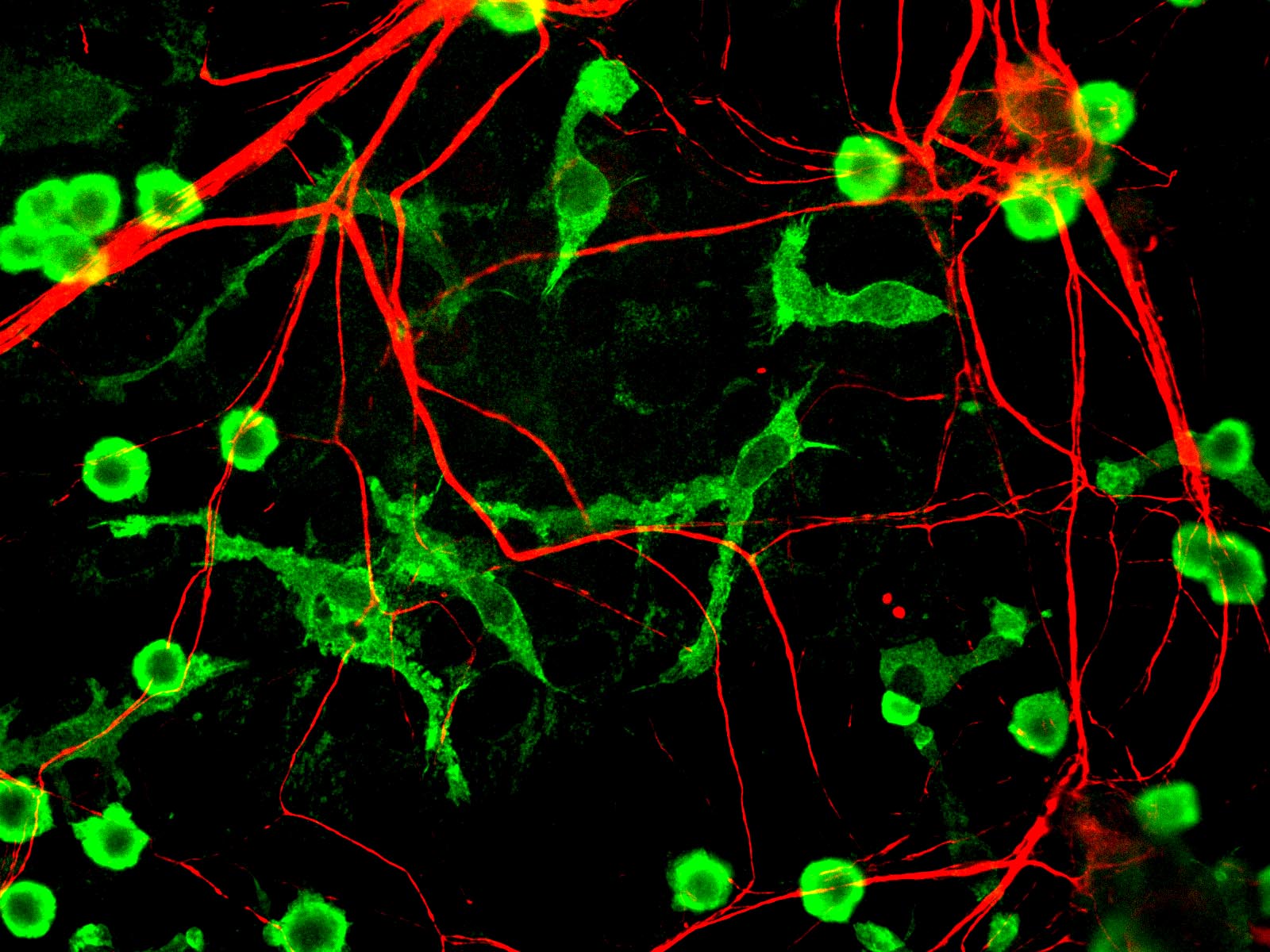
Photograph: GerryShaw, CC BY-SA 3.0, via Wikimedia Commons.
Comments