


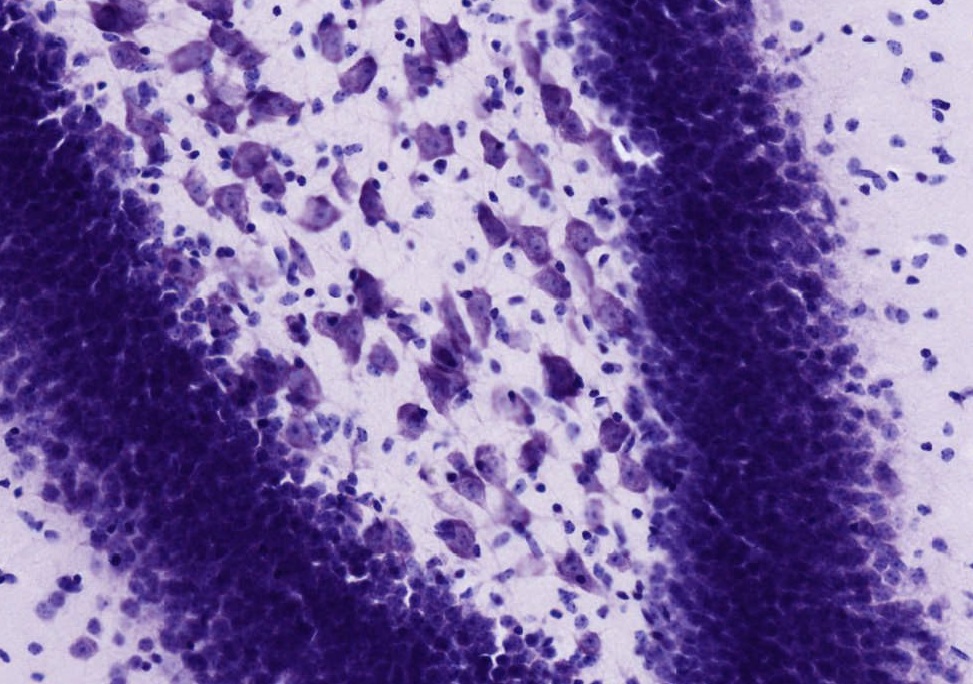
While a mouse sleeps, its hippocampus keeps working. Bursts of coordinated firing sweep through the region hundreds of times a night, each one lasting a fraction of a second. Neuroscientists have long suspected these bursts, called sharp-wave ripples, are how the brain files away the day's experiences. But there was a puzzle. Most ripples seem to carry nothing at all. Only a minority actually replay the patterns that encoded a recent event, and nobody knew what set that useful minority apart.
A team at Cornell now has an answer, and it comes down to size. In work published in Neuron, Heath Larsson Robinson and colleagues in Antonio Fernandez-Ruiz's lab report that the ripples doing the real memory work are the large ones. These big events stand out physically from the crowd, and they are the ones tied to genuine replay in both the hippocampus and the prefrontal cortex.
Finding the ripples that matter
The researchers recorded from mice as the animals learned something new, then slept. They watched for moments when the brain reactivated the specific neural ensembles that had fired during learning. That reactivation showed up in the hippocampus and, importantly, in the prefrontal cortex, a downstream region thought to hold memories over the long term.
When they lined up the reactivation events with the ripples, a pattern emerged. The ripples that coincided with replay were consistently larger than the rest. And the number of these large ripples went up specifically during sleep that followed new learning. The brain was producing more of them exactly when it had something worth storing.
That correlation is suggestive, but on its own it does not prove the big ripples cause anything. A larger ripple could just be a side effect of a memory being reactivated for some other reason. So the team went further.
Turning the effect up on demand
Using a closed-loop optogenetic setup, the researchers detected ripples as they happened during sleep and gave them a boost with light, in real time. This let them add more large ripple activity without waiting for the brain to generate it. The manipulation increased ensemble reactivation in both the hippocampus and the prefrontal cortex, which is what you would expect if these events are the vehicle for replay.
The payoff came the next time the mice were awake. Animals whose ripples had been boosted during sleep did better at remembering, and the coordination between their hippocampus and prefrontal cortex was tighter during waking recall. Because the intervention happened during sleep and the benefit showed up later in behavior, the authors argue this is a causal chain rather than a coincidence. Push on the large ripples, and memory improves.
It is a satisfying result partly because it turns a vague idea into something you can grab hold of. The claim is no longer that ripples in general support memory. It is that a measurable, targetable subset does the heavy lifting, and adding more of them changes what an animal can recall.
What the study does not settle
This is mouse work, and the leap to human memory is not automatic. The optogenetic technique used here reaches into the brain with light and genetically modified neurons, which is not something you can do to a person. So while the finding points toward possible sleep-based memory interventions, any clinical version would need a completely different toolkit.
There are open questions inside the biology too. The study shows that boosting large ripples helps, but it does not fully explain why some ripples grow large in the first place, or what upstream signal decides which memories get the large-ripple treatment. It also focused on a particular kind of learning and a particular hippocampal-to-cortex route. Whether the same size rule holds across other memory types and brain circuits is still to be worked out.
Still, the core message is clean. During sleep, the brain is not replaying memories at random. It is picking out the important ones and shipping them to long-term storage on the back of its biggest waves. Find those waves, and you have found a lever.
Robinson, H.L. et al. "Large sharp-wave ripples promote hippocampo-cortical memory reactivation and consolidation during sleep." Neuron, 2025. doi.org/10.1016/j.neuron.2025.10.003
PubMed PMID: 41205608.
Photograph: Public domain, via Wikimedia Commons.
Comments