


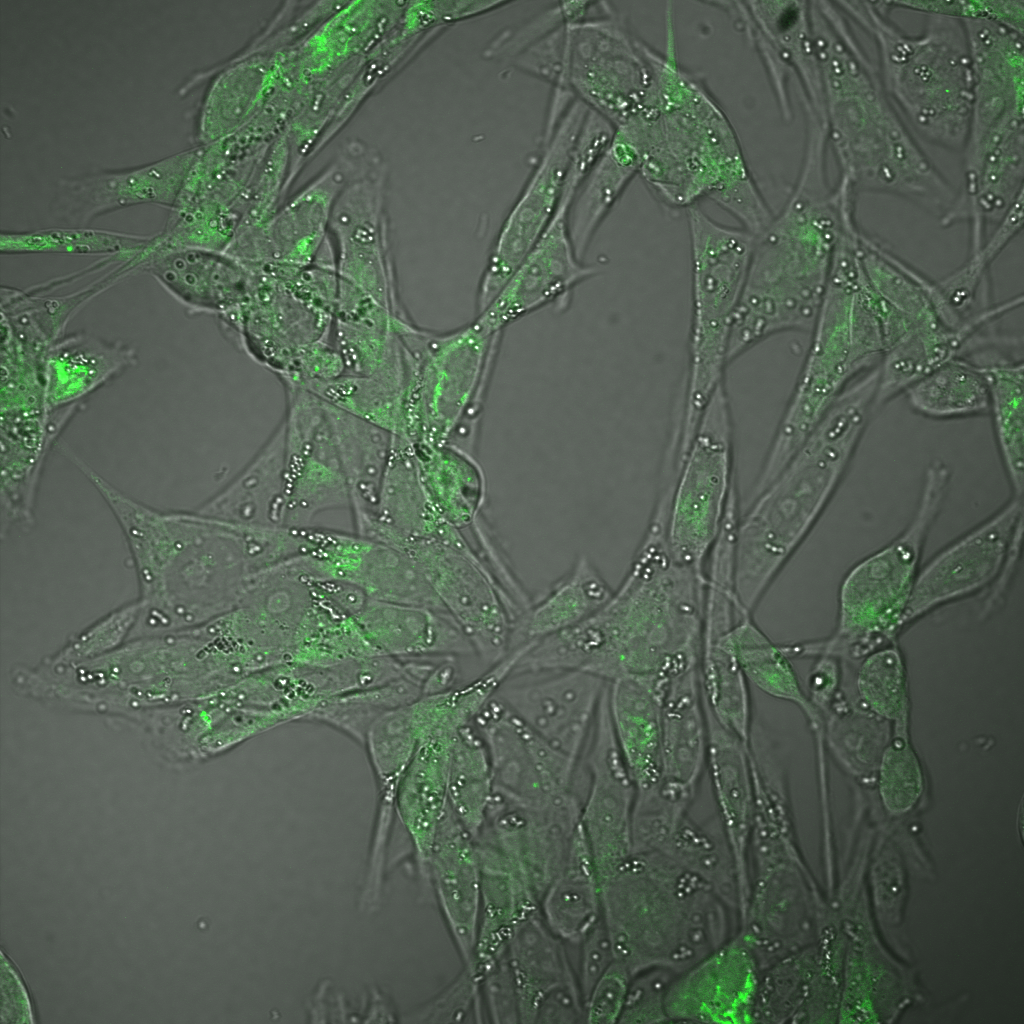
Most tools for switching genes on and off act like a light switch. On or off, high or low, with not much room in between. But cells rarely work that way. A small shift in how much of a protein a cell makes can push it toward one fate instead of another. Biologists who want to study or exploit those shifts have been stuck with blunt instruments.
A team at MIT has built something closer to a dimmer switch. In a paper published in Nature Biotechnology on October 13, Sneha Kabaria, Kate Galloway and their colleagues describe a framework they call DIAL: editable promoters that let researchers set a gene's activity to a chosen level and keep it there. The setting even survives cell division, passed down to daughter cells like an inherited trait.
Editing the promoter, not the gene
A promoter is the stretch of DNA that sits in front of a gene and controls how loudly it gets read. DIAL rewires that region. The researchers placed short DNA spacers between the binding site for a synthetic zinc-finger transcription factor and the core promoter. Those spacers hold the activating machinery at arm's length, keeping expression low.
To turn the gene up, they used a recombinase, an enzyme that snips out defined chunks of DNA. Cut out a spacer, and the transcription factor moves closer to the promoter, so the gene gets read more often. By nesting different numbers and lengths of spacers into a single promoter, the team could generate a whole ladder of distinct expression levels from one starting construct. Both the zinc-finger factor and the recombinase are controlled by small molecules, so the timing of each change is in the researcher's hands.
The word that matters here is heritable. Because DIAL physically edits the DNA rather than just nudging the cell's current state, each new setpoint is permanent. Once a spacer is gone, it stays gone, and every descendant of that cell inherits the higher expression level. That makes it possible to lock in a level and then watch what it does over many generations.
From setpoints to cell fate
The team showed DIAL works beyond convenient lab cell lines. Delivered by lentivirus, it produced multiple distinct expression levels in primary cells and in induced pluripotent stem cells. Then they put it to a real test. During the direct conversion of cells into induced motor neurons, they used DIAL to map how different transgene levels steered the outcome. Because each level is stable and heritable, they could connect a specific dose to a specific fate rather than guessing from a noisy average.
That is the practical promise. Gene circuits, the engineered networks that let cells sense and respond, often behave unpredictably because their parts fire at levels that drift or vary from cell to cell. A tool that produces defined, unimodal setpoints (meaning the population clusters tightly around one value instead of splitting into high and low groups) gives circuit designers a steadier foundation. The authors frame DIAL as modular and extensible, meaning it can be adapted to additional transcription factors rather than being locked to one design.
What the paper does not settle
This is a proof of concept, and the demonstrations run mostly in cultured cells. Editing a promoter is a one-way move in the versions described here. You can ratchet expression up by removing spacers, but you cannot dial it back down through the same mechanism, which limits how you might use it in a system that needs to go both directions. Delivering the components by lentivirus works in the lab, yet moving any DNA-editing system toward the clinic raises the usual questions about where things insert and how safely. And the motor-neuron work shows the tool can map dose to fate in one setting; whether that mapping holds across other cell types and other genes is a question for the next round of experiments.
Still, the underlying idea is appealing in its simplicity. Instead of hunting for a new promoter every time you need a different expression level, you edit the one you have. For a field that has long wanted finer control over how much, not just whether, DIAL offers a way to turn the knob and have it stay put.
Kabaria, S. R. et al. "Programmable promoter editing for precise control of transgene expression." Nature Biotechnology, 2025. doi.org/10.1038/s41587-025-02854-y
PubMed PMID: 41083901.
Photograph: Borys Olifirov, CC BY 4.0, via Wikimedia Commons.
Comments