

Most engineered genetic circuits live inside bacteria or yeast. You program the cell, feed it, and hope the machinery you added does not get shrugged off as the organism grows and mutates. A team at Boston University decided to skip the cell entirely. Their circuits run in a tube of extracted molecular parts, and when the reaction is dried onto paper it holds its programmed information for months.
The system is called CRIBOS, short for cell-free recombinase-integrated Boolean output system. It was described in Cell Systems by Jingyao Chen, Aviva Borison, Douglas Densmore, and Wilson Wong. The core idea is to do computation with enzymes called site-specific recombinases, which cut DNA at defined sequences and flip or excise the pieces in between. Arrange those cut sites carefully and a strand of DNA becomes a physical logic gate.
Logic gates in a test tube
Cell-free gene expression has been growing as a research tool because it strips away the unpredictability of a living host. You mix the transcription and translation machinery with your DNA template and the reaction runs on its own. What CRIBOS adds is a way to compute inside that reaction rather than just express a single output.
The group built more than 20 circuits that take multiple inputs and produce multiple outputs. Among them are 2-input, 2-output circuits and a 2-input, 4-output decoder, the kind of branching logic that lets one set of signals steer several downstream responses at once. Recombinases handle the switching. Depending on which inputs are present, the enzymes rearrange the DNA template so that different combinations of genes get read out.
To let the circuits sense their surroundings, the researchers paired them with allosteric transcription factor sensors. These are proteins that change behavior when they bind a specific small molecule. Wired into CRIBOS, they turn a chemical in the reaction into an input the logic can act on, so the same platform can detect several environmental cues in parallel.
Information that survives on paper
The part that stands out is durability. The team dried CRIBOS reactions onto paper and used them as a memory device. Because recombinases physically edit the DNA, a circuit that has switched stays switched. That change is written into the sequence itself, not held in a fragile pool of protein or RNA.
In their tests, the paper-based version preserved DNA-encoded information for more than four months. It needed almost no upkeep, no cold storage, no steady supply of energy. For a field that usually fights to keep engineered systems alive and stable, storing a logical state as dried molecules on a strip of paper is a different way to think about the problem.
That portability matters for where these tools might go. A sensor circuit that computes an answer and locks it in could sit in a field kit or a low-resource clinic and be read later, without instruments running the whole time. The authors frame CRIBOS as a bridge, taking the multiplex Boolean logic that has mostly lived inside cells and moving it into a setting you can carry, dry, and store.
What the paper does and does not show
This is a demonstration of a platform, not a finished device. The circuits and the four-month memory result were shown in the lab under controlled conditions, and the paper does not claim a validated diagnostic or a specific clinical use. Scaling recombinase-based logic to larger, more complex computations brings its own engineering questions, and the range of chemicals the aTF sensors can detect depends on which transcription factors are available. Whether paper storage holds up across the messier conditions of real field deployment is a separate test that lies ahead.
What the work establishes is that meaningful computation and stable memory can happen outside a living cell. Recombinases give the logic a physical form, and drying the reaction onto paper gives it a shelf life. It is a reminder that synthetic biology does not always need a cell to host it.
Chen, J. et al. "Cell-free recombinase-integrated Boolean output system." Cell Systems, 2025. doi.org/10.1016/j.cels.2025.101395
PubMed PMID: 40992371.
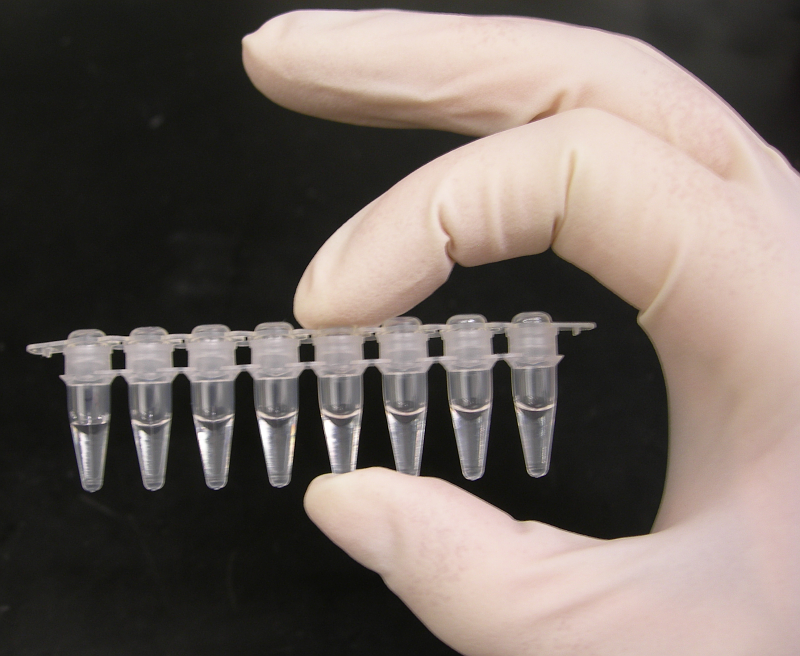
Photograph: Madprime, CC0, via Wikimedia Commons.
Comments