


The man in the study can no longer make himself understood when he talks. Amyotrophic lateral sclerosis has weakened the muscles of his mouth and throat, so his speech comes out slurred and hard to follow. For years the best that brain implants could offer someone like him was a way to spell out words on a screen, letter by letter, or produce text that a computer would read aloud in a flat, generic voice a beat or two later. Useful, but nothing like actually speaking.
A team based at the University of California, Davis has now built something closer to real speech. They implanted four small arrays of electrodes into the part of his brain that plans mouth and tongue movements, then trained software to turn that activity directly into sound. When he tried to speak, he heard a voice come out almost immediately, and it was built to sound like his own. He could hear himself as he went, which is something none of the earlier text-based systems allowed.
Reading movement plans, not words
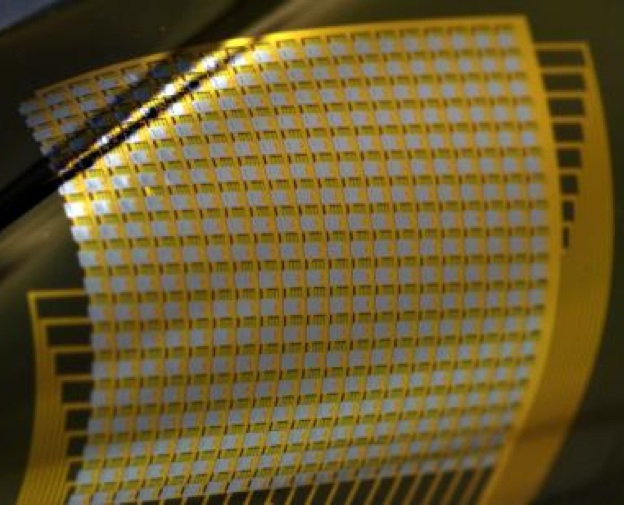
The implant sits in the ventral precentral gyrus, a strip of cortex that issues the motor commands for speaking. Two hundred and fifty-six tiny electrodes pick up the firing of individual neurons there. As the participant attempted to say something, the system read those signals and converted them into an audio waveform roughly every ten milliseconds. That is fast enough that the gap between intention and sound felt, to him, like ordinary talking rather than a delayed translation.
Getting there meant solving an awkward problem. To teach a decoder to map brain activity onto speech, you normally need recordings of the person actually speaking the target words, so the software has something to match against. This man cannot produce clear speech, so that ground truth did not exist. The researchers worked around it by pairing his neural activity with the words he was cued to attempt, and using a voice built from recordings of how he sounded before the disease progressed. The result was a synthetic voice that listeners recognized as his.
Tone, questions, and a bit of singing
What sets this apart from decoding text is everything text throws away. Human speech carries meaning in how we say things, not only in the words. The system captured some of that. The participant could stress a word to change emphasis, raise his pitch at the end of a sentence to signal a question, and shift his intonation on command. He was even able to hum short melodies, holding notes at different pitches, which shows the decoder was tracking fine control over his voice rather than just stringing phonemes together.
Listeners could understand a good share of what he produced when he spoke freely, and they understood far more when he chose from a limited set of possible sentences. The words also came out with the natural rhythm of speech, including the small pauses and run-ons that make conversation sound alive. For a form of communication that has mostly meant staring at a screen and waiting, hearing an expressive voice appear in near real time is a meaningful shift.
What the study can't say yet
This is one person. A single participant, however striking the result, cannot tell you how well the approach will work across others whose anatomy, disease stage, or remaining ability differ. Brain-computer interface studies almost always begin this way, and the honest read is that this is a proof of concept, not a finished device.
There are limits inside the result too. Free-form speech was intelligible but far from perfect, and accuracy leaned heavily on the system knowing the pool of likely sentences. The implant is a research setup that requires surgery and a rack of equipment, not something a person takes home. And the voice, while recognizable and expressive, is still a reconstruction, not a recording of him talking. How the system holds up over months or years, as the brain and the electrodes both change, remains an open question.
Still, the direction is clear. The field has spent years proving that thoughts of speech can be turned into text. This work argues that the richer target, a voice that arrives fast enough to feel like your own and flexible enough to carry a question or a tune, is now within reach. For people losing the ability to speak, that difference is not cosmetic. It is the difference between sending messages and having a conversation.
Wairagkar et al. "An instantaneous voice-synthesis neuroprosthesis." Nature, 2025. doi.org/10.1038/s41586-025-09127-3
PubMed PMID: 40506548.
Photograph: Jesse Emspak, Public domain, via Wikimedia Commons.
Comments