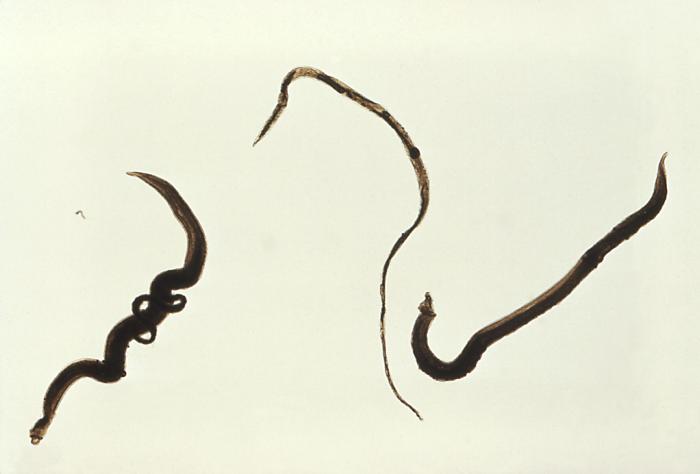

A double-strand break is the injury a cell is least able to tolerate. Both strands are severed, so nothing remains to copy from except the matching chromosome, and cells that cannot manage the repair usually die or turn cancerous. The repair is expected to finish within hours, in the cell where the damage occurred. An organism that carried a broken chromosome into its offspring should not have viable offspring.
Bdelloid rotifers break that expectation routinely. These microscopic animals live in mosses and lichens that dry out repeatedly, they have reproduced asexually for millions of years with no males ever observed, and they survive desiccation and radiation doses that shatter their chromosomes into hundreds of pieces. A group working across Brussels and Namur followed the genomes of irradiated Adineta vaga through months of culture and found something the timescale alone makes strange: broken chromosomes were passed to descendants unrepaired, and then rebuilt gradually across generations, using the intact homologous chromosome as a template.
Why it matters: Repair was assumed to be a within-lifetime problem with two outcomes, fixed or fatal. This describes a third, where a lineage carries damage forward and finishes the job over generations.
The work, by Houtain et al., appears in Science Advances. It combines two experiments: lines bottlenecked to a single individual each generation for 75 to 135 generations, and lines hit with acute damage, either 30 days of desiccation, which causes an estimated 15 to 20 breaks per genome, or proton radiation at 100, 250 and 500 grays, theoretically producing about 88, 220 and 440 breaks. Mothers were isolated after treatment and their first two eggs discarded, so every sequenced descendant came from an egg that was undifferentiated at exposure.
Damage that does not go away, and does not stay
Radiation raised recombination in proportion to dose, with 39% of the resulting loss of heterozygosity attributable to repair by homologous recombination. At 500 grays the genomes carried large single-copy deletions, some spanning up to 400 kilobases. The shape of those deletions is the finding.
Ordinary repair pathways rejoin broken ends, which leaves a sharp boundary: coverage drops abruptly by half and stays there. That is not what the sequencing showed. Coverage fell gradually toward the middle of each deletion and the allele frequency climbed smoothly at the edges, a pattern that only makes sense if individuals in the same culture carried deletions of different lengths, some being eaten away and others already partly rebuilt.
The test was time. One heavily damaged clone was grown for six further months and resequenced with long reads. Coverage had climbed inward from the edges of every deletion, and the two smallest were fully restored. Comparing 12 radiation-induced deletions against 200 deletions the strain already carried, only the new ones recovered; the ancestral ones sat unchanged. Deletions that had lost both copies never recovered at all, which is the control the mechanism predicts, since with no homologous template there is nothing to copy.
Long reads also showed no rejoined ends. The broken chromosome was not resealed and then repaired; it stayed in pieces while being extended. Counting chromosomes in single eggs agreed. Eggs from control animals averaged 12 stained bodies, matching the known six pairs, while eggs descended from the irradiated clone carried significantly more, and varied between eggs.
A mechanism that needs two unusual features
The authors call the process break-induced homologous extension repair. A broken end invades the matching chromosome, copies a stretch of it, and stops; the extended fragment is inherited through mitosis until the next generation's modified meiosis pairs the chromosomes again and another round of copying occurs. Extension outpaces degradation, so deletions shrink over generations until the two advancing ends meet. Larger gaps need more rounds, which is why recovery was gradual and scaled with size.
Two features of these animals make it possible. Their meiosis is non-reductional: homologous chromosomes pair but do not segregate, producing diploid eggs, so the template stays available generation after generation. And fragments without a centromere ought to be lost at cell division, yet these are inherited, which leads the authors to propose that the chromosomes are holocentric, attaching to the spindle along their whole length. Chromosome-conformation data failed to find discrete centromeric regions, consistent with that idea.
What the study can't say yet
Holocentric chromosomes are a proposal, not a demonstration. The supporting evidence is a failure to detect centromeres plus the inheritance pattern the proposal explains, which is weaker than showing the structure directly.
The mechanism is inferred from coverage and allele-frequency curves supported by simulation, and the simulations do not single out one process. The authors say so: the specific mechanism underlying this coverage recovery remains difficult to disentangle, since a bias toward repair could come from longer repair tracts or from a higher per-generation probability of repair. Much of the strongest evidence, including the six-month resequencing and the karyotypes, comes from a single clone.
The damage is also far beyond anything these animals meet in a moss cushion. Thirty days of drying causes perhaps 15 to 20 breaks; 500 grays causes an estimated 440. What is shown is that the machinery can handle catastrophic damage, not that it is routinely used at that scale. Fertility fell measurably only at the highest dose. And a lineage rebuilding chromosomes by copying its homolog steadily erases heterozygosity, an evolutionary cost this design cannot weigh, though wild populations appear to retain more heterozygosity than these bottlenecked lines.
The claim the data do carry is narrower and still striking: broken chromosomes can be maintained and transmitted over multiple generations. As the authors put it, By maintaining reproductive capacity despite chromosomal breakage and enabling progressive, template-mediated restoration across generations, BIHER may represent an adaptation to recurrent DNA damage that enables extremophiles to thrive in harsh environments. They suggest tardigrades and some nematodes may do something similar, which is a hypothesis, not a result.
Quick questions
How can an animal reproduce with broken chromosomes? Only if the fragments are still passed on. Normally a piece without a centromere is lost at cell division. These fragments are inherited, and the chromosome is rebuilt later from its partner.
If they are asexual, why have meiosis at all? The authors argue the point of pairing chromosomes is not to shuffle genes but to put the template next to the damage. Repair, not sex, would be what the machinery is retained for.
What's the one-line takeaway? Irradiated bdelloid rotifers hand broken chromosomes to their descendants and rebuild them across generations by copying the intact homolog, a repair process measured in generations rather than hours.
Houtain A, Dupré ML, Hespeels B, et al. "Transgenerational chromosome repair in the asexual bdelloid rotifer." Science Advances, 2026;12(37):eaee0891. doi.org/10.1126/sciadv.aee0891
PubMed PMID: 42726870.
Image: Adineta cf. acuticornis. Zeng Y, Wei N, Wang Q, Iakovenko NS, Li Y, Yang Y (2020), CC BY 4.0, via Wikimedia Commons.
Comments