


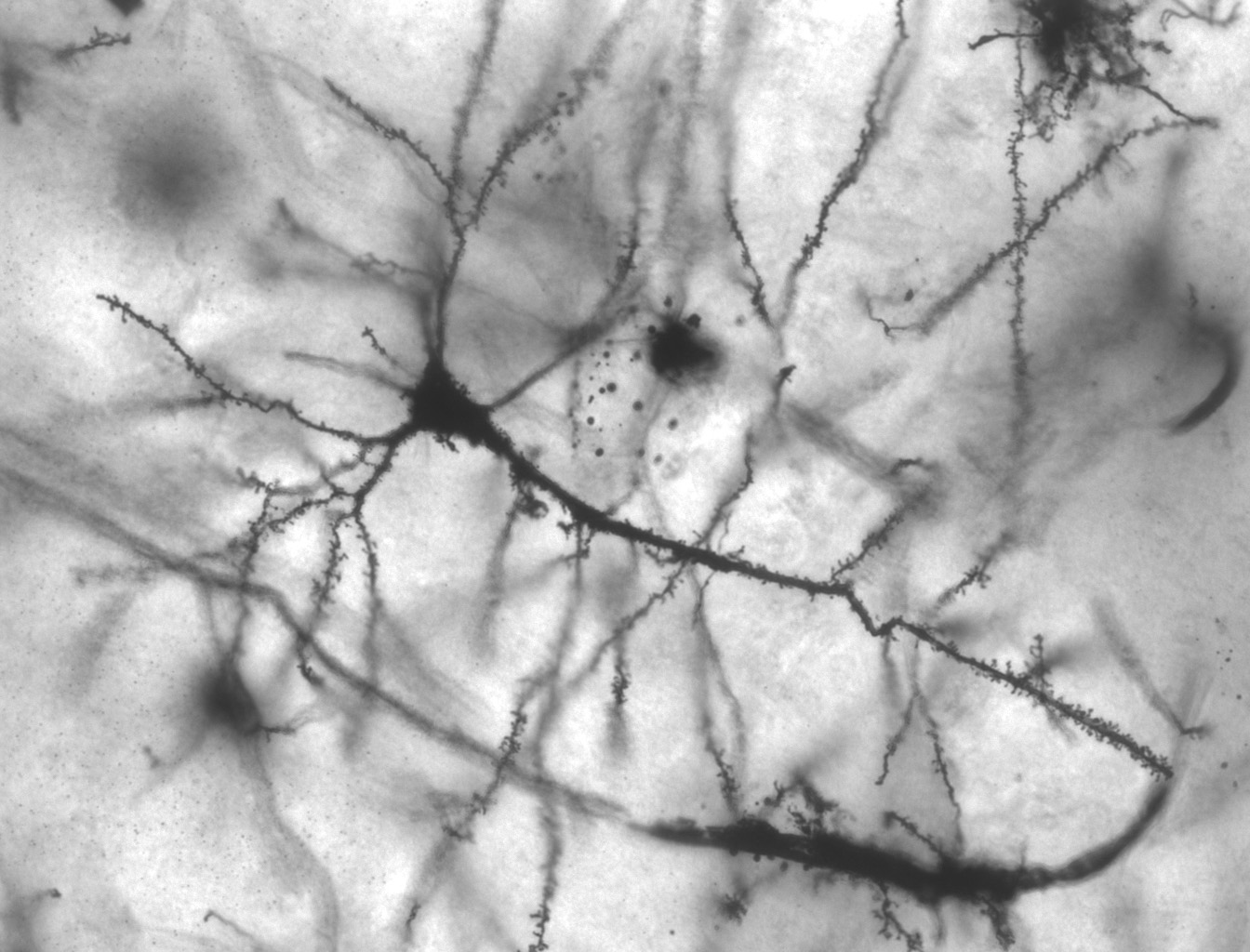
For more than a century, the picture of a neuron has been tidy. Signals come in on the branching dendrites, get summed at the cell body, and shoot out along a single wire, the axon. The little bumps called spines, where excitatory contacts land, belonged to the input side. The axon was the output. That division of labor is in every introductory textbook.
A study in Nature Neuroscience now reports spines sitting in the wrong place. A team led by Hongkun Yang and Yousheng Shu at Fudan University found spines on the axon itself, right at the segment where a neuron decides whether to fire. These axonic spines carry excitatory synapses. And rather than sitting at the end of the decision, they help start it.
Spines where the signal is born
The spot in question is the axon initial segment, or AIS. It is the launch pad for the action potential, the brief electrical spike that a neuron sends to its neighbors. The AIS was already known to receive inhibitory GABAergic contacts, which act like a brake. What excitatory input it might get was much less clear.
Looking in adult mice, the researchers found axonic spines on the AIS in roughly half the neurons they examined across three brain regions: the dorsal lateral septum, the bed nucleus of the stria terminalis, and the striatum. This was not a rare quirk in one odd cell type. It showed up in a sizable fraction of cells in several places.
In the dorsal lateral septum, the team looked closely at what these spines were made of and what they did. The spines carried ionotropic glutamate receptors, the molecular hardware for receiving fast excitatory signals. They also changed shape over time, a property called structural plasticity that is usually discussed for dendritic spines and tied to learning. So these were working synapses, not leftover scraps of development.
A head start on firing
Location turns out to matter a lot. Because the axonic spines sit at the AIS, their signals do not have to travel down a long dendrite and fade along the way. The researchers found that voltage-gated sodium channels, the same channels that generate the spike, amplified the synaptic responses coming from these spines. That boost pushed the neuron toward firing. Hence the paper's phrase: the spines jump-start the action potential.
The team then traced where the input comes from and what it does downstream. Neurons in the dorsal CA3 region of the hippocampus, a structure tied to memory, send axons to the lateral septum. Those hippocampal cells contact both spine-bearing neurons and their spine-less neighbors. But they preferentially activate the spine-bearing ones. Those activated cells then inhibit the neighboring non-spine neurons through feedforward inhibition, a circuit motif where one excited cell recruits an inhibitory relay to quiet nearby cells.
The net effect is a sorting mechanism. Axonic spines give certain septal neurons a firing advantage and, through the feedforward loop, shape which information flows out of the hippocampus toward downstream targets. The spines are not just receiving; they are routing.
What is still open
This is anatomy and physiology in mice, and the questions it opens are large. The work does not establish what these circuits do for behavior. Do axonic spines matter for the kinds of memory or emotional processing the septum and hippocampus are linked to? That remains to be tested. It is also unknown how widespread the structures are across the rest of the brain, or whether human neurons carry them in the same proportion. The plasticity is intriguing but its triggers and its role in learning are unmapped.
Still, the basic observation is hard to ignore. A structure long assumed to belong to one part of the neuron shows up on another, doing a job no one had cataloged. It is the sort of finding that nudges a settled diagram back into pencil. If excitatory synapses can help fire a cell from the axon, the clean input-output story of the neuron has at least one more chapter to write.
Yang, H. et al. "Excitatory synapses onto axonic spines jump-start action potentials and route information flow." Nature Neuroscience, 2026. doi.org/10.1038/s41593-026-02282-4
PubMed PMID: 42141306.
Photograph: MethoxyRoxy, CC BY-SA 2.5, via Wikimedia Commons.
Comments