
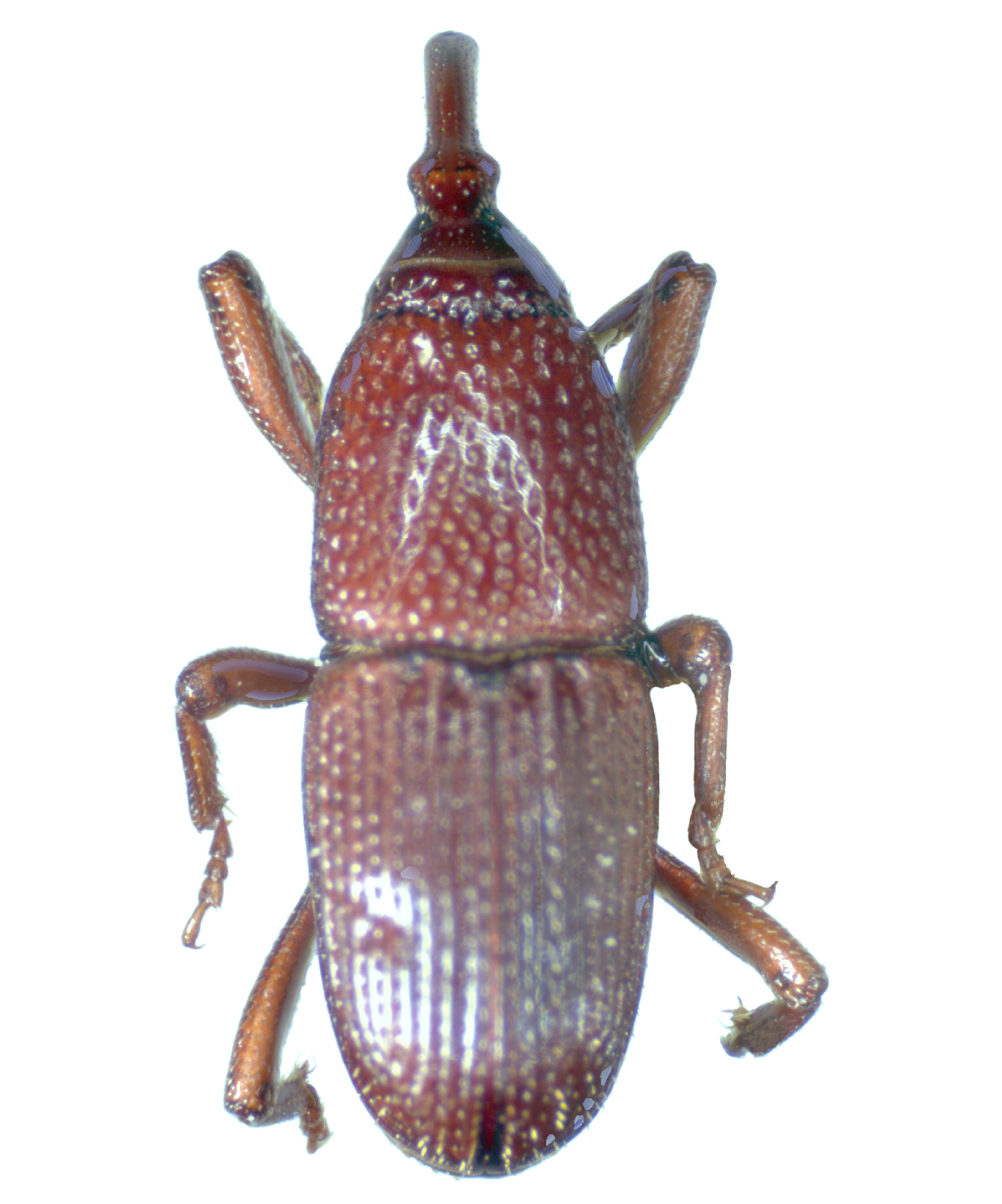
A grain weevil eats one thing: dry cereal. Wheat, rice, corn kernels, milled or whole. That diet is almost all starch and short on the amino acids and vitamins an insect needs to build a body. Weevils solve the problem by keeping bacteria inside their own cells, a partner called Sodalis pierantonius that turns cereal into the missing nutrients. It is one of the tidier deals in biology. The host provides raw sugar, the bacterium provides what the sugar lacks.
What nobody had seen clearly was the machinery that moves material across the boundary between the two. A team led by Severine Balmand went looking, using high-resolution electron microscopy to reconstruct the interior of the bacteria in the weevil Sitophilus. The paper appeared in Cell in late October. What they found is that the bacteria are not simple blobs sitting in host cytoplasm. They are riddled with plumbing.
Tubes inside the cell
The researchers call the structures tubenets, short for tubular networks. They are membranous tubes that thread through the interior of each endosymbiont and connect back to the bacterial surface. The effect is to fold a large amount of membrane into a small volume. That matters because everything the bacterium trades with its host has to cross a membrane, and more surface area means more room to trade.
To figure out what was actually moving through these tubes, the team ran chemical analysis at high spatial resolution, mapping what sat inside the tubenets versus the rest of the cell. The tubes were enriched in carbohydrates. That fits the logic of the partnership. Cereal starch breaks down into sugars, the weevil feeds those sugars to its bacteria, and the bacteria use them as the feedstock for making the amino acids and vitamins the insect cannot make on its own. The tubenets appear to be where that carbohydrate handoff is concentrated.
It is worth pausing on how strange this is. A single-celled bacterium, living permanently inside an animal cell, has evolved an internal organ-like structure whose job is to expand a trading surface. Multicellular organisms do versions of this all the time. The lining of your gut is folded into villi and microvilli for exactly the same reason, to pack more absorptive membrane into a fixed space. Here a bacterium has arrived at the same solution on its own.
Convergence at two very different scales
That parallel is the part the authors lean on. They describe the tubenets as a convergently evolved biostrategy: unrelated systems, under the same pressure to move a lot of nutrient across a membrane, landing on the same physical trick of increasing interface area. The weevil gut folds. The bacterium inside the weevil folds too, three orders of magnitude smaller. Evolution reused the geometry.
The finding also reframes how we think about nutritional endosymbiosis in general. This kind of partnership is everywhere in insects. Aphids, tsetse flies, sharpshooters, and many beetles all carry bacteria that patch holes in a restricted diet, and those insects include serious agricultural and disease-related pests. Weevils alone spoil enormous quantities of stored grain worldwide, and they can do it precisely because their bacteria let them thrive on food too poor for most animals. Understanding the exchange surface at the center of that relationship is a step toward understanding what keeps it running.
What the pictures do and do not settle
The strength of this work is that it shows a structure and shows what is concentrated inside it. The tubenets are real, they are membranous, and they carry carbohydrates. That is a solid, image-based result. The interpretation, that these tubes function mainly to boost nutrient exchange with the host, is well supported by the diet and the chemistry, but it is still an inference drawn from anatomy and composition rather than from watching molecules cross in real time. The exact transporters and the direction of every flux remain to be pinned down.
The study also focuses on one insect-bacterium pair. Whether other endosymbionts build comparable networks, or whether the weevil system is unusual, is an open question the authors flag rather than answer. Still, the basic image is a good one to carry around. A weevil sits in a bag of rice, and inside its cells its bacteria have grown their own set of pipes to keep the bargain going.
Balmand, S. et al. "Bacterial tubular networks channel carbohydrates in insect endosymbiosis." Cell, 2025. doi.org/10.1016/j.cell.2025.10.001
PubMed PMID: 41161318.
Photograph: CSIRO, CC BY 3.0, via Wikimedia Commons.
Comments