
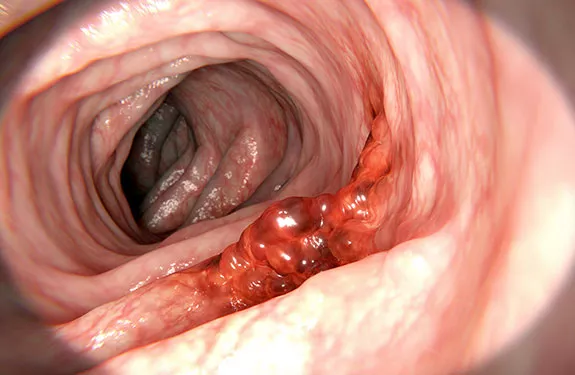
Colorectal cancer is one of the most common cancers in the Western world and one of the most frustratingly difficult to pin down at a molecular level. Age, diet, and lifestyle account for a lot of the risk, but the specific biological triggers often stay out of reach. For years, researchers have kept circling back to one suspicious player: Bacteroides fragilis, a gut bacterium that shows up more often in colorectal tumors than in surrounding healthy tissue. The problem is that B. fragilis also lives quietly in the gut of most healthy people. It was a persistent association that nobody could turn into a clean mechanism.
A study published in Communications Medicine by researchers at the University of Southern Denmark and Odense University Hospital suggests the missing piece may not be the bacterium at all, but something living inside it.
A hitchhiker in the genome
The team, led by Flemming Damgaard of the Department of Clinical Microbiology, suspected that different strains of B. fragilis might be behaving differently because of what they were carrying. They began with data from a Danish population study of roughly two million people, focusing on patients who had experienced serious bloodstream infections caused by B. fragilis. A small subset of those patients went on to be diagnosed with colorectal cancer within weeks.
When the researchers sequenced the bacteria from cancer and non-cancer patients, a pattern emerged. B. fragilis strains from cancer patients were significantly more likely to carry a specific, previously undescribed bacteriophage — a virus that infects bacteria rather than human cells. In this case, the virus had stitched its own genome into the bacterial genome, becoming what is called a prophage: a permanent hitchhiker inside the bacterial cell.
To test whether the pattern held outside Denmark, the team analyzed stool samples from 877 people across Europe, the United States, and Asia — 434 with colorectal cancer and 443 without. Patients with cancer were roughly twice as likely to carry traces of the prophage.
What we can and cannot say yet
The most important caveat is that this is an association, not a cause. The prophage genes do not obviously code for anything cancer-related, like a toxin or a mutagen. It is equally possible that the inflamed, tumor-adjacent gut environment in cancer patients simply happens to favor the specific bacterial strains that carry this virus — meaning the disease could be selecting for the prophage rather than the other way around.
Damgaard has been straightforward about this: the virus may be a contributing factor, or it may be a signal that something else in the gut has shifted. The team is now running laboratory and animal experiments to see whether the prophage changes the bacterium’s behavior in ways that could actually promote tumor development.
A screening handle
The near-term usefulness of the finding is practical. Current non-invasive colorectal cancer screening relies heavily on the fecal immunochemical test, which looks for traces of blood in stool. In a preliminary analysis, the Danish team built a simple panel based on fragments of the prophage genome and found it flagged roughly 40 percent of colorectal cancer cases in their dataset. That is not a stand-alone screening tool, but it is a meaningful signal that could, in principle, be layered onto the same stool samples already being collected.
The broader takeaway is a shift in how researchers are thinking about the gut. The microbiome has mostly been studied as a community of bacteria, with occasional attention to fungi and archaea. Viruses living inside those bacteria have largely been a blind spot. This study suggests that some of the long-standing puzzles about microbiome-disease links may be hiding one layer down, inside the bacteria themselves.
Damgaard, F. et al. “Bacteroides fragilis prophages associated with colorectal cancer.” Communications Medicine, 2026.
University of Southern Denmark / Odense University Hospital press release, April 2026.
ScienceDaily, “Hidden virus in your gut may be linked to colon cancer,” April 22, 2026.
ScienceAlert and Oncology Central reporting, 2026.
Comments