
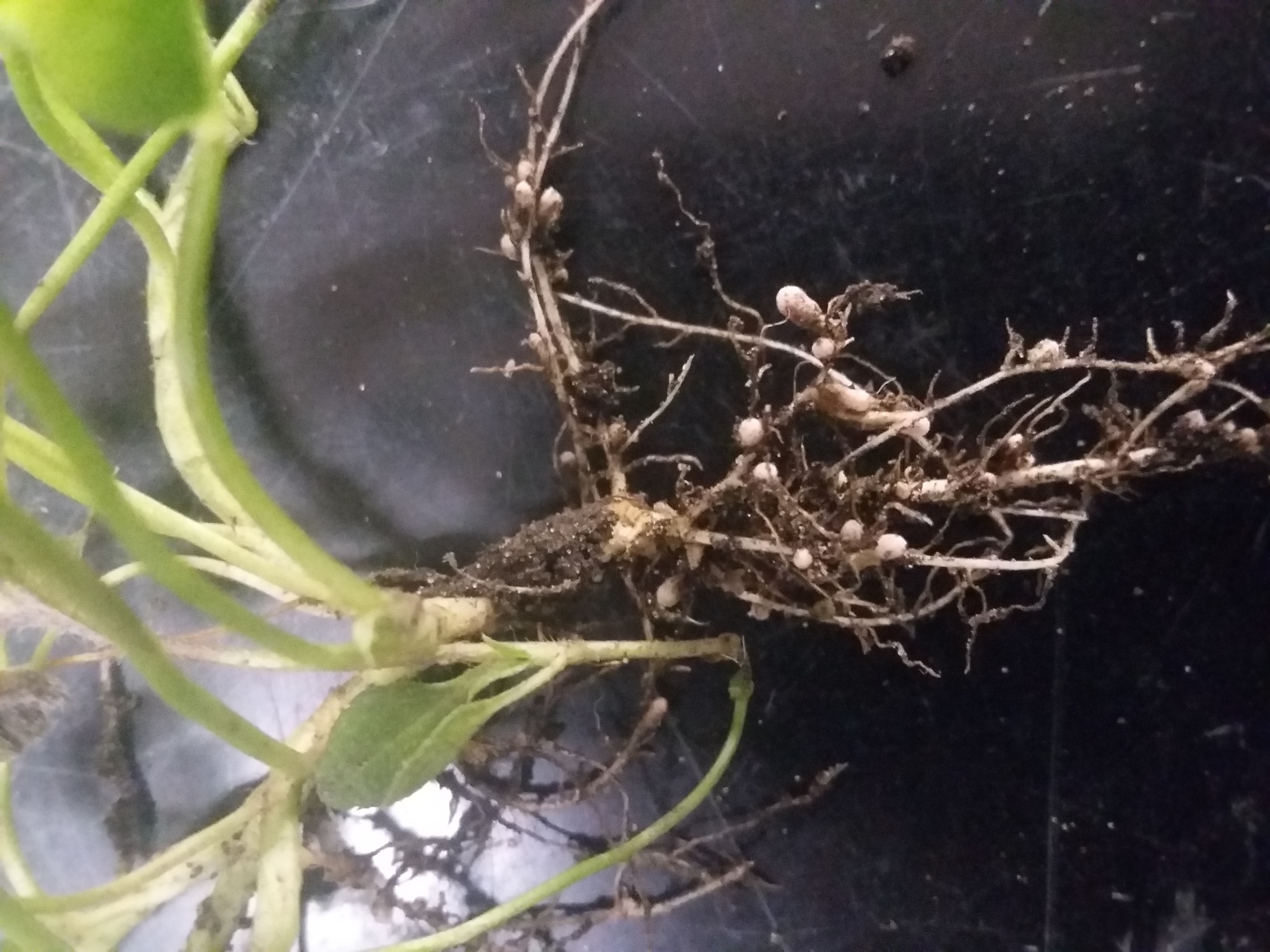
A clover root sits in the soil next to a fungal thread and a nitrogen-fixing bacterium. Both microbes wave a chemical hello made of the same sugar backbone, chitin. One of them the plant should kill. The other it should invite inside, build a home for, and feed with sugar for the rest of the season. The receptors that read these two near-identical signals look almost the same. So how does the root avoid the catastrophic mistake of hugging a pathogen or attacking a partner?
A team led by Simona Radutoiu and Kasper Rojkjaer Andersen at Aarhus University has an answer that is smaller than anyone expected. Writing in Nature, they report that the difference between "immune attack" and "symbiotic welcome" comes down to two amino acids sitting inside the receptor, on the part that faces the cell's interior.
A motif called Symbiosis Determinant 1
Legumes such as Lotus japonicus carry a receptor kinase named NFR1 that recognizes Nod factors, the molecular passwords that nitrogen-fixing rhizobia present when they want to form a partnership. The plant also carries a close relative, a chitin receptor named CERK6, that recognizes fungal cell-wall fragments and triggers defense. Both are receptor kinases. Both bind chitin-based ligands. Their outer sensing regions are structurally conserved. From the outside, they are hard to tell apart.
The researchers looked instead at the inside face, the kinase domain that relays the signal into the cell. There, in the stretch just below where the receptor crosses the membrane, they found a short conserved sequence they named Symbiosis Determinant 1. Two residues within that motif turned out to be the deciding factor. In the paper's words, those two residues are "indispensable hallmarks of NFR1-type receptors" and are "sufficient to convert" a defense receptor into one that speaks the language of symbiosis.
Rewriting a receptor's job with a two-letter edit
To test whether these residues really carry the instruction, the team edited them into receptors that normally have nothing to do with symbiosis. They took CERK6, the fungal-defense receptor from Lotus, and RLK4, a related kinase from barley. Barley is a cereal, not a legume, and cereals do not form these nitrogen-fixing nodules. After installing the Symbiosis Determinant 1 residues, both reprogrammed receptors were able to drive symbiotic signaling in Lotus japonicus.
That is a striking result. It says the capacity to trigger symbiosis is not spread thinly across the whole protein. It is concentrated. A conserved juxtamembrane motif, and specifically two positions inside it, acts like a switch that routes a chitin signal toward "let this microbe in" rather than "sound the alarm." The finding also reframes how these two ancient pathways stay separate. The plant does not need wildly different receptors for defense and symbiosis. It needs the same receptor architecture with a couple of characters changed in one region.
Why a soil bacterium matters for fertilizer
The practical dream behind this line of work is old and stubborn. Legumes get much of their nitrogen for free, fixed from the air by bacteria living in root nodules. Cereals like wheat, rice, and barley do not. They get their nitrogen from synthetic fertilizer, which is energy-hungry to manufacture, expensive for farmers, and a source of water pollution and greenhouse gas. If the symbiotic program could be transferred to cereals, the payoff for food production and the environment would be large.
This study does not deliver a nitrogen-fixing wheat plant. What it does is narrow the problem. It identifies a compact, transferable molecular determinant, and it shows that even a barley kinase can be nudged into symbiotic signaling with a defined edit. That is the kind of concrete handle engineers need.
A few cautions are worth keeping in mind. The reprogrammed receptors were tested inside Lotus, a plant that already has the full downstream symbiosis machinery waiting to receive the signal. A cereal in a field has no such machinery, and the actual nodule, with its housing, oxygen control, and nutrient exchange, involves many more genes than one receptor. Getting a signal to fire is a first step, not the finish line. The work also focuses on the receptor's kinase output rather than the whole life cycle of a working nodule. Still, knowing exactly which two residues carry the symbiotic instruction turns a vague ambition into a targeted design question. That is real progress on a problem that has resisted easy answers for decades.
Tsitsikli, M. et al. "Two residues reprogram immunity receptors for nitrogen-fixing symbiosis." Nature, 2025. doi.org/10.1038/s41586-025-09696-3
PubMed PMID: 41193803.
Photograph: Bwiltz, CC BY-SA 4.0, via Wikimedia Commons.
Comments