
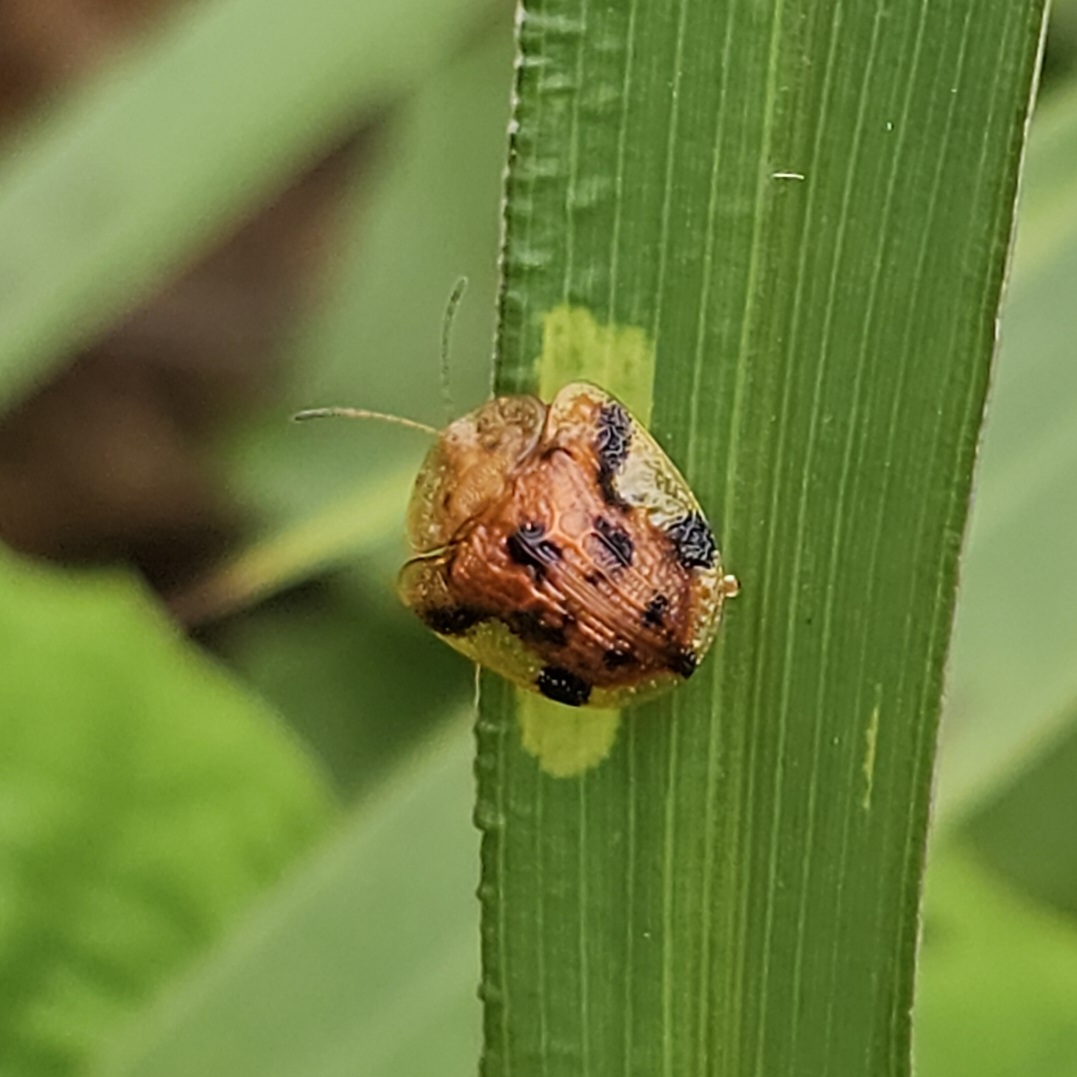
Tortoise beetles carry a passenger they cannot live without. Tucked into specialized organs near their gut sits a bacterium called Stammera capleta, and its job is narrow but essential: it helps the beetle break down plant cell walls. Without it, larvae struggle to develop. The relationship is old, dating back to around the Paleocene, roughly 60 million years ago. And like many such partnerships, it looked airtight from the outside. The beetle keeps the microbe, the microbe keeps the beetle fed, and neither strays.
A new study in Nature Communications pried that arrangement open. Inès Pons and colleagues at the Max Planck Institute for Biology in Tübingen managed something that has long stumped researchers who study inherited symbionts. They physically moved Stammera from one beetle species into another and watched what happened. The answer turns out to be more interesting than a simple yes or no.
Why swapping symbionts is normally impossible
Most bacteria that live permanently inside animal hosts sit deep within cells, sealed off and impossible to extract without killing them. That makes it hard to ask a basic question: how picky is the host, really? Is a symbiotic partnership specific because the two species are genuinely incompatible with anyone else, or just because they never get the chance to meet other partners?
Stammera offered a rare workaround. Despite its extreme dependence on the beetle, it lives outside cells, and it gets passed to offspring in a peculiar way. Females coat their eggs with small spheres packed with the bacterium. Newly hatched larvae pick up their symbiont from these deposits. Pons and her team realized they could manipulate the spheres directly, in effect handing a beetle larva a symbiont its mother never gave it.
The bacterium's genome tells you how committed it is to this life. At around 0.25 million base pairs, it is a genomic husk, stripped down to almost nothing, the signature of a microbe that long ago outsourced most of its survival to the host.
Closeness helps, up to a point
When the researchers transplanted Stammera across beetle species, the outcome tracked genetic relatedness. A symbiont from a distant relative could still find its way into the host's symbiotic organs and set up shop. But it provoked a stronger reaction from the host, measured in gene expression, and it only partially restored normal larval development. The mismatch showed.
Symbionts from close relatives behaved almost like the real thing. They multiplied at similar rates and drew a comparable response from the host. By the measures you would check first, the swap looked like a success. Then came the catch. Those well-matched foreign symbionts failed to propagate to the next generation. They could do the job for one beetle, but they did not make it onto the eggs and into the next round of larvae.
That gap matters. It means the specificity holding these partners together is not only about whether a microbe can perform inside a single host. Transmission is its own filter. A symbiont has to be handed down, and that step appears to enforce fidelity even when compatibility looks fine on paper.
What this does and does not settle
The work draws a cleaner line between three things that usually get lumped together: whether a symbiont can colonize, whether it can function, and whether it can be inherited. Each is a separate gate, and passing one does not guarantee the next.
Some limits are worth keeping in view. This is one lineage of beetles and one bacterium, and the experiments trace a partnership with an unusual transmission route that makes swaps feasible in the first place. Whether the same layered specificity governs the intracellular symbionts of aphids, tsetse flies, or the countless other insects that carry inherited microbes is an open question. The study also measures outcomes over the generations it could track, not the deep evolutionary time over which local adaptation accumulates.
Still, the core message is hard to miss. An ancient partnership can look like a locked contract, but the lock has more than one tumbler. Being the right bacterium is not enough. You also have to be the one that gets passed down.
Pons, I. et al. "Fidelity in co-diversified symbiosis." Nature Communications, 2026. doi.org/10.1038/s41467-026-69366-4
PubMed PMID: 41680145.
Photograph: Gannu03, CC BY-SA 4.0, via Wikimedia Commons.
Comments