
Alan Turing's proposal that two interacting, diffusing chemicals could break symmetry and lay down stripes is among the most cited ideas in developmental biology, and among the least often built. The gap is not mathematical. Reaction-diffusion is usually invoked to explain a pattern after the fact, and the link running from a particular circuit design to a particular spatial outcome has stayed thin. Explaining a zebra is not the same as programming one.
A group at Arizona State University has now built the programming end. Their circuit, MINPAC, couples gene regulation, which is the reaction half, to colony expansion and quorum sensing, which together supply the diffusion half. Bacteria carrying it organise themselves into periodic three-dimensional patterns, from the scale of single cells up to whole colonies, and the patterns proved robust to environmental variation while growing more complex as colonies got larger. The mechanism the modelling supports is not a standing Turing instability but a clock and a wavefront: an oscillation in time, read out into space by an advancing edge. The most instructive result is inverted. Dialling the circuit's expression down produced more rings, not fewer.
Why it matters: Repeated structure, the segments of a spine or the stripes on an animal, is one of the basic things development produces, and reaction-diffusion has long been the leading candidate explanation for how. Building a circuit that produces it deliberately tests whether the principle is understood well enough to use, and the authors point to biomaterials and regenerative medicine as where that control would matter.
The work comes from Wu et al. at the School of Biological and Health Systems Engineering, Arizona State University, with co-authors in the university's School of Mathematical and Statistical Sciences and at the Georgia Institute of Technology and Emory University. It appeared in Science Advances on 20 November.
Why a built pattern claims more than an observed one
An observed pattern is compatible with many mechanisms. Stripes on a fish and bands in a bacterial colony can each be reproduced by several different sets of equations, which is why reaction-diffusion has been easy to invoke and hard to confirm. A designed circuit removes that freedom, because the parts list is known and any link in it can be cut to see whether the pattern survives.
That is what the paper's network analysis does. The authors examined which wiring arrangements can produce patterning at all, and report a specific answer: Topological analysis reveals that specific network architecture is essential for pattern formation. The word essential is scoped to the architectures examined: this circuit's shape is not incidental, which is not the same as no other shape working.
A clock, and a moving front
Two ingredients make the system work, and neither is exotic. Quorum sensing is the bacterial habit of secreting and sensing a small signalling molecule, giving a colony a shared readout of its own local density. Colony expansion supplies motion: the growing edge sweeps outward across the plate over hours.
Clock-and-wavefront is the arrangement those two produce together. A gene oscillator cycles on and off in time, and because an advancing front keeps moving while it cycles, each cycle gets laid down at a different radius. Time is converted into space, and the result is a set of concentric bands. The same scheme is the long-standing proposal for how a vertebrate embryo cuts its body axis into repeating segments. A Turing instability generates periodicity from diffusion alone, with no clock anywhere in it. Both sit under the reaction-diffusion heading, but they are different machines, and this one has a clock.
The verb in the paper is "supports", and it should be read literally. A model that reproduces the observed rings is consistent with clock-and-wavefront; it is not a direct recording of an oscillator meeting a front.
Turning the circuit down to get more structure
The gene-dosage result is the part that reads like genuine understanding rather than a demonstration. Having built a model, the authors used it to predict how pattern complexity should shift with expression level, then showed that complexity can be tuned that way, with lower expression favouring multiple rings. The stated reason is faster dynamics, and the arithmetic that follows is straightforward: a quicker oscillator fits more cycles into the time the colony edge needs to spread, so more bands get written.
Prediction first and confirmation second is the strongest shape evidence takes in synthetic biology, because the explanation cannot have been fitted to a result already in hand. It is also the claim most exposed by the absence of numbers. How many rings, over what range of dosage and in how many replicates are quantities this work's summary does not carry.
What the study can't say yet
This is bacteria on a plate. The patterns are described as volumetric, and a colony does have thickness, but a colony is not a tissue and nothing here was built into a material or placed in an animal. Biomaterials and regenerative medicine appear as potential applications, which is the authors' stated ambition rather than a result.
The robustness claim is unquantified in the same way as the ring counts: environmental variation is said not to break the patterns, without a stated range of conditions. And the mechanism carries the usual warning attached to this field, that visually similar stripes can come from dissimilar causes, so a model's agreement is weaker evidence than it feels. Finally, nothing in this work says that any organism uses a circuit like MINPAC. Showing that a class of mechanism can produce periodic pattern in living cells is a proof of principle, not a discovery about development.
Quick questions
Is this how a zebra gets its stripes? No. The circuit shows that engineered cells can self-organise into periodic pattern, and the mechanism identified is the clock-and-wavefront kind rather than the Turing instability usually pictured for animal markings.
Why would lower expression give more rings? The paper attributes it to faster dynamics. A faster oscillator completes more cycles while the colony edge is still spreading, and each completed cycle is written down as another band.
What is the one-line takeaway? A designed gene circuit that couples an oscillator to an expanding, quorum-sensing colony makes bacteria arrange themselves into periodic rings, and turning its expression down produces more rings rather than fewer.
Wu et al. "Self-assembly of bacterial volumetric patterns directed by a synthetic reaction-diffusion circuit." Science Advances, 2026. doi.org/10.1126/sciadv.aec9323
PubMed PMID: 43063270. Full text: PMC13787468.
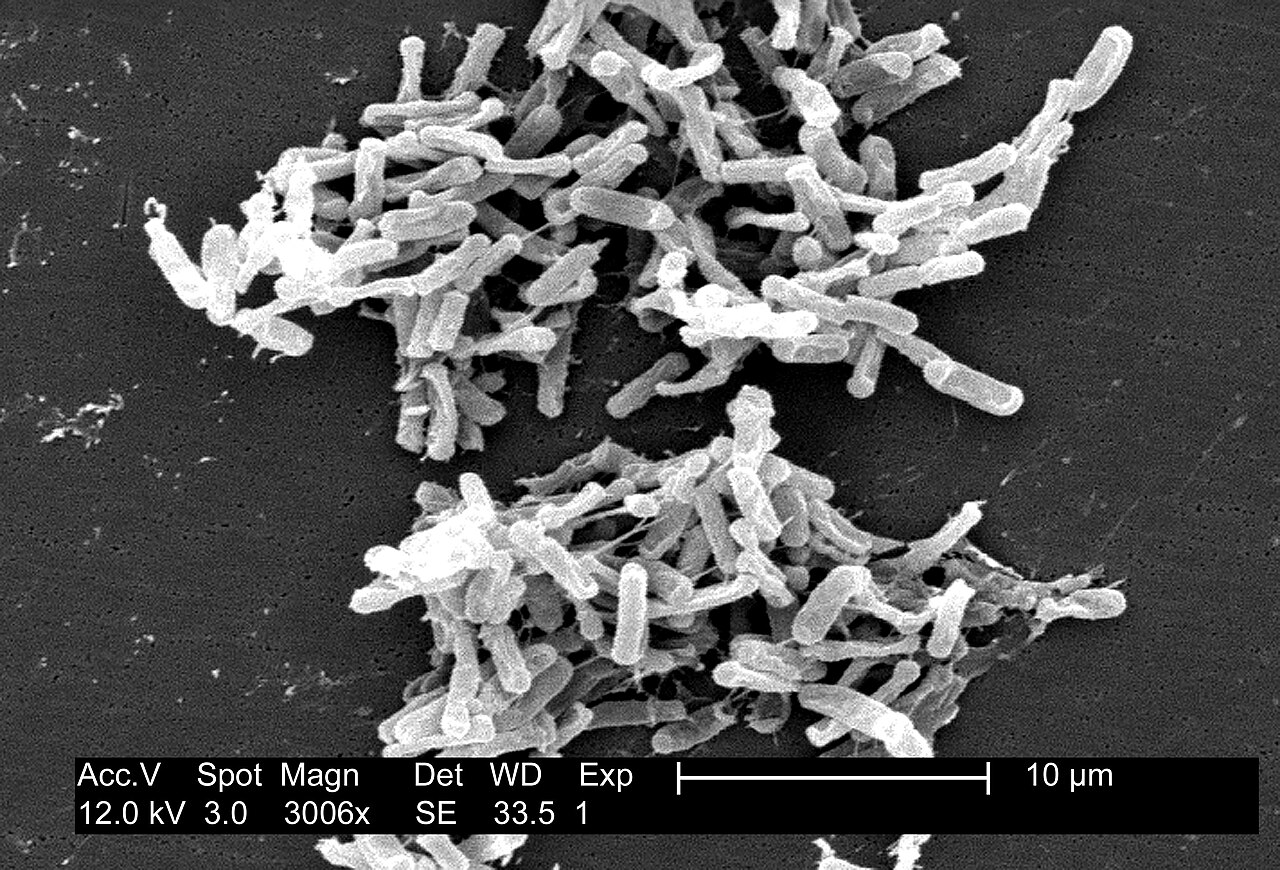
Image: microscope view of a bacterial colony. Korinna, CC BY 4.0, via Wikimedia Commons.
Comments