
Transplanting whole stool from a healthy donor is an effective treatment for recurrent Clostridioides difficile infection, and that success is also the obstacle. Stool cannot be standardised, assayed or manufactured the way a drug can, so the long-standing goal has been to replace it with a defined mixture of cultured bacteria. The limiting step is not growing the organisms. It is that nobody can say which members of a healthy gut community do the blocking, or through what chemistry.
A team has now narrowed that question using a community small enough to take apart: 14 commensal gut bacteria, assembled deliberately, grown in a continuous flow bioreactor, treated with antibiotics and then challenged with C. difficile. Communities derived from donor faeces were put through the same sequence. Suppression of the pathogen turned out to depend on interactions between Escherichia coli and Bacteroides and Phocaeicola species, and three metabolic routes carried the effect. When the authors looked for the same signatures in metagenomic data from patient cohorts and clinical trials, the balance between those two groups of bacteria separated successful resistance better than the diversity scores the field usually reports.
Why it matters: Recurrent C. difficile infection is the clearest case in medicine where giving someone another person's gut microbes works. Converting that into a defined, reproducible product requires knowing which bacteria and which metabolic steps do the work, and that is what this study set out to name.
The work comes from Ambat et al., with the first author at the Department of Veterinary Pathobiology, Oklahoma State University, and co-corresponding authors at the MRC Toxicology Unit, University of Cambridge, and Oklahoma State University. It appeared in Nature Communications on 18 October.
What 14 species can show that a stool sample cannot
A faecal community contains hundreds of species and cannot be rebuilt one member at a time, which is why so much correlational microbiome work produces lists of associated taxa and few mechanisms. A synthetic community inverts that: every member is known, every genome is available, and the whole assembly can be grown repeatedly under identical conditions. The continuous flow bioreactor supplies the other half, holding the community near a steady state so that an antibiotic and then a pathogen can be introduced in a controlled order rather than reconstructed afterwards from a single stool sample.
The two modelling frameworks the authors applied do different jobs. Generalised Lotka-Volterra models infer which species suppress or promote which others from the way abundances move together over time. Genome-scale metabolic modelling asks a separate question of the genomes themselves: which compounds each organism can consume or produce, and therefore where two members would compete or feed one another. Both are inference rather than observation, which is why the pairing they flagged, E. coli with Bacteroides and Phocaeicola, then had to be carried into targeted experiments.
Three routes, and the weight that "causally" carries
Metabolomics and targeted validation implicated three things. The first is fructooligosaccharides derived from fructans, the plant fibres humans cannot digest; these are the sugars gut bacteria liberate and compete over. The second is the biosynthesis of vitamin B3. The third is competition for the precursors of Stickland metabolism, the paired fermentation of amino acids that C. difficile uses, where a commensal consuming the same amino acids leaves the pathogen less to work with.
The authors describe all three as causally contributing, and that word is doing real work because of the stated range: the effect held across multiple C. difficile strains and multiple donor backgrounds. Robustness of that kind is the right check on a mechanism found in one reactor. The division of labour is worth stating precisely. The pathways were tested. The interaction that pointed at them came out of models.
A ratio, not a diversity score
The clinical half of the paper is an analysis of metagenomic data already gathered in patient cohorts and clinical trials, and it produced the sharpest claim here. Alpha diversity, a count of how many species a sample holds and how evenly, is the usual predictor in work like this. The ratio between Bacteroides and Escherichia did better. The latter was found to be a stronger discriminator than commonly used alpha diversity metrics.
Two qualifications belong beside that sentence. A discriminator is a classifier, not a mechanism, and no number is attached to the comparison, so the size of the advantage is not stated alongside the claim. And a ratio that separates outcomes is not yet an instruction: the paper presents the two genera as interacting partners rather than nominating one of them as the beneficial member.
What the study can't say yet
Nobody was treated. Every causal experiment reported here ran in a bioreactor, and a reactor has no immune system, no mucus layer, no bile flow and no host, which is where colonisation resistance in a person is thought to be settled. The human evidence is a re-examination of metagenomes collected for other purposes, searched for the signatures the laboratory work predicted. The authors' own verb is cautious: the analysis attested the relevance of those pathways and that ratio, which is agreement rather than a test.
The identification of the key interaction also inherits whatever its models assume. Lotka-Volterra fits compress a community into pairwise coefficients, and genome-scale reconstructions predict metabolic capacity from genome annotation rather than from measured flux. Together they mean the headline pairing is a hypothesis that validation supported, not something watched directly. Nothing here shows that giving these organisms to a patient, in any proportion, would protect them.
Quick questions
Does this mean E. coli is good for you? It means an interaction involving E. coli contributed to suppressing the pathogen in a defined community. The study presents it as one side of a partnership, not as something to be swallowed.
Could this replace a faecal transplant? Not on this evidence. The causal work is in vitro and the patient data were collected for other studies, so the next step is testing a defined mixture in a host rather than in a reactor.
What is the one-line takeaway? In a 14-species gut community, blocking C. difficile ran through an interaction between E. coli and Bacteroides via fibre sugars, vitamin B3 and amino-acid competition, and in patient data the balance between those genera tracked resistance better than diversity did.
Ambat et al. "Bacteroides-Escherichia interactions contribute to colonization resistance against Clostridioides difficile." Nature Communications, 2026. doi.org/10.1038/s41467-026-78132-5
PubMed PMID: 43039887. Full text: PMC13774456.
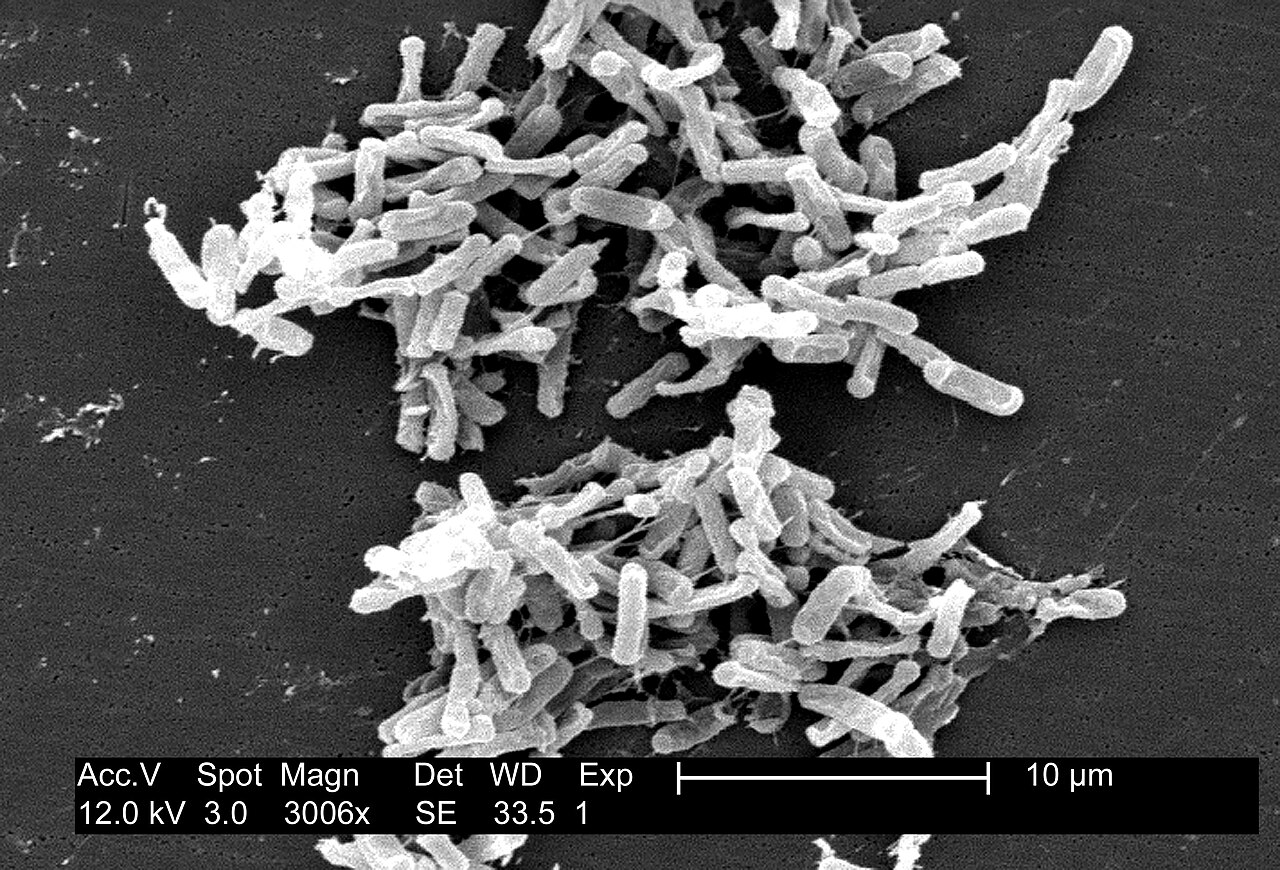
Image: scanning electron micrograph of Clostridioides difficile from a stool sample. CDC / Lois S. Wiggs, Public domain, via Wikimedia Commons.
Comments