
Total dependence on a microbe is usually treated as a one-way door. Insects that house nutritional bacteria inside their cells typically keep the same partner for tens to hundreds of millions of years, and the bacterium's genome can shrink until it is entirely dependent on its host. The open question is whether every obligate partnership ends that way, or whether an animal can need its bacteria absolutely and still be free to change them.
Gutless marine oligochaetes are a hard test case. These sediment-dwelling worms, a few millimetres long, have lost both their digestive and excretory systems; bacteria living beneath the cuticle supply their nutrition and recycle their waste. A metagenomic survey of 246 worms from 63 species at 17 sites now finds that their bacterial communities are highly consistent within a species but reshape rapidly once species diverge. Even the main nutritional symbiont, Candidatus Thiosymbion, acquired early and present in nearly all host species, tracked its hosts' family tree only loosely.
Why it matters: Obligate symbioses are often pictured as evolutionary dead ends in which host and microbe decay together. This survey describes an animal group that depends completely on bacteria while still adding and exchanging partners, which may help explain its success across very different seafloor habitats.
The study, by Mankowski et al. at the Max Planck Institute for Marine Microbiology in Bremen, with collaborators at Kiel University and elsewhere, appears in Science Advances. The worms were collected between 1991 and 2018 across six ocean regions. The authors declare no competing interests.
Specific within a species, scrambled between them
The team identified 33 symbiont genera, 16 of them new to these hosts, with each host species carrying 2 to 10. Nine times as many host species as earlier work (63 versus 7) yielded only about twice as many genera (33 versus 17), which suggests the worms draw on a small pool of bacterial groups despite living in microbially highly diverse marine sediments.
Host species identity explained about 90% of the variation in symbiont communities, against 20% for geography and 7% and 13% for organic input and sediment type. The authors benchmark the host figure against other animals, where host identity seldom accounts for more than about 30 to 60%, and caution that an obligate symbiosis is likely predisposed to stronger specificity.
That specificity does not survive speciation well. Four of 18 sister-species pairs had highly similar communities: more than chance would predict, but a minority. Across all 63 species, the host family tree and the tree of symbiont communities were less congruent than chance predicts (an entanglement score of 0.83, where 0 is perfect agreement, against a null mean of 0.57), and host relatedness explained almost none of the variation in community composition (R² = 0.03).
How fidelity was measured, and how much the numbers can bear
To ask whether symbionts follow the maternal line, the team compared bacterial genome divergence with divergence in two host genes: mitochondrial COI, inherited from the mother, and nuclear 28S rRNA. Fidelity to the mitochondrial genotype was higher on average (mean Mantel r of 0.25 versus 0.07), but the t test gave P = 0.07, short of the conventional 0.05 threshold. Strong correlations with the mitochondrial genotype appeared in only 16 of 56 host-symbiont pairs.
Most pairs produced no significant result: 56 of 61 for the nuclear marker and 51 of 56 for the mitochondrial one. The authors decline to draw conclusions for any pair that did not reach significance, so much of the within-species "weak fidelity" conclusion is an absence of detectable signal. Across species the evidence is firmer: all 12 genera found in at least four hosts correlated positively with host genetic distance, but strong codivergence appeared in only 5 of 12 comparisons for the nuclear gene and 6 of 12 for the mitochondrial one.
Selection on symbiont genes was mostly strongly purifying, without the broad genome erosion of strictly inherited insect symbionts, and the more faithful symbionts showed slightly more relaxed selection (R² = 0.38, P = 0.032). That fits the idea that occasional mixing keeps symbiont genomes healthy, though a P-value of that size supports it rather than settles it.
A 159-million-year history and one worm that lost its main partner
Molecular clock analysis dated the radiation of gutless oligochaetes to 159 million years ago, roughly three times an earlier estimate of 50 million. Thiosymbion was acquired before the hosts diversified and was unambiguously lost in only one species, Inanidrilus exumae. Secondary symbionts were gained about twice as often as lost, 179 inferred gains against 83 losses.
The Thiosymbion-free worm also corrects the record. Earlier work proposed that another bacterium, Gamma4, stood in by oxidising sulfur and fixing carbon. The new reconstructions show Gamma4 carries sulfur-oxidation genes but lacks RuBisCO and other known carbon-fixation pathways, so any replacement works differently.
What the study can't say yet
No experiment here watched a worm acquire or swap a partner. Horizontal transfer is inferred from mismatched family trees, and the authors' caution about the nonsignificant fidelity tests applies broadly: those results should not be interpreted as evidence for the absence of fidelity because factors such as limited sample size and uneven sampling across host species may have reduced statistical power. Comparisons between distant populations rested on just four host species.
Metabolic roles are read from gene content, not measured; nitrogen-fixation genes in a few symbiont genomes still need experimental confirmation. Some apparent symbiont absences may be artefacts of low sequencing coverage, and the new age estimate rests on a clock model built from 28S sequences of eight gutless species.
Quick questions
How does an animal without a gut eat? Its main symbiont is a chemoautotrophic sulfur oxidiser that fixes carbon using energy from sulfur compounds, and is assumed to supply most of the worm's nutrition.
If symbionts pass from mother to egg, how can they change? They are smeared onto eggs laid in sediment, so bacteria from the surroundings or from nearby worm species can be picked up during or after deposition.
What is the one-line takeaway? Gutless worms keep a stable, species-specific set of bacteria within each species but reshuffle it as species diverge, so total dependence on microbes need not mean a fixed set of partners.
Mankowski et al. "Stability in flexibility: Shifting alliances stabilize the symbioses of marine animals over 150 million years." Science Advances, 2026. doi.org/10.1126/sciadv.aed1476
PubMed PMID: 42814824.
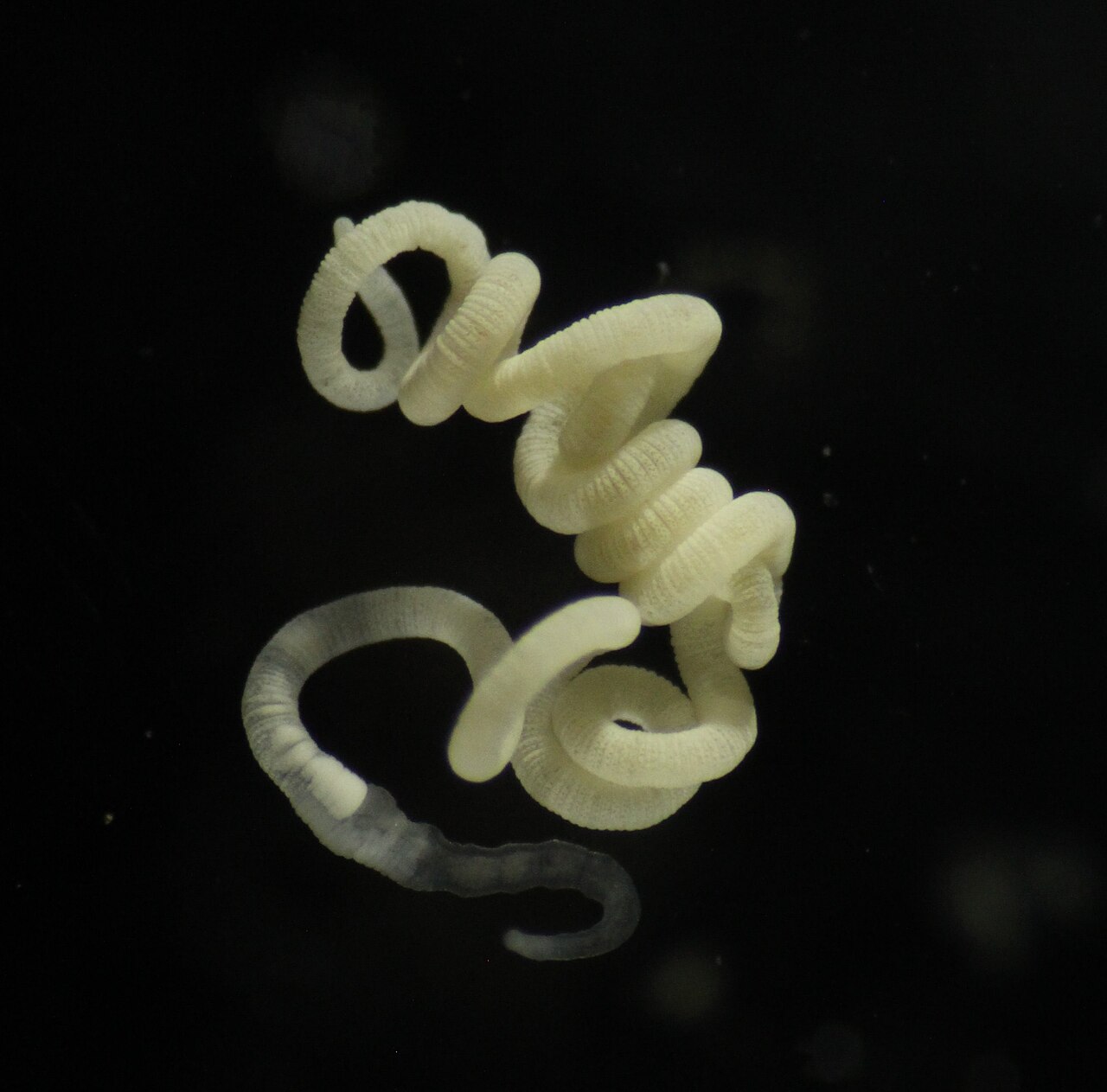
Image: the gutless worm Olavius algarvensis from Elba, Italy. Alexander Gruhl, CC BY-SA 4.0, via Wikimedia Commons.
Comments