

The claim that gut bacteria affect your joints is now ordinary, and the evidence behind it is weaker than the confidence. Most of it is correlation: people with osteoarthritis have a different gut microbial mix, certain bacterial metabolites track with how bad the joint damage is, and feeding rats probiotics reduces the damage. What has been missing is a way to watch the supposed mechanism happen, because the two tissues involved are nearly impossible to keep alive together. Gut bacteria that matter most need an oxygen-free environment; the gut lining needs oxygen on one side; and cartilage needs neither, but does need mechanical flow.
A group at the Chinese University of Hong Kong has built a plastic chip that holds all three conditions at once. One chamber grows a human gut lining with an oxygen gradient across it, so an oxygen-hating Bifidobacterium and an oxygen-tolerant Lactobacillus can both colonise it. Fluid then carries whatever those bacteria produce into a second chamber holding cartilage grown from human stem cells. With the probiotics present, the cartilage matured better, resisted an inflammatory insult, and partly recovered after one.
Why it matters: Osteoarthritis affects around 5% of people worldwide and nothing on the market changes its course; treatments manage pain until the joint is replaced. Probiotics are already sold for joint health on evidence this thin, so a system that can test which strains actually do something, and how, is useful whichever way the answers come out.
The study, by Liu et al. at the Chinese University of Hong Kong, with collaborators across several Chinese institutions, appears in Science Advances. Every result is in cultured human cells on a microfluidic device.
Why the engineering is the actual finding
The three constraints the authors list are worth taking seriously, because they explain why this question has stayed correlative. Standard cell culture cannot host obligate anaerobes next to mammalian cells; it has no oxygen gradient, no fluid shear, no peristalsis; and keeping two tissue types in contact invites cross-contamination.
Their answer is a double-layered channel that maintains an oxygen-poor face against an oxygen-rich one, letting both bacteria sit on gut epithelium that stays alive. Cartilage is grown in an array of microwells, which forces the organoids to come out a uniform size, and the flowing medium applies shear roughly like the fluid inside a real joint while clearing waste. Crucially the two chambers are physically separate and connected only by flow, so the cartilage never meets the bacteria, only what they release. That is what makes the result interpretable: anything the cartilage does is a response to secreted molecules, not to contact.
What the cartilage did
Three experiments, in rising order of ambition. In healthy conditions, cartilage downstream of the colonised gut produced more matrix. Exposed to the inflammatory signal interleukin-1-beta, it held up better than cartilage fed by a bacteria-free gut. And cartilage already damaged by that signal partly recovered when probiotics were introduced afterwards, which is the only version of the experiment that resembles treating an existing problem.
The mechanism is handled with more care than usual. Two signalling pathways, PI3K/Akt and MAPK/ERK, do opposite things depending on context: they drive matrix building during cartilage formation, but when over-activated by inflammation they drive matrix destruction instead. The authors report that probiotic effluent raised activity in the first setting and damped the excess in the second, and they add pathway-activation experiments rather than resting on the correlation. Measuring what was in the fluid turned up several candidate molecules, including indole derivatives and the short-chain fatty acid butyrate, which they then tested directly on cartilage organoids built from cells taken from osteoarthritis patients.
What the study can't say yet
No animal was treated and no patient was treated. The whole result is cells in a device, and the authors call it a proof-of-concept platform rather than a finding about osteoarthritis.
The model is deliberately stripped down, and the missing parts are the ones most likely to matter. There is no immune system, no liver, no endocrine signalling, so anything a probiotic metabolite would normally do by passing through the bloodstream or provoking immune cells is absent by construction. The gut lining is a cancer-derived cell line standing in for intestinal epithelium.
The strain choice was pragmatic, not therapeutic: the two were picked for their contrasting oxygen requirements, in the authors' words rather than as the only or optimal candidates for cartilage protection. So this is not evidence that these two probiotics are the right ones, and the handful of metabolites tested does not capture the strain diversity or day-to-day variability of a real gut.
The patient-derived part, which is the closest thing here to human relevance, is also the smallest. The authors state that the donor pool was limited and included only female donors, leaving both patient variation and sex differences untested. They also note they have not yet done the variance estimates needed to size future experiments properly, which is an unusually honest thing to put in print and a fair signal of how early this is.
Quick questions
Should I take probiotics for my joints? Nothing here supports that. The study tested two specific strains on cells in a machine, and its own authors decline to claim they are the right strains.
Why bother with a chip instead of mice? Because mice carrying human gut bacteria still cannot show human-specific signalling, and you cannot watch two tissues talk to each other in real time inside an animal. The trade is realism for visibility.
What is the one-line takeaway? A device that keeps gut bacteria, gut lining and cartilage alive together showed probiotic by-products helping cartilage resist inflammation, which makes the gut-joint link testable for the first time without yet showing it matters in a body.
Liu et al. "Effects of probiotics on joint homeostasis and osteoarthritis: Development of microbe-gut-cartilage axis-on-a-chip." Science Advances, 2026. doi.org/10.1126/sciadv.aeg8557
PubMed PMID: 42853928.
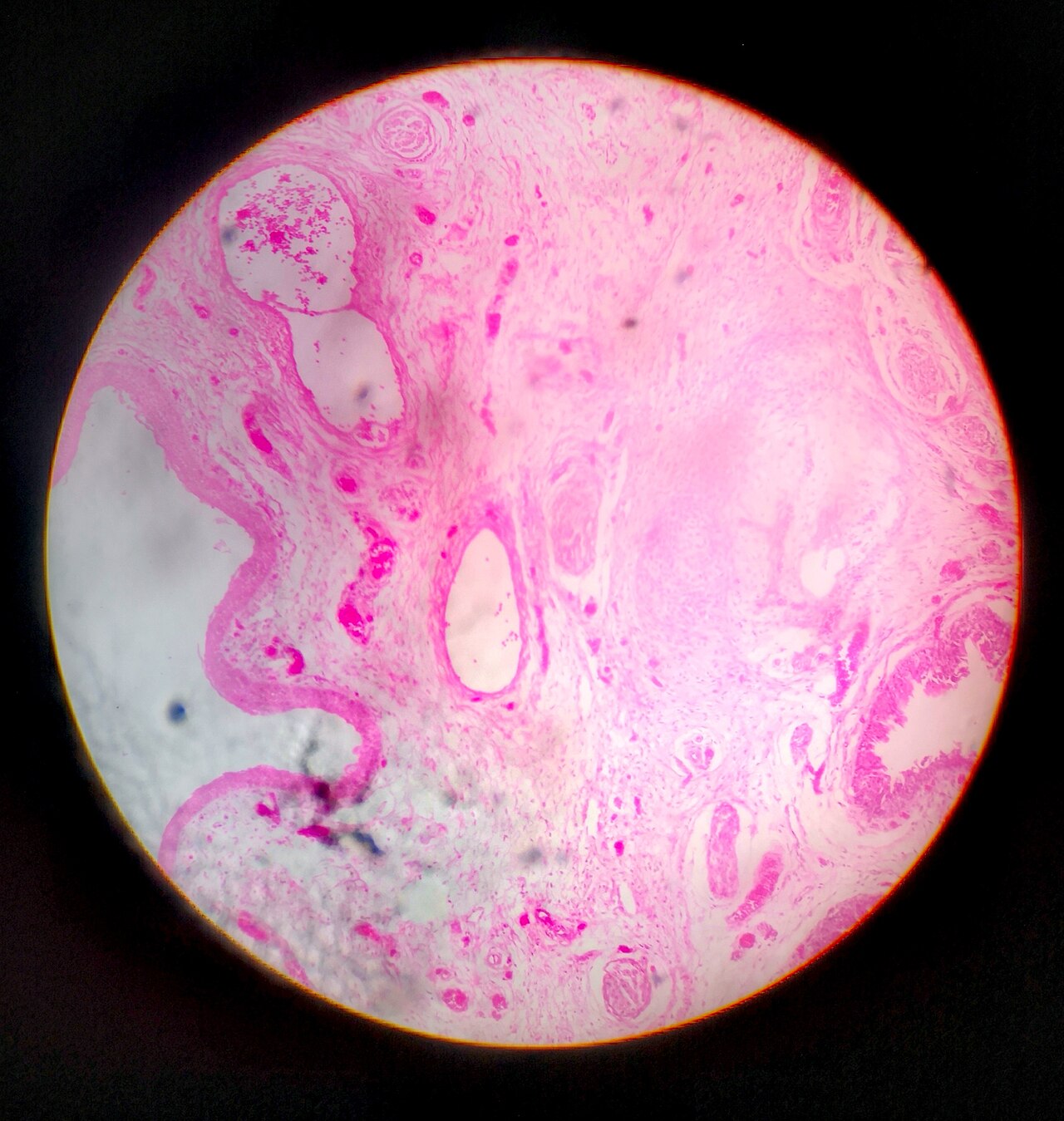
Image: human hyaline cartilage tissue. Naz Amann, CC BY 4.0, via Wikimedia Commons.
Comments