A bleached coral is not a dead coral. It has lost the single-celled algae that live inside its tissues and supply most of its food, and it is now slowly starving while filamentous algae colonise its surface. Whether it survives depends on getting those symbionts back. The two routes biologists know about are both slow: whichever symbionts remain can multiply, or new ones can arrive from sediment and seawater, where they sit at abundances several orders of magnitude below what coral tissue holds. Recovery on those terms takes months, which is part of why severe bleaching events kill so much of what they touch.
A group at Stanford University tried the blunt thing that had not been tested carefully: hold a bleached coral against a healthy one. In fragments of the branching coral Pocillopora damicornis, all five bleached pieces placed in direct contact with a healthy clone recovered completely within eight weeks, and one within four. Five more fragments parked five to seven millimetres away, close enough to catch anything the healthy coral shed into the water, stayed bleached, were overgrown by algae, and mostly died.
Why it matters: Nearly every reef intervention in development is preventative, meant to stop bleaching or raise heat tolerance before it happens. This one addresses corals that have already bleached, which is the group that currently dies. It also turns out to work only between clonemates, which sharply limits how it could ever be used.
The study, by Collins et al. at Stanford University, appears in Science Advances. All of it was done in aquaria at the university's Hopkins Marine Station in Pacific Grove, California, using fragments one to three centimetres long.
The gap between touching and nearly touching
Confocal imaging established how empty the bleached fragments were to begin with. On day zero, bleached polyps held a mean of 7 symbiont cells per square millimetre, with one fragment containing none that could be detected, against more than 6,700 in healthy polyps. The bleached corals had lost 99.9 to 100% of their symbionts, so anything that appeared afterwards had to come from outside rather than from survivors multiplying.
It appeared quickly. Symbionts were visible in bleached polyps by day three, and by day twelve those polyps had reached 70.6% of the density in adjacent healthy polyps, give or take 24.2%. The transfer and the growth ran on different clocks: symbiont numbers doubled every 18.3 hours over the first six days, which reflects bulk import from the donor, then every 4.13 days over the following six, which reflects replication inside the recipient. That second figure is the one worth holding onto. On the Great Barrier Reef, symbiont loads in recovering Acropora have been documented doubling over three months; in Samoa, recovering Montipora doubled in 16 to 24 days.
The isolated fragments make the contrast. Four of five managed only 5 to 20% polyp recovery at a branch tip in the final three weeks. By week nine, two were fully overgrown and dead, and the remaining three carried algae over at least 87% of the fragment.
How little contact is needed, and where the paper overstates it
Separating the pairs after fixed intervals showed that contact does not have to be maintained. Every fragment given a week or more, plus one given five days, achieved complete polyp recovery within seven weeks. Because transfer stops at separation, all later gains must come from replication inside the recipient, which is what makes the week-long dose sufficient on its own.
The abstract then pushes further than the results do, stating that A single week of contact, and in some cases as few as 3 days, provides sufficient symbionts to initiate sustained and full self-recovery. In the main text, the ten fragments held for three days or more did show transfer and visible signs of recovery at separation, and were then covered by algae anyway. The one fragment that recovered on a short dose had five days, not three. Two fragments given a single day showed nothing.
The mechanism is tissue fusion, which explains the strangest limit in the paper. Directional transfer from healthy to bleached tissue requires the two fragments to be the same genet, meaning clones; pair different genets and they attack each other instead. A second, slower route, uptake through the polyps, happens in both matched and mismatched pairs but never delivers enough to rescue a colony.
What the study can't say yet
These were aquarium animals, not reef animals. The colonies came from aquarium suppliers and had been kept at the marine station for three and a half years, and for the original fragments collection location and depth were not available. One species was tested, with one symbiont community, in groups of two to ten fragments.
Scale is the open question the authors put most plainly, writing that The areal extent over which contact-mediated symbiont transfer can promote recovery within a colony remains unknown and may constrain recovery at larger scales. A two-centimetre fragment recovering says little about a colony the size of a table. Nor is it clear why the transferred symbionts multiply so fast; the absence of prior heat stress in the donor's symbionts is one proposal, and nutrients moving across the junction alongside the symbionts is another, neither of them demonstrated here.
Quick questions
Could this be used on a real reef? Not as described. The same-genet requirement means a bleached colony would need a healthy clone of itself in contact with it, which is a nursery arrangement rather than a wild one. The authors frame it as a foundation for recovery interventions, not an intervention.
Why would a coral reject a neighbour's symbionts? The block appears to sit in the host, not the algae: mismatched pairs transferred some symbionts but never fused, and the fast replication seen between clones did not happen.
What is the one-line takeaway? Bleached coral fragments recovered fully and fast when touching a healthy clone and died when held millimetres away, revealing a natural repair route whose usefulness is limited by the fact that it only works between clones, in aquaria, at the scale of a few centimetres.
Collins et al. "Rapid coral bleaching recovery via symbiont transfer from healthy corals." Science Advances, 2026. doi.org/10.1126/sciadv.aeh1580
PubMed PMID: 42873873. Full text: PMC13665998.
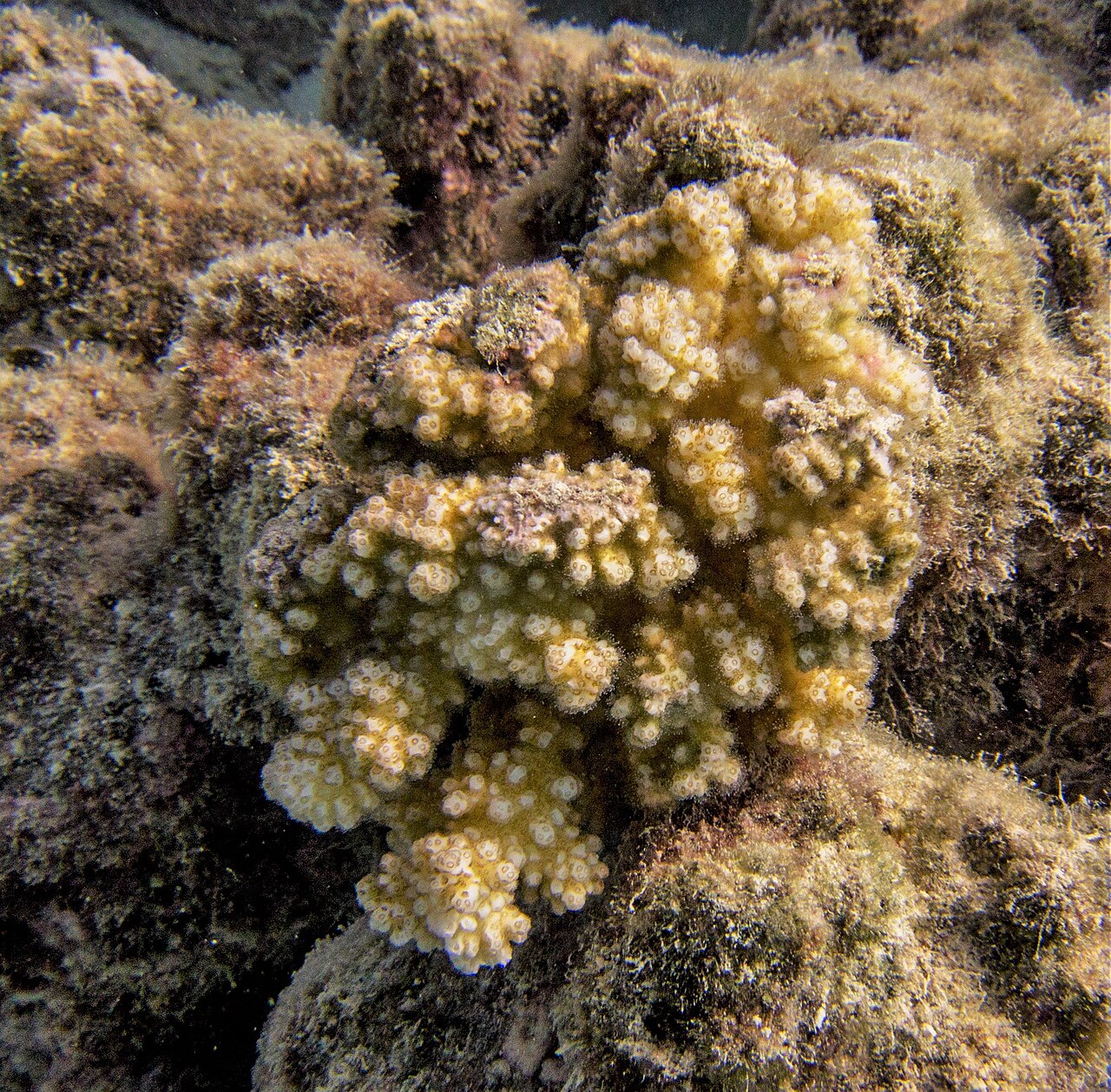
Image: Pocillopora damicornis, Moorea. Ryan McMinds, CC BY 2.0, via Wikimedia Commons.
Comments