
The limiting factor in fatty liver disease is not the fat. A liver can hold a great deal of fat and keep working; what predicts liver failure, cancer and death is how much scar tissue it has laid down. The useful question is which signal turns a fatty liver into a fibrotic one.
A study in Science Advances nominates an unexpected candidate: Toll-like receptor 5, a sensor whose known job is to recognise flagellin, the protein bacteria build their swimming tails from. In human liver biopsies, TLR5 was elevated in advanced fibrosis while its better-studied siblings TLR2 and TLR4 were not, and high hepatic TLR5 tracked both liver complications and death from any cause. More unexpectedly, in human liver cells the same receptor carried a second signal that had nothing bacterial about it. Fat taken up into the cell triggered a TLR5-dependent injury response with no flagellin present anywhere in the dish.
Why it matters: Liver scarring in metabolic liver disease still has no reliably reversing treatment, and most drugs in development aim at metabolism rather than at the injury signal itself. A receptor that reads both of the things a fatty, permeable gut delivers to the liver would be one place to intervene instead of two.
The work comes from Li et al. at the Barts Liver Centre, Blizard Institute, Queen Mary University of London, with collaborators at KU Leuven, the University of Edinburgh and University College London. The study avoids mice, whose literature on this receptor is contradictory, working instead in patient cohorts, primary human cells and slices of living human liver.
Two signals, one receptor
Purified flagellin provoked a strong release of interleukin-8 from primary human hepatocytes and two liver cell lines. TH1020, a selective TLR5 blocker, abolished it, as did silencing the receptor, while blocking TLR2, TLR3 or TLR4 did nothing. Flagellin still worked at 1 nanogram per millilitre, the concentration measured in patient plasma, which matters because a receptor that only answers to a laboratory dose is not a disease mechanism.
Loading the same cells with oleic and palmitic acid, the most abundant unsaturated and saturated fats in a Western diet, produced the same interleukin-8 response, and it too disappeared when TLR5 was blocked. The discriminating experiment came next. In reporter cells engineered to light up when TLR5 is engaged, the fatty acids produced no signal at all, so they are not ligands for the receptor. Blocking the transporters that carry fat into hepatocytes, chiefly fatty acid transport protein 2, abolished the response, and media from fat-loaded cells provoked interleukin-8 in untreated cells, again via TLR5. Fat has to get inside, and something the injured cell then releases trips the receptor from the outside. Signalling ran through MyD88 and TAK1, the receptor's conventional route, and not through TRIF.
One result needs care. At the high fat dose, adding flagellin produced no further interleukin-8, which looks like evidence against a shared pathway. The response was already saturated, and at lower fat doses the two signals did add up.
What the patient data can carry
The discovery cohort is small: 24 biopsies, five patients per group at the extremes. Replication carries the clinical claim. In three further biopsy-proven cohorts, TLR5 but not TLR2 or TLR4 rose with stage, and in the largest, high hepatic TLR5 was associated with liver decompensation and all-cause mortality, adjusted for age and sex. The thresholds splitting high from low were chosen by fitting the same data, which flatters any separation it finds. The mortality association held only in patients who already had advanced fibrosis, so this reads as a marker of established disease, not an early warning.
The ligand side is interesting for what did not move. Plasma flagellin was higher in advanced fibrosis; bacterial lipopolysaccharide, the molecule this field has watched for two decades, was not. Flagellin genes in stool were on average 28 times more abundant. In 18 non-obese patients with untreated hepatitis B, flagellin showed no gradient with fibrosis, which argues the signal is specific to metabolic liver disease rather than to scarring generally. After metabolic surgery, plasma flagellin fell 1.4-fold at a median of 89 days, though the authors concede that could reflect the surgery rewiring the gut rather than the liver improving.
The step that matters is the scar
Collagen in the liver is made by hepatic stellate cells, and those cells, isolated from 19 donors, do not express TLR5. Neither flagellin nor fat activated them directly. Media from fat-injured hepatocytes did, raising both TGF-beta-1 and the precursor of collagen I, and blocking TLR5 in the hepatocytes beforehand removed that effect. Interleukin-8 on its own did not activate stellate cells, so the cytokine everyone measures here is a readout and not the messenger.
The closest thing to a treatment experiment used precision-cut liver slices from three patients, architecture intact. Fat loading raised collagen III expression 1.7-fold; pretreating the slices with the TLR5 blocker brought it down 1.4-fold. Both comparisons were significant, with the statistics computed across three donors rather than across the eighteen imaged regions, which is the conservative and correct choice.
What the study can't say yet
Nobody was treated. TH1020 is a laboratory compound applied for 16 hours to tissue in a dish. The mouse literature points both ways: deleting this receptor made liver disease worse in two models, while blocking it pharmacologically improved fibrosis in a third. All the hepatocyte experiments used cells from a single healthy donor, many runs were two to four experiments deep, and only two fatty acids were tested. Not every patient had a biopsy; some were classified by scan and liver stiffness. The receptor is also present throughout the body, and the authors write that its inhibition may lead to unintended adverse effects within the liver or in extrahepatic tissues. They suggest blocking the downstream kinase TAK1, or reducing flagellated bacteria in the gut, as alternatives.
Quick questions
Does this show gut bacteria cause liver scarring? No. Flagellin in blood and stool is associated with advanced fibrosis, but nothing here shows it starts the disease.
Could a flagellin blood test be useful? Perhaps as a marker of advanced fibrosis or of response to treatment. These are small cohorts, and the paper does not test flagellin against the fibrosis scores clinics already use.
The one-line version? In human liver tissue, a receptor for bacterial tails also relays fat injury to the cells that make scar, and blocking it lowered collagen.
Li et al. "TLR5 drives metabolic dysfunction-associated steatohepatitis through lipid- and flagellin-induced hepatocyte injury signaling." Science Advances, 2026. doi.org/10.1126/sciadv.aef9541
PubMed PMID: 43050520.
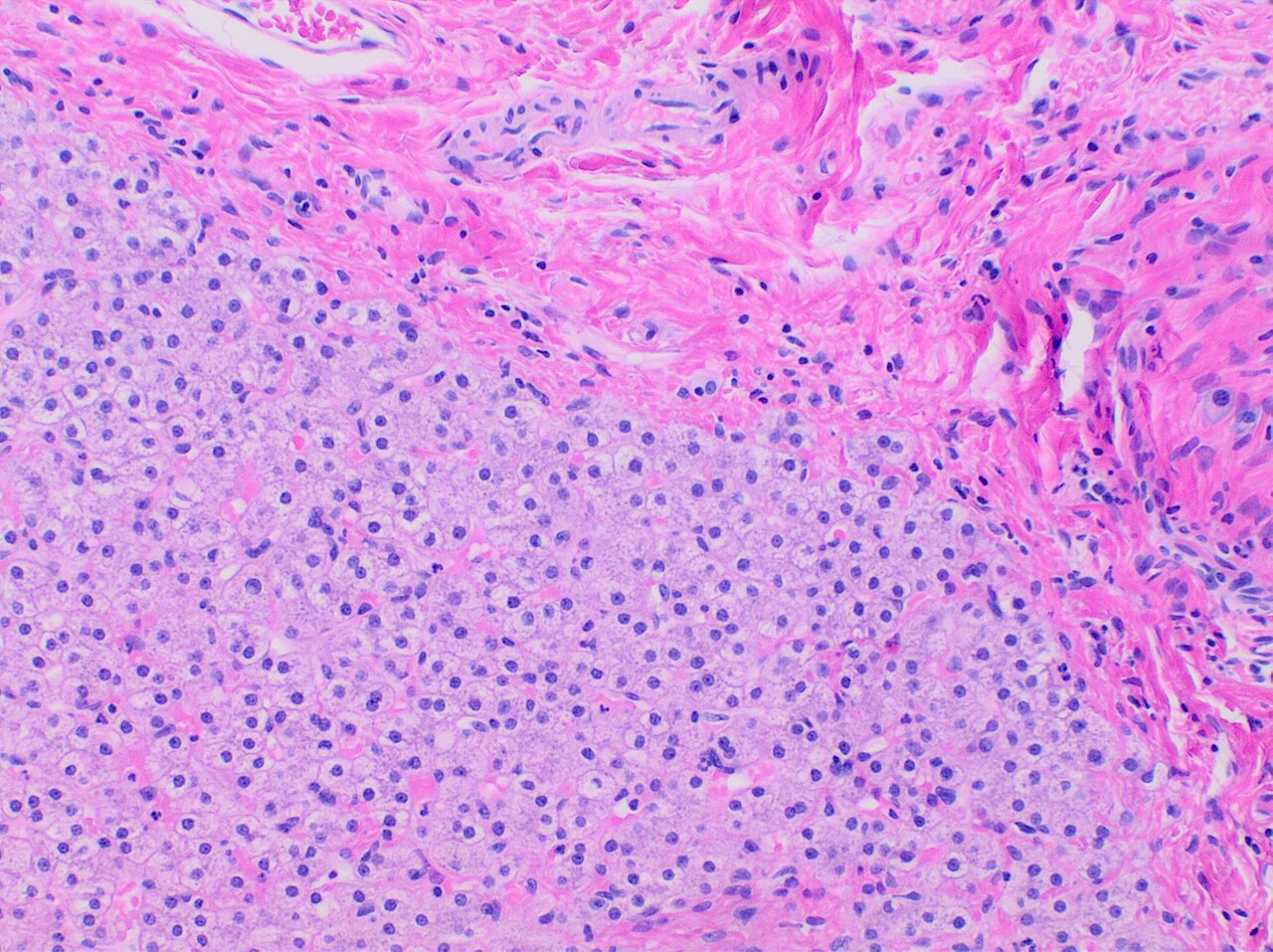
Image: human liver tissue histology. Mikael Häggström, M.D., CC0, via Wikimedia Commons.
Comments