
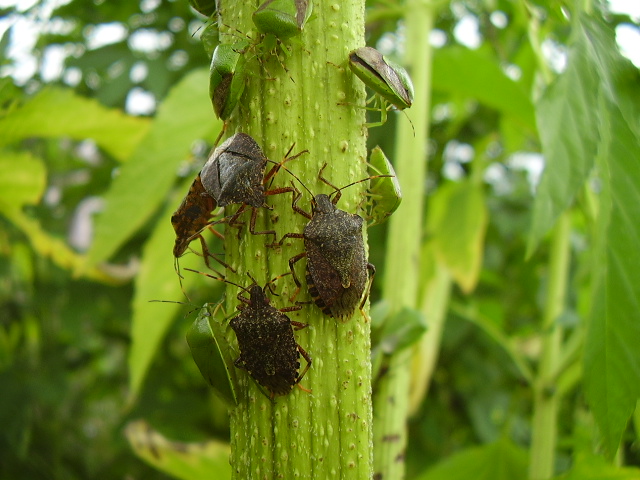
Break one gene in a common gut bacterium and it changes sides. That is roughly what a team in Japan found while poking at the relationship between the brown-winged green stinkbug, Plautia stali, and the microbes it carries. Knock out a single bacterial gene and a strain that offered the insect nothing becomes a partner it can grow up with. The insect develops, the bacterium gets passed to the next generation, and a mutualism that took evolution a long time to build appears in the lab almost by accident.
The insect matters here as much as the microbe. Many stinkbugs keep dedicated symbionts in specialized gut pouches, and without the right bacteria the young insects grow slowly or die. In earlier work, researchers had shown that ordinary lab Escherichia coli could be nudged into playing this symbiotic role by a single mutation in its carbon catabolite repression system, a master switch that controls how the cell handles nutrients. That was a neat trick. It was also suspicious, because that particular mutation does not show up in the bacteria that actually live inside wild stinkbugs.
One gene, not five hundred
The carbon catabolite repression switch is a blunt instrument. Flipping it changes the activity of more than 500 downstream genes, so the fact that it produced a working symbiont did not tell anyone which change actually mattered. The team went looking for the gene that carried the weight. They found it in tnaA, which encodes an enzyme called tryptophanase.
Tryptophanase breaks down the amino acid tryptophan and, in doing so, produces indole, a compound that is toxic to the developing insect. Disable tnaA and two things happen at once. Tryptophan piles up instead of being consumed, and the toxic indole stops accumulating. That combination is apparently enough. An E. coli strain with a broken tnaA gene, and nothing else altered, becomes mutualistic to Plautia stali. A single loss-of-function change did what the sprawling 500-gene switch had done, and it did it for a reason that makes chemical sense.
What the wild bacteria already knew
The convincing part came from checking nature rather than the bench. The typical symbionts of Plautia stali and other stinkbugs are bacteria in the genus Pantoea. When the researchers surveyed wild populations, they found that these natural partners consistently lack the tnaA gene. Evolution, in other words, had already arrived at the same solution the lab found by deletion.
The exceptions prove the point. Some Pantoea species, such as Pantoea ananatis, still carry a working tnaA and cannot set up shop inside the insect. Disrupt tnaA in P. ananatis and its ability to partner with the stinkbug partially returns. Run the experiment in reverse and the logic holds: when the team engineered a functional tna operon back into a natural Pantoea mutualist, a bacterium that normally supports the insect became much worse at it. Add the gene, lose the partnership. Remove the gene, gain it.
That symmetry is the strongest thing in the paper. It suggests that losing tryptophanase was not a side effect of becoming a symbiont but a step on the road to it, a small genomic sacrifice that removed a poison standing between two organisms and a shared life.
How far the lesson stretches
Worth keeping the scope honest. This is one insect and a handful of bacterial species, and the experiments show that disrupting tnaA promotes mutualism, not that it is the only thing required. The engineered E. coli and the fixed P. ananatis restored symbiotic ability only partially, which means other genetic differences still separate a passable partner from a native one. The study speaks to gut mutualisms in stinkbugs; whether the same trick underlies symbioses in other animals is an open question, not a finding.
Still, the appeal of the result is how clean it is. A great deal of writing about the microbiome leans on correlation and community-level hand-waving. Here is a case where you can name the gene, name the molecule it destroys, and watch a relationship switch on and off as you add or subtract that one piece of DNA. Symbiosis usually looks like an achievement of long coevolution. Sometimes it starts by losing something small and toxic.
Wang, Y. et al. "Tryptophanase disruption promotes insect-bacterium mutualism." Nature Microbiology, 2026. doi.org/10.1038/s41564-026-02264-z
PubMed PMID: 41760926.
Photograph: Matsumomushi, Public domain, via Wikimedia Commons.
Comments