


Say a sentence out loud and something remarkable happens in your head before the words ever leave your mouth. You pick words, slot them into an order, keep track of what a phrase is doing, and update all of it on the fly. For decades neuroscientists could watch this play out only through the blurry lens of brain scans or the coarse hum of electrodes sitting on the cortical surface. A study published this week in Nature gets much closer. It listens to individual neurons in the human brain as a person speaks.
The work comes from a team at Massachusetts General Hospital and Harvard Medical School, led by Jing Cai, Sydney Cash and Ziv Williams. They recorded from single neurons across the frontotemporal cortex, the swath of tissue on the front and side of the brain long tied to language. Then they paired those recordings with modern natural language processing models, the same family of tools that power today's chatbots, to ask what each firing cell was actually keeping track of.
Some cells mind the grammar, others mind the arc
What they found is a kind of division of labor at the cellular level. Certain neurons responded to fine grammatical relationships between words or to a word's part of speech, whether it was a noun, a verb, and so on. Other neurons did something more sweeping. They tracked the higher-order syntactic structure of the sentence, its phrase transitions, and where a given word sat in the sequence.
The interesting part is that these cells were not rigid labelers. A single neuron did not just fire for "verb" and stop there. The same population captured a word's syntactic and semantic properties while also folding in the specific context of the sentence being spoken. That combination matters. It means a small group of neurons can represent an enormous range of meanings by mixing and matching, encoding information combinatorially rather than one fixed tag per cell. That is roughly the trick that lets a finite brain produce an effectively infinite set of sentences.
Micro, meso, macro
The team did not stop at individual cells. They looked at how the neurons were arranged locally, in small clusters, and how their microscale activity compared with the broader field potentials nearby, the smeared electrical signals that surface methods usually capture. The single-cell picture was sharper and carried information the wider signals missed.
Zoom out further and geography appears. These language-encoding neurons were spread broadly across the frontotemporal cortex, not packed into one tidy spot. But their ability to carry linguistic information was left-lateralized, stronger on the left side, and it varied from region to region. That fits a century of clinical observation about the left hemisphere and language, now rendered in the currency of single spikes. The authors frame the result as a map spanning three scales at once: the cell, the local population, and the region.
What this does not settle
It is worth being clear about the reach of a study like this. Recordings from inside the living human brain are rare because they depend on patients who are already undergoing neurosurgery for other reasons, so the number of people involved is small and the sampling is limited to wherever the clinical electrodes happen to go. The work describes language production, people generating speech, and should not be read as the full story of comprehension. And using language models to interpret neural activity is a powerful lens, but it is still a lens. Showing that a model's representation lines up with a neuron's firing is a correlation, not proof that the brain computes the way the model does. The paper identifies building blocks. It does not hand us the finished blueprint of how humans speak.
Still, the direction is striking. For most of the history of language neuroscience, the cell has been out of reach, a level of detail we could theorize about but rarely observe directly in people. Pulling grammar and sentence structure out of the firing of identified human neurons moves the field from arguing about boxes on a diagram to watching the parts move. It also hints at practical futures. Speech neuroprostheses that aim to restore communication for people who cannot talk will work better the more precisely we understand what these neurons are tracking. This study is a detailed early read on exactly that.
Cai, J. et al. "Mapping the neuronal building blocks of human language with language models." Nature, 2026. doi.org/10.1038/s41586-026-10691-5
PubMed PMID: 42310453.
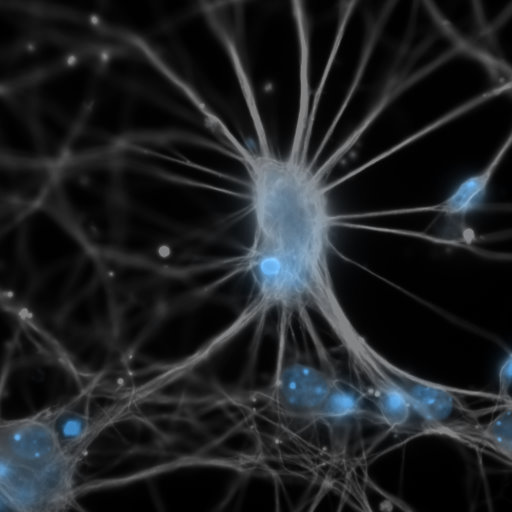
Photograph: Dchordpdx, CC BY 4.0, via Wikimedia Commons.
Comments