
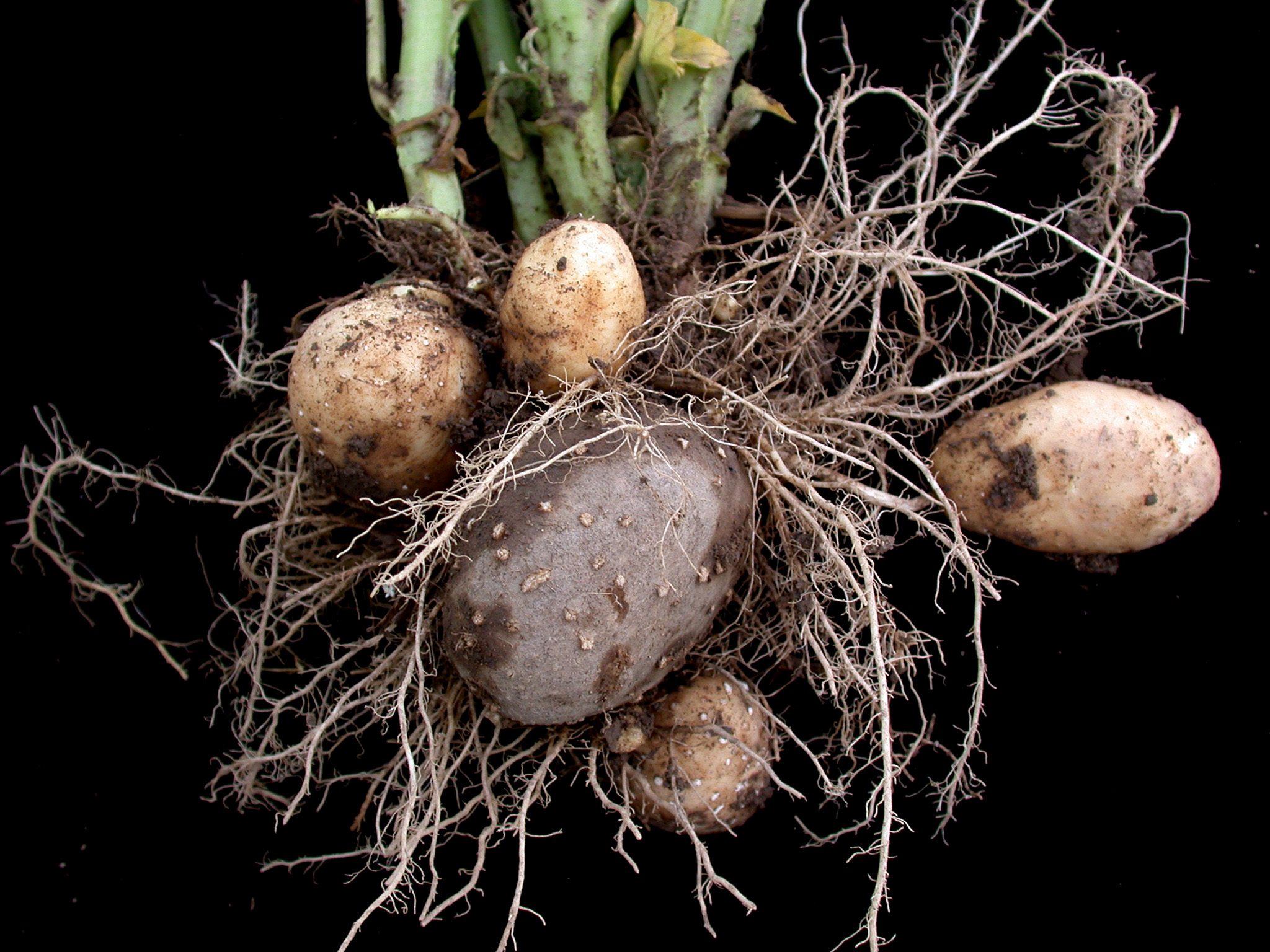
Almost every potato you have ever eaten is, in a sense, a clone. Farmers plant chunks of last year's tubers, and the new plants are genetically identical to the parent. It has worked for centuries, but it comes with a catch. Diseases pile up in the tuber stock, seed potatoes are heavy and expensive to ship, and improving the crop through breeding crawls along because the plants carry four copies of every chromosome instead of two.
A team at the Agricultural Genomics Institute at Shenzhen has been chipping away at that problem for years, trying to reinvent the potato as a crop grown from true seed rather than tubers. Their latest paper, published in Nature Plants, adds a piece that had been missing. They made potato lines that will not pollinate themselves.
Why self-pollination was in the way
Hybrid crops get their punch from heterosis, the vigor that shows up when two different inbred parents are crossed. Corn breeders have exploited it for a century. To make hybrid seed reliably, though, you need a mother plant that cannot fertilize its own flowers, otherwise you end up with a messy mix of self-pollinated and cross-pollinated seed. In corn, male-sterile lines do the job.
Potato is harder. It is normally clonally propagated, so tools for controlling pollination were never developed the way they were for grain crops. The researchers went at it through haploid breeding, collapsing the genome down and building homozygous diploid lines that carry a working self-incompatibility system. Those plants reject their own pollen. Cross them with a second inbred line and you get uniform hybrid seed, produced at large scale and low cost.
There was a second, less obvious payoff. Potato plants put energy into flowers and berries above ground while also filling tubers below. Those two sinks compete. When the engineered plants could not set fruit, that competition disappeared, and more of the plant's resources flowed to the tubers. The authors report a higher harvest index, meaning a larger share of the plant's mass ended up in the part people actually eat.
Haploids as a shortcut
The clever move here is using haploid breeding to sidestep potato's tangled genetics. A cultivated potato has four sets of chromosomes, which makes it nearly impossible to breed the clean inbred lines that hybrids require. By reducing the plant to a haploid state and then doubling it, the team produced diploid plants that are homozygous, genetically fixed, and predictable. Stack self-incompatibility on top of that, and you have a mother line that behaves the way a hybrid seed system needs it to.
The appeal of true potato seed is not new. A single gram of seed can replace the roughly two tons of seed tubers needed to plant a hectare. Seed is easy to store, easy to ship, and free of the viruses that accumulate in tuber stock. The obstacle has always been getting from that vision to plants that perform in a field. Controlling pollination is one of the gates, and this work walks through it.
How far this actually goes
This is a proof of concept, and the authors frame it that way. The paper describes a breeding strategy and demonstrates the pieces working together in their lines. It does not claim a finished commercial variety, and it does not report multi-season yield trials across different climates and soils. Whether these hybrids match or beat established tuber-grown varieties on flavor, disease resistance, and total yield in real farming conditions is the question that field testing will have to answer.
Reworking a staple crop's entire propagation system is a long game, and potato has resisted it before. But the logic is clean. If hybrid potatoes grown from seed can be produced cheaply and reliably, the payoff would reach a lot of tables. Potato is the third most important food crop in the world by consumption, and much of it is grown by smallholders who would benefit most from lighter, cleaner, cheaper planting material. A plant that refuses its own pollen is a small strange step toward that.
Li, D. et al. "Generating self-incompatible hybrid potatoes through haploid breeding." Nature Plants, 2026. doi.org/10.1038/s41477-026-02235-6
PubMed PMID: 41703055.
Photograph: Gilles Ayotte, CC BY-SA 4.0, via Wikimedia Commons.
Comments