

Your large intestine is not a uniform swamp. Oxygen seeps in near the gut wall and fades to almost nothing toward the center, and the bacteria living there sort themselves along that gradient by how much oxygen they can survive. It is a quiet piece of ecological order. A new study in Cell Host & Microbe looks at one bacterium that seems to be breaking the rules, and the reason it can is a gene it appears to have stolen.
The bug is Segatella copri, a name most people have never heard even though it sits in a lot of guts. It is an old companion, common in people who eat fiber-heavy diets, and it is usually more sensitive to oxygen than the better-known Bacteroides species it shares space with. That sensitivity should pin it deep in the low-oxygen zone. Youssef El Mouali and colleagues at the Helmholtz Centre for Infection Research, working with collaborators in Trento, wanted to know how Segatella handles oxygen at all, and whether every strain handles it the same way.
One regulator does the everyday work
The team found that a transcriptional regulator called PerR sits at the center of the bacterium's oxygen response. PerR governs a network of genes that lets Segatella cope with the oxygen stress it meets in the gut, and the authors show this system matters for the bacterium actually colonizing the intestine rather than just surviving in a dish. Knock out that machinery and the microbe struggles to establish itself. So the baseline defense is real, but modest. It keeps Segatella alive in the anaerobic core, not out at the oxygenated edge.
Then the surprise. A subset of Segatella strains carry a second oxygen regulator, OxyR, that the others lack. OxyR is a well-traveled gene in the bacterial world, and the sequence evidence points to Segatella acquiring it through horizontal gene transfer from other Bacteroidales, its neighbors in the same order. In other words, this was not a slow tuning of a gene the bacterium already had. It was a borrowed part, dropped into the genome, and the strains that carry it tolerate oxygen noticeably better than those that do not.
Where the tolerant strains live
The part that lifts this out of pure microbiology is where those OxyR-positive strains turn up. They are more common in people from industrialized countries. They are absent from people living traditional lifestyles today, and absent from ancient human gut samples the team examined. The trait tracks with modern industrialized living and does not appear in the older or more traditional records.
That pattern is what makes the horizontal-transfer story feel timely rather than ancient. If OxyR had been part of Segatella for tens of thousands of years, you would expect to find it scattered across all kinds of populations. Instead it clusters in one slice of contemporary humanity. The authors read this as a sign of recent evolutionary pressure on Segatella, plausibly connected to the dietary and lifestyle changes that come with industrialization. A more oxygen-tolerant strain could shift where the bacterium lives inside the gut, nudging the fine spatial arrangement that normally keeps this ecosystem organized.
What the study does and does not show
Worth being careful here. The link between OxyR and industrialization is a correlation drawn from strain distributions, not a demonstration that modern diets caused the gene to spread. The molecular work on PerR and colonization was done in defined models, and translating that to the churn of a real human gut is a separate leap. The paper does not claim OxyR is good or bad for the person carrying it. What it establishes is cleaner and narrower: a widespread gut commensal has a two-tier oxygen defense, the upgraded tier came in from outside via gene transfer, and that upgraded tier maps onto a specific and recent human context.
The appeal is in the scale mismatch. A single regulatory gene, swapped between bacteria, leaves a fingerprint you can read against the sweep of how humans have changed how they live. It is a reminder that the microbes inside us are not static passengers. They are still evolving, still trading genes, and sometimes doing it on a timescale short enough to line up with the story of industrialization itself.
El Mouali, Y. et al. "Biogeography-associated emergence of enhanced oxygen tolerance in the abundant human gut commensal Segatella copri." Cell Host & Microbe, 2026. doi.org/10.1016/j.chom.2026.04.006
PubMed PMID: 42097142.
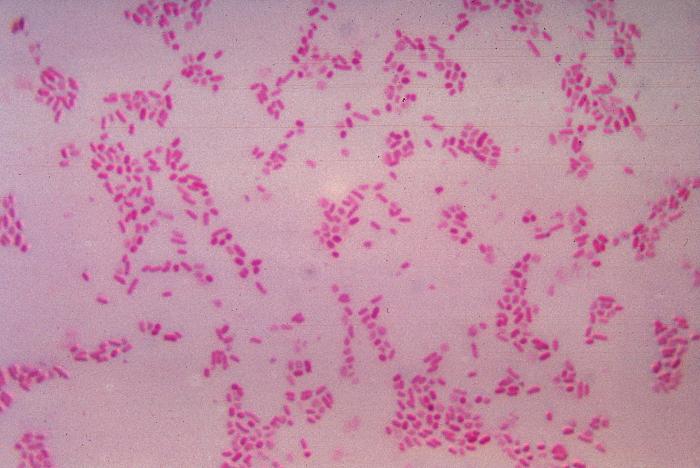
Photograph: CDC/Dr. V.R. Dowell, Jr., Public domain, via Wikimedia Commons.
Comments