
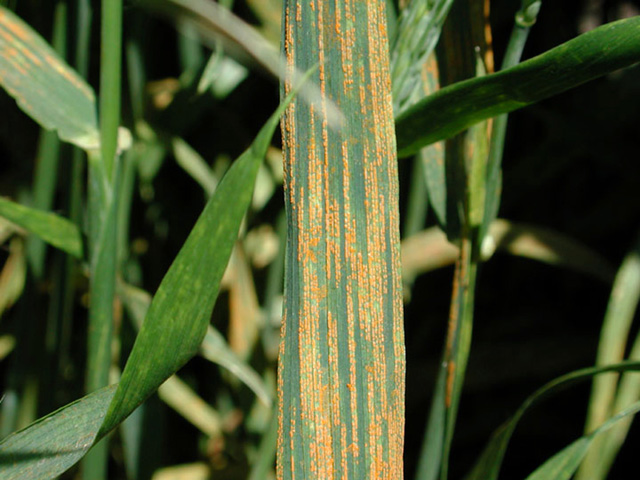
Stripe rust looks almost decorative up close. Rows of orange-yellow pustules run in neat lines along a wheat leaf, each one a factory pumping out spores. Across a field it is anything but pretty. The fungus behind it, Puccinia striiformis f. sp. tritici, is one of the most damaging pathogens in global wheat, and it keeps outrunning the resistance genes breeders throw at it. New races appear, a once-reliable gene stops working, and the cycle starts over.
A team led by Chunhui Wang, reporting in Nature Plants, went looking for fresh ammunition in an unusual place: rye, a cereal cousin that wheat breeders have borrowed from before. They screened 100 triticale accessions, a wheat-rye hybrid crop, against the three Chinese rust races that dominate in the field, CYR32, CYR33 and CYR34. Most held up well. One cultivar, Rozovskaya, was close to untouchable.
What map-based cloning turned up
Tracking the resistance to its source, the researchers landed on a gene on the long arm of rye chromosome 6R. They named it Yr83. Resequencing 117 rye accessions showed the gene comes in two main versions, and both delivered near-immunity when moved into transgenic wheat. Virus-induced gene silencing confirmed that switching the gene off switched the protection off too.
The interesting part is what Yr83 actually encodes. Plant immune genes of this class usually make an NLR protein, a receptor that recognizes signs of attack and triggers a defensive response. Yr83 is one of these, but with an extra piece bolted on: a nuclease domain derived from a Harbinger transposase. Transposases are the enzymes that let transposons, so-called jumping genes, cut and paste themselves around the genome. At some point in evolution, one of those mobile-element enzymes got captured and welded onto an immune receptor, and the fusion became a working defense gene.
That fused domain is not decoration. When the team truncated the transposase-derived nuclease portion, the gene stopped protecting the plant. So the borrowed enzyme is doing real work in the immune response, not just riding along. A phylogenetic survey found these NLR-transposase fusions only within the Pooideae, the grass subfamily that includes wheat, rye and barley, which hints the arrangement arose in a shared ancestor of these grasses.
A bonus hiding in the chromosome
Getting a rye gene into wheat is easier said than done. Dragging in a large chunk of rye chromosome usually brings along neighboring genes that hurt yield or quality, the reason many wild-relative resistance genes never make it into real cultivars. Here the researchers used a small 6RL translocation line, a wheat line carrying only a compact segment of the rye chromosome arm. It carried the resistance without the usual agronomic baggage.
It did something else too. Plants with the small translocation produced more spikelets and more grains per spike than their unmodified counterparts. A resistance gene that also nudges yield upward is the kind of two-for-one result breeders rarely get, and it makes the line far more attractive as breeding stock rather than a lab curiosity.
Reasons to stay measured
Near-immunity against today's dominant races is not the same as durable protection. Rust populations evolve, and any single gene can eventually be defeated as new virulent strains spread. The work also relied heavily on transgenic wheat and a specific translocation line, so how the gene performs across diverse elite varieties, growing regions and field seasons still has to be worked out. The yield boost was measured in these experimental lines, not across years of multi-site trials. And the mechanistic story, exactly how a transposase-derived nuclease strengthens an immune response, is still more sketch than blueprint.
Even with those caveats, Yr83 widens the toolbox. It adds a new resistance source pulled from rye, and it points to a whole class of transposase-fused immune genes that plant breeders have barely begun to mine. Sometimes the most useful defense turns out to be built from a piece of genetic machinery that once existed only to copy itself.
Wang, C. et al. "An NLR-transposase fusion gene from rye provides broadly effective resistance to stripe rust in wheat." Nature Plants, 2026. doi.org/10.1038/s41477-026-02248-1
PubMed PMID: 41792268.
Photograph: USDA Agricultural Research Service, Public domain, via Wikimedia Commons.
Comments