
A root-knot nematode cannot feed until the plant builds it a feeding site, and the plant will only build one if told to. The worm settles inside the root and, over days, a handful of host cells swell into multinucleate giant cells that it drinks from for the rest of its life. Which signal gives that instruction has been an open question. A new study proposes that the worm sends it in the plant's own vocabulary: a secreted peptide that copies a plant root-growth hormone closely enough to switch on the plant's receptors.
Why it matters: Root-knot nematodes attack a very wide range of crops, and the chemical controls once used against them are being withdrawn. A defined host pathway the worm depends on is the kind of target breeders can act on. Whether it is the same target in every crop is the question this study leaves least settled.
The work, by Li et al. at Huazhong Agricultural University, appears in Nature Plants. The full text is behind a paywall; this account draws on the abstract and the paper's publicly posted extended-data figure legends, which describe designs and sample sizes but not effect sizes.
A counterfeit growth signal
Plants make short ROOT MERISTEM GROWTH FACTOR peptides, RGFs, to keep the dividing zone at the root tip active. The team found RGF-like genes conserved across root-knot nematodes and focused on two: MgRGF from the rice pathogen Meloidogyne graminicola, and MiRGF1 from M. incognita, which infects a broad range of plants. Both are made in the worm's subventral gland cells during early infection and secreted into the space between host cells.
The evidence that the worm's peptide acts like the plant's own comes in three layers. First, synthetic nematode peptides applied at 100 nM promoted root development in Arabidopsis, scored as root length and the number of dividing meristem cells, and altered root growth and the meristem in tomato within 12 hours. Second, Arabidopsis lines engineered to make MgRGF secreted mature, tyrosine-sulfated peptides, confirmed by mass spectrometry, and those plants were more heavily parasitised. Third, the peptides stopped working in plants lacking the receptors: an Arabidopsis line missing all five RGI receptors was insensitive to the nematode peptide, and in both Arabidopsis and rice the peptide-triggered activation of the MPK3 and MPK6 kinases disappeared in rgi mutants.
The loss-of-function test in the worm was run by feeding M. incognita double-stranded RNA to silence MiRGF1, then infecting tomato and counting galls at 30 days and feeding sites at 10. Silencing reduces a gene's output rather than removing it, so the size of any effect depends on how complete the knockdown was, which the authors measured by RT-qPCR. The abstract's summary is that nematode RGFs are critical for feeding site development.
The result that complicates the crop story
The receptor evidence does not point the same way in both hosts. In Arabidopsis, the quintuple rgi mutant slowed nematode development, and the receptor genes were strongly switched on inside galls at three and five days after infection before fading by day 12. In rice, the cereal host, one legend reads plainly: The size of feeding sites is not significantly affected in rice rgi mutants. Feeding cells in those mutants were measured at 7 days in 10 galls per line.
That is a qualifying result, and it deserves weight. Either other receptors cover for the missing ones in rice, or the rice feeding site does not rely on this route for its size, or the mutants tested were not complete enough to show it. The public material does not distinguish among these. The abstract's own framing anticipates part of it, describing host-specific outcomes in the two species, and the rice half of the story runs through a different set of genes: PLT transcription factors and, newly, PSY peptide genes, one of which, OsPSY5, appears to promote cell elongation and help the worm.
What the study can't say yet
Several steps in the model are proposed rather than tested, and the authors mark them so. Their summary figure notes: Solid lines indicate regulation tested in this study, whereas dashed lines represent proposed regulation. The idea that PSY induction helps the worm by suppressing plant defences is one of the dashed lines.
The gain-of-function experiments used synthetic peptide at fixed concentrations on seedlings in plates, 100 nM for growth and 10 μM for the kinase assays. Those establish that the peptide can drive the pathway; they do not show how much peptide a nematode actually delivers at a feeding site. Group sizes in the legends run from 8 to 20 plants or galls per condition, with experiments repeated three times.
The engineering route the authors point toward, highlighting potential targets for engineering nematode resistance in crops, carries a built-in tension. The nematode peptide works because it functionally mimics the plant's own. A receptor edited to ignore the counterfeit would have to keep answering the genuine hormone that runs its root tip, and the rice result suggests that in at least one crop, blocking the receptor may not be enough by itself. None of this has been tested in the field.
Quick questions
Is this the first parasite found mimicking a plant hormone? No. Plant-parasitic nematodes were already known to secrete mimics of other plant peptide families. What this study adds is a root-growth peptide family and the host receptors it acts through.
Which plants were tested? Arabidopsis, rice and tomato, all in controlled conditions. Tomato was used for the peptide-treatment and gene-silencing experiments.
What's the one-line takeaway? Root-knot nematodes secrete a copy of a plant root-growth peptide that works through the plant's own receptors, but in rice the feeding sites kept their size without those receptors, so the crop-engineering case is not yet made.
Li, W. et al. "Root-knot-nematode-derived mimics of RGF peptides hijack host signalling to orchestrate feeding site formation." Nature Plants, 2026. doi.org/10.1038/s41477-026-02301-z
PubMed PMID: 42141169.
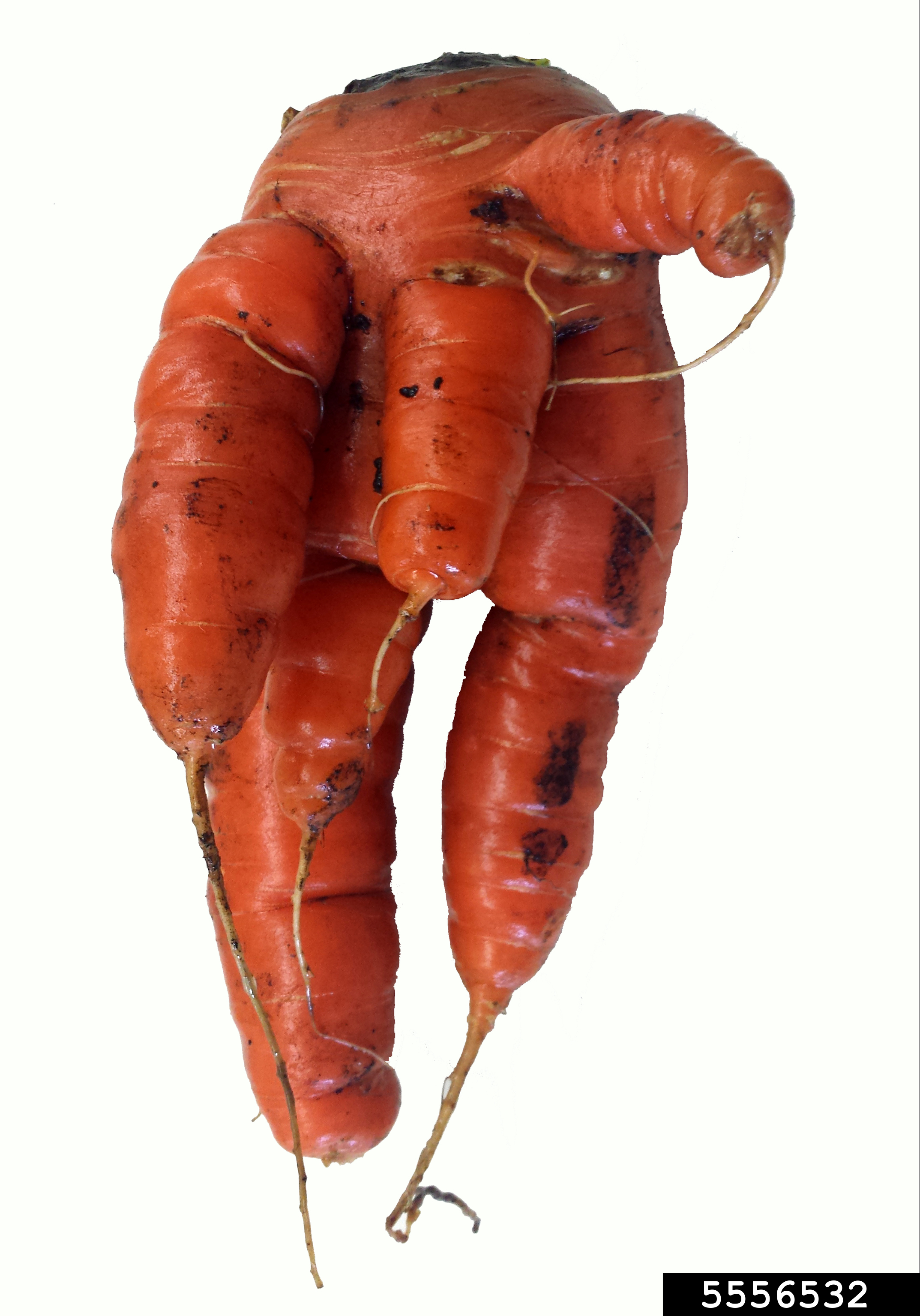
Photograph: Walter Peraza Padilla, National University of Costa Rica, Bugwood.org, CC BY 3.0 us, via Wikimedia Commons.
Comments