
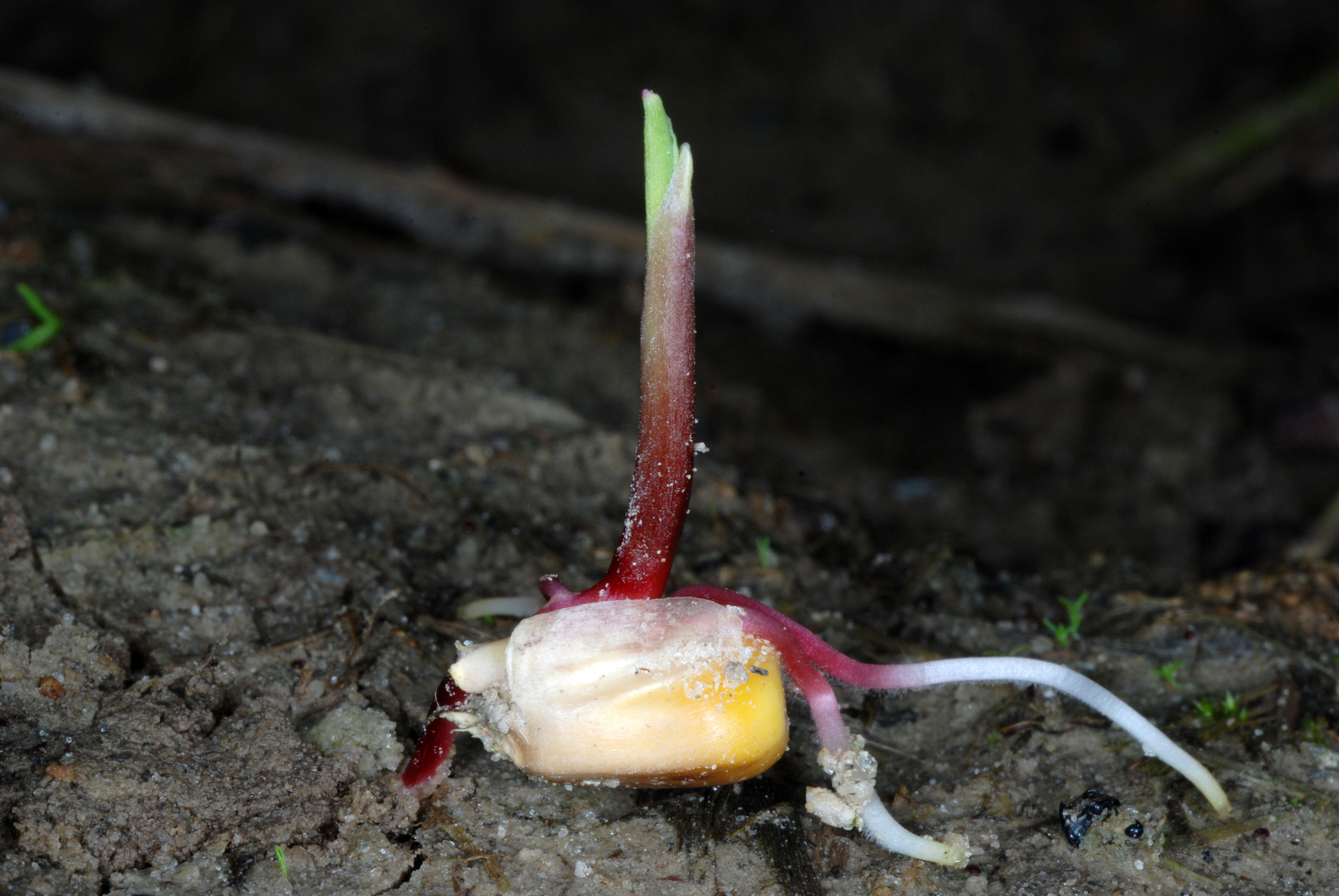
A maize root sitting in soil is not a quiet thing. It leaks a steady stream of chemicals, some of them defensive compounds meant to fend off insects and microbes. One of those defenses is a class of molecules called benzoxazinoids. You would expect a plant's chemical armor to keep pests away. For at least one pest, it does the opposite.
Researchers at Zhejiang University and collaborators in China, Japan, the Netherlands, and Switzerland found that Meloidogyne incognita, the southern root-knot nematode, uses maize's own benzoxazinoids as a homing beacon. The work, led by Zhenwei Wu and colleagues, appeared in Nature Plants. Root-knot nematodes are among the most damaging soil pests in agriculture. A microscopic worm that can read a plant's chemistry to locate it is bad news for any crop.
A defense chemical that backfires
The team focused on one benzoxazinoid breakdown product, 6-methoxy-benzoxazolin-2-one. In their experiments this compound did two things you would not want a defense to do. It made nematode infection worse, and it actively pulled the worms toward the roots. So a molecule the maize plant produces to protect itself ends up advertising its exact location.
There was a catch that turned out to be the whole story. The attraction only happened when soil was present. Take away the soil matrix and run the same test in a clean dish, and the effect vanished. That pointed to something living in the dirt doing the actual work.
The bacteria are the messengers
What the benzoxazinoid does is reshape the community of bacteria living around the root, the rhizosphere. The compound shifts which microbes are abundant and which are rare. Those altered bacterial communities then release their own volatile chemicals, including methyl ketones and a compound called 2-phenylethanol. It is these bacterial volatiles, not the plant chemical directly, that the nematodes actually smell and follow.
The researchers traced how the worms detect the signal down to specific genes. Three chemosensory genes in the nematode, named Mi-odr-1, Mi-odr-7, and Mi-gpa-6, are involved in picking up the volatile cues. So the full chain runs from a maize defense compound, to a rearranged bacterial community, to bacterial odors, to nematode sensory genes, and finally to a worm crawling toward a root it has never touched. The plant, its microbes, and the pest are all part of one conversation, and the pest has learned to eavesdrop.
That framing matters because plant-microbe interactions are usually cast as a defense system. Beneficial soil bacteria are often recruited by root chemicals to help the plant. Here the same kind of chemistry gets hijacked. The distinction between a plant summoning helpers and a plant unwittingly summoning attackers turns out to depend on who is listening in the soil.
What this does and does not tell us
This is mechanism worked out in a controlled system, with maize and one nematode species. Whether other crops and other benzoxazinoid compounds behave the same way in a working field, with its messier and more variable microbiome, is not something a single study can settle. The genes identified in the nematode are implicated in detecting the cues, but the paper describes the sensing pathway rather than mapping every step of it. And knowing that certain bacterial volatiles attract the worm does not yet mean anyone can flip that knowledge into a practical control method.
Still, the direction is worth noticing. Benzoxazinoids have been studied for years as a route to more pest-resistant maize, on the assumption that more defense chemical means better protection. This result complicates that assumption. If a defensive metabolite can be co-opted into a beacon through the soil microbiome, then breeding for higher levels of it might, under some conditions, make a crop easier for nematodes to find. The soil is not a neutral background. It is an active third party, and any strategy that ignores it is only seeing part of the field.
Wu, Z. et al. "Root-knot nematode Meloidogyne incognita uses secondary-metabolite-mediated soil microbiome shifts to locate host plants." Nature Plants, 2026. doi.org/10.1038/s41477-025-02205-4
PubMed PMID: 41554884.
Photograph: Douglas Goldman, CC BY-SA 4.0, via Wikimedia Commons.
Comments