
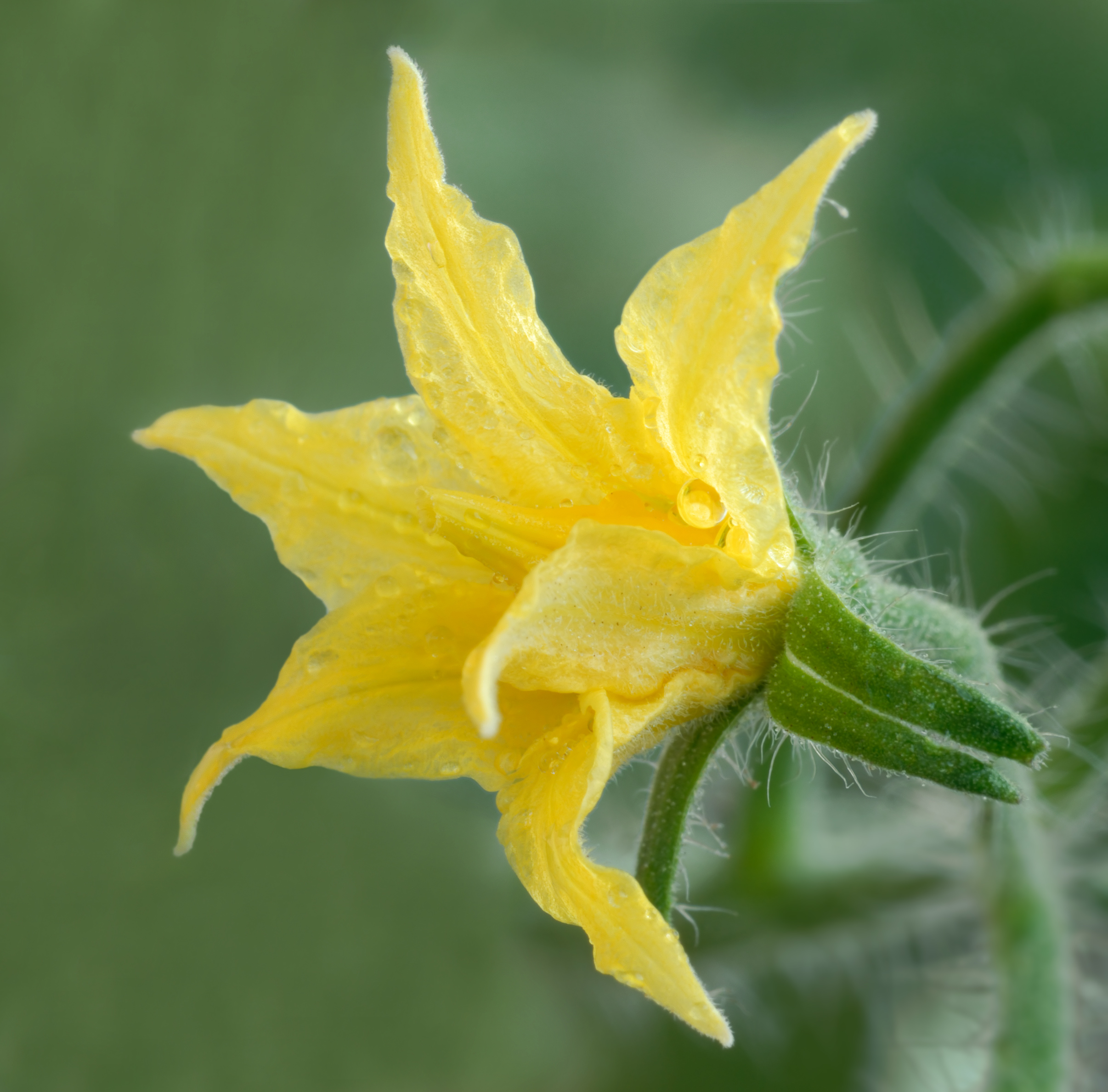
Making a hybrid tomato is fussy, hands-on work. A breeder holds a flower, tweezes out the immature male parts before they can shed pollen, then dabs pollen from a second plant onto the sticky stigma at just the right moment. Do this a few thousand times a season and you start to understand why hybrid seed is expensive and why some crops rarely get bred this way at all. The stigma, the part that needs the pollen, often sits tucked down inside a cone of fused anthers where neither a person nor a machine can easily reach it.
A team at the Chinese Academy of Sciences decided the problem was partly the flower. If a robot cannot work with the tomato bloom as it is, then change the bloom. In a paper published in Cell in August 2025, the group describes a strategy it calls GEAIR, short for genome editing plus artificial-intelligence-based robots. They edited tomatoes to produce flowers with the stigma sticking out where a camera can see it, and they built a robot that recognizes those flowers and pollinates them on its own.
Rebuilding the flower
The first job was genetic. Using CRISPR, the researchers knocked out genes so the plants made no viable pollen of their own, which removes the need to physically remove the male parts before crossing. In the same lines they pushed the stigma to grow past the anther cone so it stands exposed at the tip of the flower. A recessed stigma becomes an exserted one. That single change turns a closed, hard-to-reach target into something a machine can spot and touch.
Then came the robot. The team trained a vision system to pick out the protruding stigmas on a moving plant and guide a mobile arm to deposit pollen on them. In their trials the machine set fruit and seed at rates comparable to a person doing the same crosses by hand. The point is not that a robot pollinates faster than a human on any single flower. It is that the robot can keep going, and that a job which used to demand skilled labor becomes something you can run at scale.
Faster varieties, and not just tomatoes
The breeders paired the automated crossing with speed breeding, a set of tricks such as long light hours that push plants through generations quickly. On top of that they used de novo domestication, editing a handful of genes in a wild or semi-wild relative to give it the traits of a crop plant while keeping the hardiness of its ancestor. Combined, these let the group move stress tolerance and flavor into new lines in far less time than conventional breeding takes.
To show the idea was not a one-off quirk of tomatoes, the team edited soybean. Multiplex editing there produced the same combination: male-sterile plants with exserted stigmas, the flower shape a robot can handle. Soybean is largely self-pollinating and notoriously awkward to cross, so making it friendlier to machine pollination could matter for a crop that feeds much of the world's livestock and a good share of its people.
What the study can't say yet
This is a proof of concept, and it reads like one. The robotic pollination was demonstrated under controlled conditions, not across muddy acres of a working farm, and a greenhouse rig is a long way from a system a seed company would trust with a commercial crop. The soybean result showed the flower could be reshaped, but the paper does not claim a full robotic soybean breeding pipeline exists today.
There is also the regulatory reality. These plants are gene-edited, and the rules for growing and selling edited crops differ sharply from one country to the next. A method that works beautifully in a Beijing lab still has to clear whatever approvals apply wherever a breeder wants to use it. And every trait the robot relies on, from the exposed stigma to the engineered sterility, has to hold up in the field without dragging down yield or quality in some way the greenhouse never revealed.
Still, the reframing is the interesting part. Most agricultural robotics tries to build a machine clever enough to cope with plants as they are. Here the researchers did the opposite. They treated the crop and the machine as one system to be designed together, and when the flower would not cooperate with the robot, they redesigned the flower. If that co-design idea spreads, the crops of the next few decades may be shaped as much by what a camera can see as by what a farmer can taste.
Xie Y et al. "Engineering crop flower morphology facilitates robotization of cross-pollination and speed breeding." Cell, 2025. doi.org/10.1016/j.cell.2025.07.028
PubMed PMID: 40795858.
Photograph: André Karwath, CC BY-SA 2.5, via Wikimedia Commons.
Comments