Here is a puzzle that has bothered agricultural scientists for years. Insects pollinate about 75 percent of the crops we grow, and that work underpins roughly 35 percent of the world's food production. Over the same decades, report after report has documented wild pollinators in decline. You would expect the two facts to collide in the form of falling harvests. For the most part, they have not. A study published this week in PNAS finally puts numbers on why.
A team led by Catarina Siopa pulled together a global dataset built on a simple, slightly tedious experiment repeated thousands of times: hand-deliver extra pollen to a crop flower, then see whether it produces more fruit or seed than a flower left to nature. If the supplemented flower does better, the crop was "pollination limited." The gap between what pollinators provide and what the plant could achieve is the shortfall. The researchers gathered 790 of these effect sizes spanning 86 different crops, then tracked how the shortfall has changed from 1950 to today.
The gap is real, but it is closing
Averaged across everything, pollination limitation runs about 36 percent. That is not trivial. It means a typical pollinator-dependent crop is leaving a meaningful chunk of potential yield on the table for want of enough pollen delivery. So the shortfall exists, and it is widespread.
The surprise is the trend. Between 1950 and the 2010s, pollination limitation dropped by roughly half. Whatever else has gone wrong for bees and other pollinators in that period, the practical shortfall in crop fields has been shrinking, not growing. The paper's central question was whether that decline could be explained, and the answer points squarely at management.
Managed bees are carrying the load
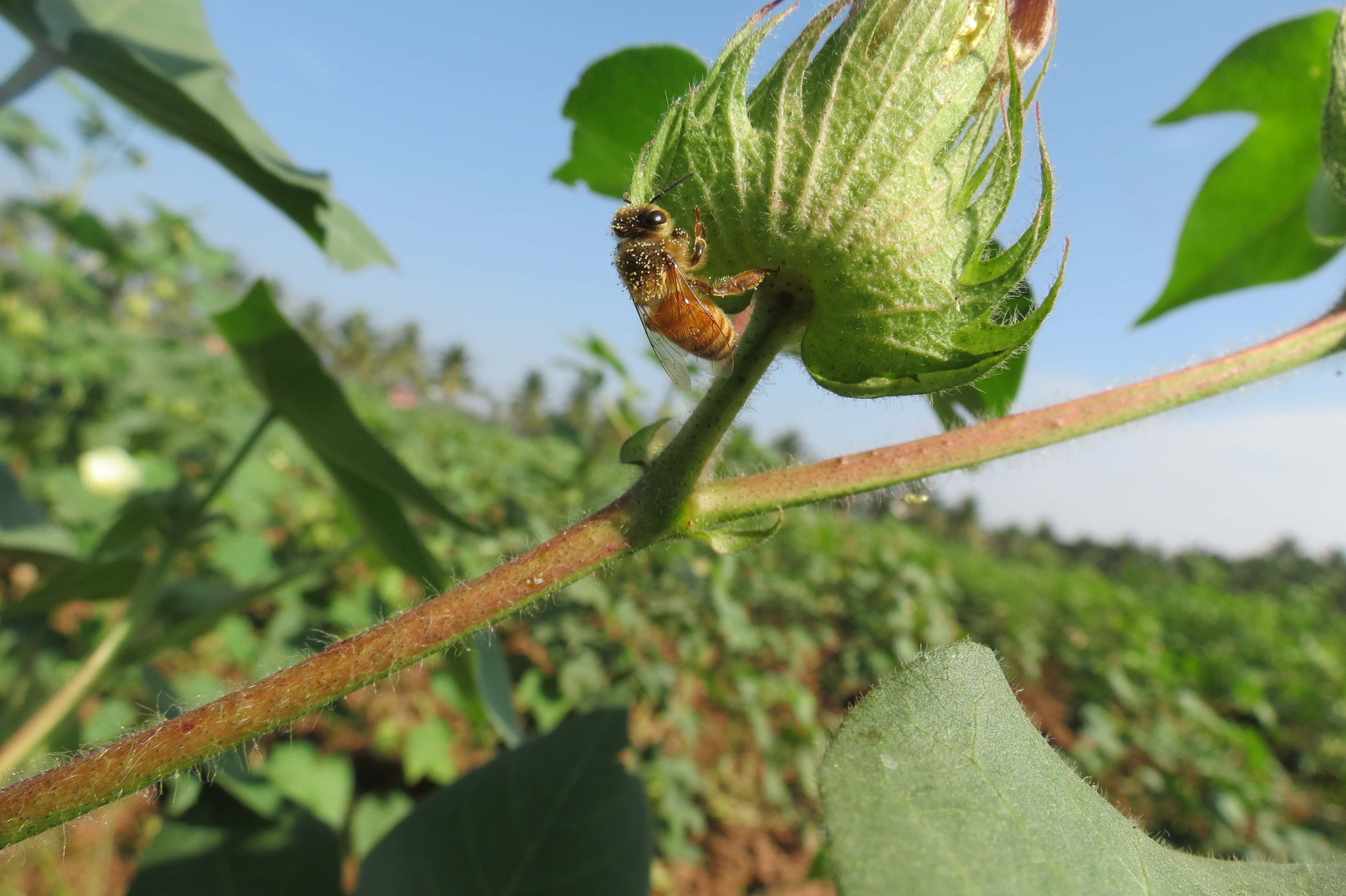
When the authors split the data by whether farmers deployed managed pollinators, usually honeybee colonies trucked in during bloom, a clear pattern emerged. Fields with managed pollinators showed lower pollination limitation than fields without them. More striking, the supplemented fields kept improving over time, while fields relying on whatever pollinators happened to show up stayed flat. The steady, decades-long decline in the shortfall is essentially a managed-pollinator story.
A second factor helped too. Crops with a greater capacity for autogamy, the ability to set fruit using their own pollen without an insect intermediary, tended to have lower limitation. That hints at a breeding lever. Selecting for self-compatibility could buffer some crops against pollinator swings, a point the authors flag as worth pursuing.
Put together, the picture is one of a food system that has, so far, engineered its way around a biodiversity problem. As wild pollinators thinned out, commercial beekeeping and crop breeding quietly absorbed the shock.
What the data cannot promise
This is where caution is warranted. The study measures pollination limitation, not the health of wild pollinator populations, and it does not claim the two are unrelated. It shows that managed bees have masked the consequences of wild decline in crop yields. That is not the same as saying the decline stopped mattering. Leaning on a handful of managed species concentrates risk. Honeybee colonies have their own vulnerabilities, from disease to transport stress, and a system propped up by one workhorse pollinator is more fragile than it looks.
The analysis is also a synthesis of many separate field experiments, gathered across different crops, regions, and eras, so it carries the usual limits of meta-analysis. Data are patchier for some crops than others, and a global average smooths over places where local shortfalls remain severe. The authors are explicit that the reassuring trend does not license complacency.
Their recommendation is to diversify rather than double down. Conserving wild pollinators, managing alternative pollinator species beyond the honeybee, and breeding for self-pollination where it fits would all spread the risk. The comforting finding, that crop pollination has held up better than the headlines suggested, comes with a quiet condition attached. It held up because someone kept managing it. The moment that management falters, the shortfall the numbers say we escaped could come back.
Siopa, C. et al. "Global decline in pollination limitation of pollinator-dependent crops." Proceedings of the National Academy of Sciences, 2026. doi.org/10.1073/pnas.2533418123
PubMed PMID: 42296365.
Photograph: Svchandran88, CC BY-SA 4.0, via Wikimedia Commons.
Comments