The standard recipe for a high-yielding forage field is simple and a little brutal. Sow one fast-growing grass, pour on nitrogen fertilizer, cut, repeat. It works. It also leaks nitrogen into water and air, costs money, and leaves the field dependent on a factory-made input. A new study in Science tested a different recipe across three continents and found that variety, not fertilizer, did more of the heavy lifting.
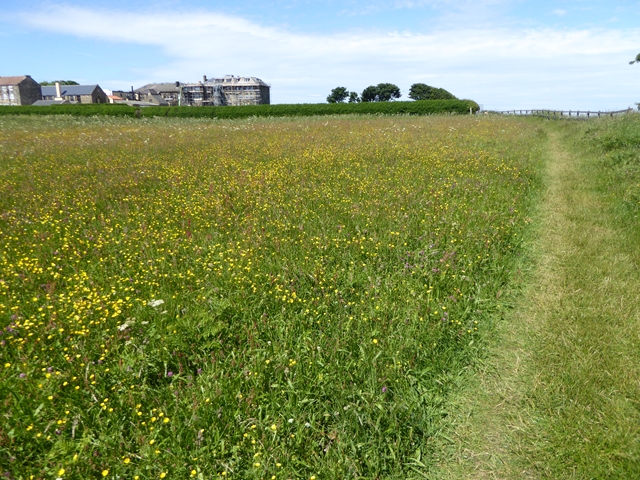
The experiment is called LegacyNet, and it ran at 26 sites spread across a wide climatic range. At each site the team, led by James O'Malley, sowed grasslands that varied in how many species they contained, drawing from a pool of six high-yielding forage plants: grasses, legumes such as clovers, and herbs. These mixtures were managed under moderate nitrogen inputs. Then the researchers compared them against two setups that farmers actually use: a grass monoculture given more nitrogen fertilizer, and a simpler two-species grass-legume stand.
The mixtures won on yield
Across the network, the multispecies mixtures out-yielded both benchmarks. That includes the grass monoculture that was receiving a bigger dose of fertilizer. So the diverse plots produced more forage while drawing on less synthetic nitrogen. For a system usually framed as a trade-off between output and inputs, getting more of one with less of the other is the interesting part.
The reason has less to do with any single plant and more with how the plants worked on each other. The authors traced the high yields to positive interactions between functional groups. Grass and legume combinations pulled their weight, and so did legume and herb combinations. Legumes host bacteria that pull nitrogen straight out of the air and fix it in the soil, which helps explain how a field can be fed less fertilizer and still grow more. The mixtures were not just a collection of good plants sitting side by side. They were feeding off each other.
Warmer sites, bigger payoff
The climatic spread of the 26 sites let the team ask whether the benefit held up as conditions changed. It did, and it sharpened. At warmer sites, the yield advantage of legume-containing mixtures over the fertilized grass monoculture grew larger. That points in a useful direction. If the places where forage is grown keep heating up, the diverse-mixture approach looks less like a niche organic tactic and more like a practical hedge.
None of this requires exotic species or new technology. The six plants are ones breeders already use. What the study changes is the design question. Instead of asking which single cultivar yields most under heavy feeding, it asks which combination of species produces the most while leaning on natural processes to supply nitrogen.
What the trial does not settle
A few things are worth keeping in view. This was a controlled agronomic experiment with sown mixtures managed on research protocols, not a survey of working farms, so translating the numbers to a commercial operation with its own soils, machinery, and markets takes more work. Multispecies stands can also be fiddlier to establish and manage than a single grass, and the paper's framing is about better mixture design rather than a claim that diversity is free. The results come from a defined set of six forage species, so they do not automatically extend to every crop or grassland type. And forage yield is one measure among several a farmer weighs, alongside forage quality, persistence over years, and the economics of buying less fertilizer.
Still, the core finding is hard to wave away. Sowing more kinds of plants, and choosing them so their strengths combine, produced more forage from less nitrogen at sites scattered across very different climates. The advantage was largest where it may matter most, in the warmth that more grasslands are heading toward. The monoculture-plus-fertilizer habit has been the default for good reasons of simplicity. This work suggests the default is beatable, and that the tool for beating it is already growing in the field next door.
O'Malley, J. et al. "Multispecies grasslands produce more yield from lower nitrogen inputs across a climatic gradient." Science, 2025. doi.org/10.1126/science.ady0764
PubMed PMID: 41343604.
Photograph: Oliver Dixon, CC BY-SA 2.0, via Wikimedia Commons.
Comments