

Watch a chameleon sleep and its skin does something odd. The color pulses, brightening and dimming on a cycle that repeats roughly every minute. It looks like a quirk of reptile physiology. A new study says it is a window onto something much older: a slow rhythm that runs through the sleeping brain of animals separated by more than 300 million years of evolution.
The work, published in Nature Neuroscience, comes from a team led by Antoine Bergel and Paul-Antoine Libourel, working across labs in France, Switzerland, Germany and the United States. They set out to ask whether an infraslow rhythm, meaning oscillations far below the familiar frequencies of brain waves, is a shared feature of sleep rather than a curiosity of one species.
Seven lizards, plus humans, rats and pigeons
The researchers recorded brain and body activity in seven lizard species. They compared those recordings against data from humans, rats and pigeons. In every species they found the same thing: a slow rhythm during sleep, cycling on the order of once a minute, well beneath the pace of ordinary sleep spindles or slow-wave activity.
What makes the result more than a pattern-matching exercise is how tightly the rhythm was tied to the rest of the body. In lizards, the infraslow oscillation tracked eye movements, muscle tone, and heart and breathing rate. The whole animal seemed to swing gently in step with it. The chameleon's pulsing skin brightness turned out to follow the same beat, which is a strange and vivid readout of a brain process you would otherwise never see from the outside.
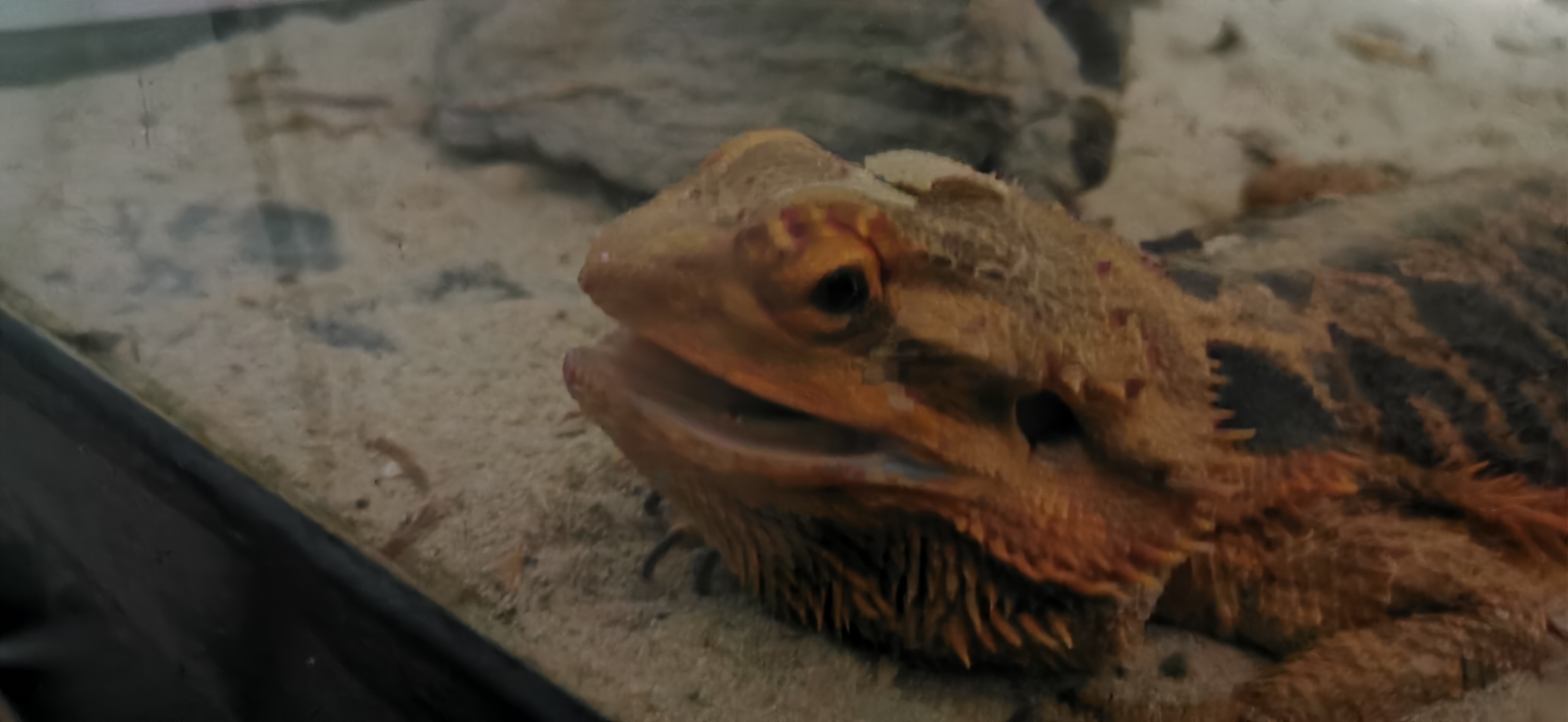
Then there was blood. In bearded dragons, and in mice during non-rapid-eye-movement sleep, the team measured pulsatile changes in the volume of blood moving through the brain that rose and fell with the rhythm. That detail matters, because pulsing cerebrovascular flow during sleep has been linked in mammals to the clearance of waste from brain tissue. Seeing the same coupling in a reptile hints that the machinery is old.
Why an old rhythm unsettles the sleep-stage story
For decades, sleep has been carved into stages, most famously REM and non-REM, and much of the field's thinking about the evolution of sleep has hung on when those stages appeared. The infraslow rhythm cuts across that framing. It shows up in animals whether or not they have the tidy sleep architecture that mammals and birds are known for, and it links brain activity to breathing, circulation and movement in a way that does not respect the usual stage boundaries.
The authors argue the rhythm is conserved across amniotes, the branch of vertebrates that includes reptiles, birds and mammals. If a single slow oscillation organizes sleep this broadly, then some of what we call distinct sleep states may be later elaborations built on top of a shared, more fundamental process. That reframes an old question. Instead of asking when REM sleep evolved, you might ask what the infraslow rhythm is for, and why it has been kept around so long.
What the recordings can and cannot settle
This is a comparative study, and comparative studies buy breadth at the cost of depth. Finding the same rhythm in a lizard and a human does not prove the two are driven by identical mechanisms. It could reflect a shared inheritance, or it could reflect different systems converging on a similar tempo because the underlying constraints, like linking neural activity to breathing and blood flow, are similar everywhere. The paper documents the coupling without nailing down the cause.
The functional claims are also still open. The link between the rhythm and brain blood flow is suggestive, and the parallel to waste clearance is worth taking seriously, but this study measures correlations rather than testing what happens when you disrupt the rhythm. Nobody has yet shown that blocking it impairs sleep or its benefits.
Still, the reach of the finding is what lingers. A person, a pigeon and a bearded dragon do not obviously have much in common at bedtime. Underneath, according to this work, their brains may keep the same slow time.
Bergel, A. et al. "Sleep-dependent infraslow rhythms are evolutionarily conserved across reptiles and mammals." Nature Neuroscience, 2026. doi.org/10.1038/s41593-025-02159-y
PubMed PMID: 41461931.
Photograph: Fabulousfabs, CC BY-SA 4.0, via Wikimedia Commons.
Comments