
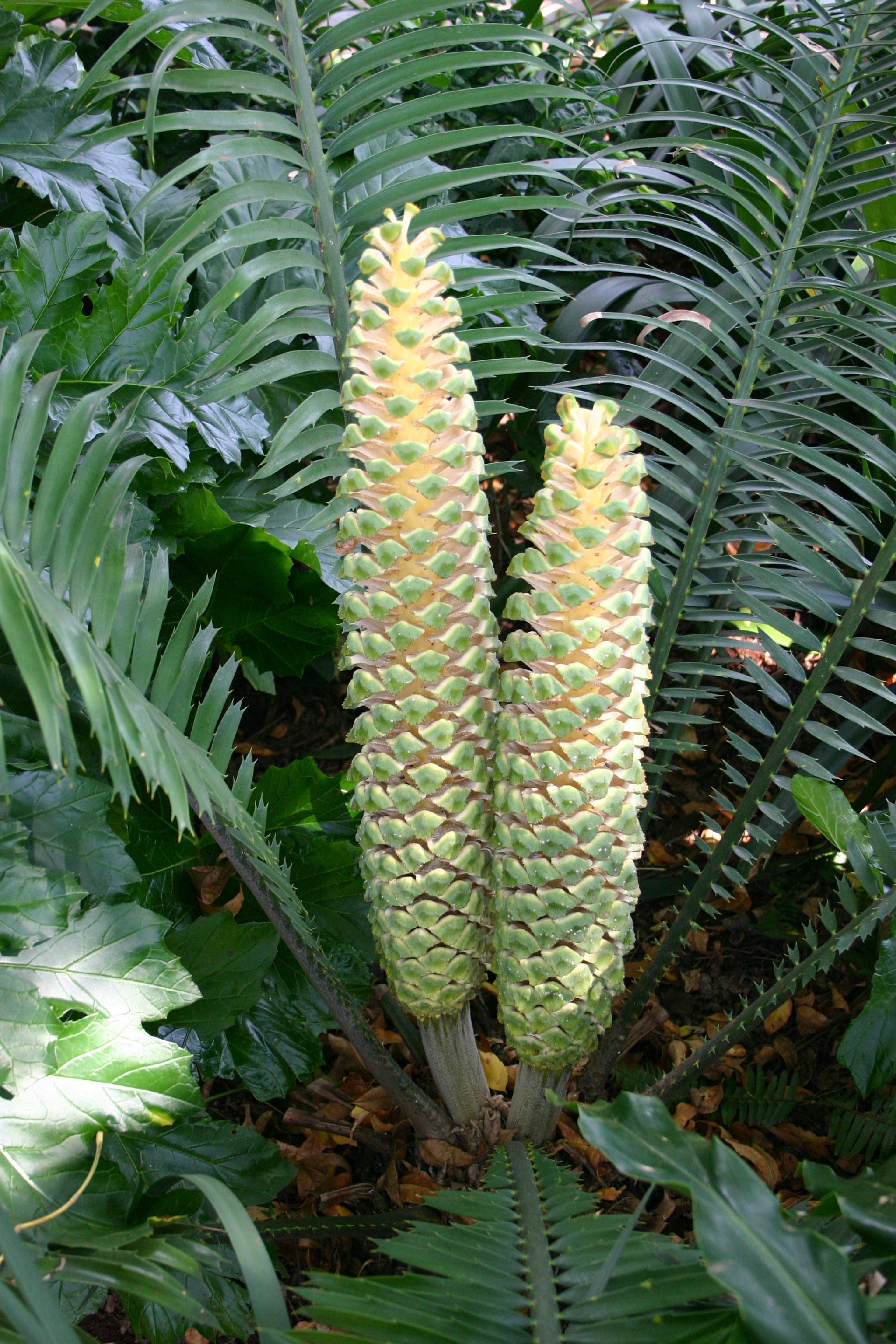
Point a thermal camera at a cycad cone at dusk and you will see it glowing. Not with light you can see, but with heat. The cone runs warmer than the air around it, and it does so on a schedule, night after night. For a long time nobody was sure what that warmth was for. A team led by researchers at Harvard, Yale, Columbia and collaborators in Belgium and Brazil now argues it is a message, and that the animals meant to receive it have been listening for a very long time.
Writing in Science, the group reports that plant-generated thermal infrared radiation works as a pollination signal. The cones heat themselves, radiate infrared, and beetles pick up that radiation and come. What makes the claim more than a nice correlation is that the researchers traced both halves of the exchange: how the plant makes the heat, and how the insect detects it.
How a cone builds its own warmth
The heat is not passive sunbathing. It comes from inside the plant. Mitochondrial adaptations in the reproductive structures generate warmth, and they do it in a circadian rhythm, so the cones brighten in the infrared at predictable times rather than whenever the sun happens to hit them. That rhythm matters. A signal that fires on a clock is one a partner can plan around.
The amount of heat produced was enough to matter biologically. According to the authors, the infrared radiating off the cones was sufficient to attract beetle pollinators on its own. So this is not a faint byproduct of metabolism that insects happen to notice. It is a beam, roughly speaking, aimed into a channel the beetles can read.
Beetles wired to feel it
On the receiving side, the researchers looked inside beetle antennae and found neurons that switch on in response to infrared. Those neurons carry thermosensitive ion channels, the molecular gates that open when temperature changes. And the tuning was not generic. The channels were structurally matched to the specific warmth the host plants produce. The plant heats to a certain range; the beetle's sensors are built to respond to that range. Sender and receiver fit together.
That fit is the part that hints at deep history. When two lineages carry traits shaped so precisely to each other, it usually means they have been interacting for a long time. The comparative analysis pushed that logic further. Infrared, the authors conclude, is among the earliest pollination signals, older than the color cues we tend to associate with flowers. Their data point to a shift over deep time, from infrared-based signaling toward the color-dominated signaling that flowering plants lean on today.
If that reading holds, it reframes how a familiar partnership began. Pollination links plants and animals across most terrestrial ecosystems, and the usual story starts with scent and color. This work slots an older sense underneath: heat, felt rather than seen, doing the recruiting before petals took over the job.
What the study does not settle
A few things are worth keeping in mind. The core system here is thermogenic cone-bearing plants and their beetle visitors, so the findings speak most directly to that group rather than to pollination in general. Evolutionary claims about which signal came "first" rest on comparative reconstruction, which infers the past from living species and can shift as more lineages are sampled. And showing that infrared is sufficient to attract beetles does not rule out scent and other cues working alongside it in the wild. The strength of the paper is that it connects a physical output, plant heat, to a sensory input, infrared-tuned neurons, in the same interaction. That link is what turns "plants make heat" into "plants send a signal."
There is also something satisfying about where the heat comes from. The warmth is powered by mitochondria, the same organelles that run our own metabolism, repurposed here into a broadcasting station. A structure most of us think of as a cellular battery is, in these plants, a way to reach across a dark clearing and say: here, now.
Valencia-Montoya, W. A. et al. "Infrared radiation is an ancient pollination signal." Science, 2026. doi.org/10.1126/science.adz1728
PubMed PMID: 41379967.
Photograph: Rotational, Public domain, via Wikimedia Commons.
Comments