Microbiome research talks constantly about species interacting, and the word carries an implication of specificity: this bacterium inhibits that one, through some molecule evolved for the purpose. A group at Umea University tested the assumption at scale, growing each of 36 gut species in the spent medium of every other, and measuring what happened across 1,224 pairings.
Most interactions were inhibitory, which is the expected result. The unexpected part is what the inhibition consists of. Replenishing the used-up medium with fresh nutrients collapsed the number of inhibitory interactions more than eightfold, from 307 to 38. Almost all of what looked like antagonism was one species having eaten the food or acidified the water, not attacking anything.
Why it matters: If the dominant mechanism structuring gut communities is pH and nutrient depletion rather than targeted chemical warfare, then the levers for changing a microbiome are environmental rather than pharmacological. That is a different research programme from hunting for antibacterial metabolites.
How much of it is just acid
The pH result is the strongest claim in the paper and the easiest to state. Growth in a spent medium correlated with that medium's pH, and the authors report that it was possible to reasonably predict the growth effect of each strain in each spent medium based on the medium pH alone. One variable, ignoring every metabolite that species A might have secreted and every gene that species B might carry, accounts for most of the pattern.
Sensitivity is not uniform, which is what makes it ecologically interesting rather than merely a nuisance. The Bacteroidota, Fusobacteriota and Pseudomonadota were strongly affected by acidity; the Actinomycetota were largely indifferent. Adjusting spent media back to neutral turned most inhibitory pairs neutral, confirming the mechanism by removing it.
Classified in ecological terms, the interactions came out overwhelmingly one-sided. Amensalism, where one species is harmed and the other unaffected, accounted for 33.5 percent of pairings. Genuine mutual competition was 7.8 percent. Mutualism, both species benefiting, was 0.36 percent, which is four interactions out of more than a thousand.
The species that pushes back
One organism behaved unlike the rest. Veillonella parvula was promoted by the spent medium of 53 percent of the other strains, and it raises the pH of its surroundings rather than lowering it. Starting from pH 5 it lifted the medium by 0.85 units. Placed in acidic spent medium, it rescued the growth of Parabacteroides merdae, a strain that otherwise fails there, and it did the same inside assembled three-species communities containing acidifiers from different phyla.
The mechanism is not what you might guess. Ammonia release, the standard way bacteria alkalinize, was not significantly elevated. Veillonella ferments organic acids such as lactate for energy, so the likely explanation is subtraction rather than addition: it consumes the acids other species excrete. Guanine amplified the effect, lifting the pH by 1.8 units from a starting point of 5.
As Buyanbadrakh and colleagues note in Nature Communications, this species sits in more than half of human gut microbiomes while almost always making up under one percent of it. A rare organism that conditions the chemical environment for others is precisely the kind of thing abundance-based surveys are built to overlook.
The interaction that was not about food
A minority of positive interactions survived nutrient replenishment, which marks them as genuine exchange rather than an artefact of scarcity, and the team followed one to its mechanism. Clostridium perfringens promoted the growth of Mediterraneibacter gnavus, and proteomics on the beneficiary showed it downshifting its own nucleotide synthesis machinery while ramping up nucleotide salvage. Something in the medium was supplying building blocks it would otherwise have had to make.
Supplementing with free nucleobases, nucleosides, ribose or bulk nucleic acid reproduced none of the benefit, which ruled out the obvious answer. What worked was the particulate fraction. Ultracentrifugation pulled out vesicles averaging around 58 nanometres, and adding them back raised growth 1.4-fold, while the vesicle-free supernatant did nothing at all. Boiling the vesicles destroyed both their structure and the effect. The cargo is delivered in a package, not dissolved in the broth, which is why feeding the ingredients separately fails.
What the study can't say yet
Spent medium is not co-culture. Species were never grown together, so anything requiring physical contact, and any interaction where both partners change each other's behaviour in real time, is invisible by construction. The ecological labels are inferred from one-directional experiments rather than observed. The authors say so, and note that testing every community combination among 36 strains would require more than ten billion conditions.
Everything also happened in a rich laboratory medium, which supplies nutrients no gut provides and omits the complex carbohydrates that actually feed these organisms. The most consequential unknown is whether pH gradients of this size exist in a real intestine at all. Bacteria occupy distinct spatial niches, but the gut is also buffered, and the authors flag that it remains unresolved whether local acidification survives that buffering.
Quick questions
Does this mean gut bacteria don't produce antimicrobials? No. A handful of pairs stayed inhibitory after both nutrient replenishment and pH correction, which points at genuine inhibitory factors. They are the minority rather than the rule.
Why does a rare species matter? Because effect on a community is not proportional to abundance. A scarce organism that neutralizes acid can determine whether acid-sensitive species persist nearby.
What's the one-line takeaway? Across 1,224 pairings, most apparent antagonism between gut bacteria disappeared once nutrients were restored, and the medium's pH alone predicted most of what remained.
Buyanbadrakh et al. "Systematic profiling of growth interactions in human gut microbiome species." Nature Communications, 2026;17(1). doi.org/10.1038/s41467-026-76526-z
PubMed PMID: 42567864.
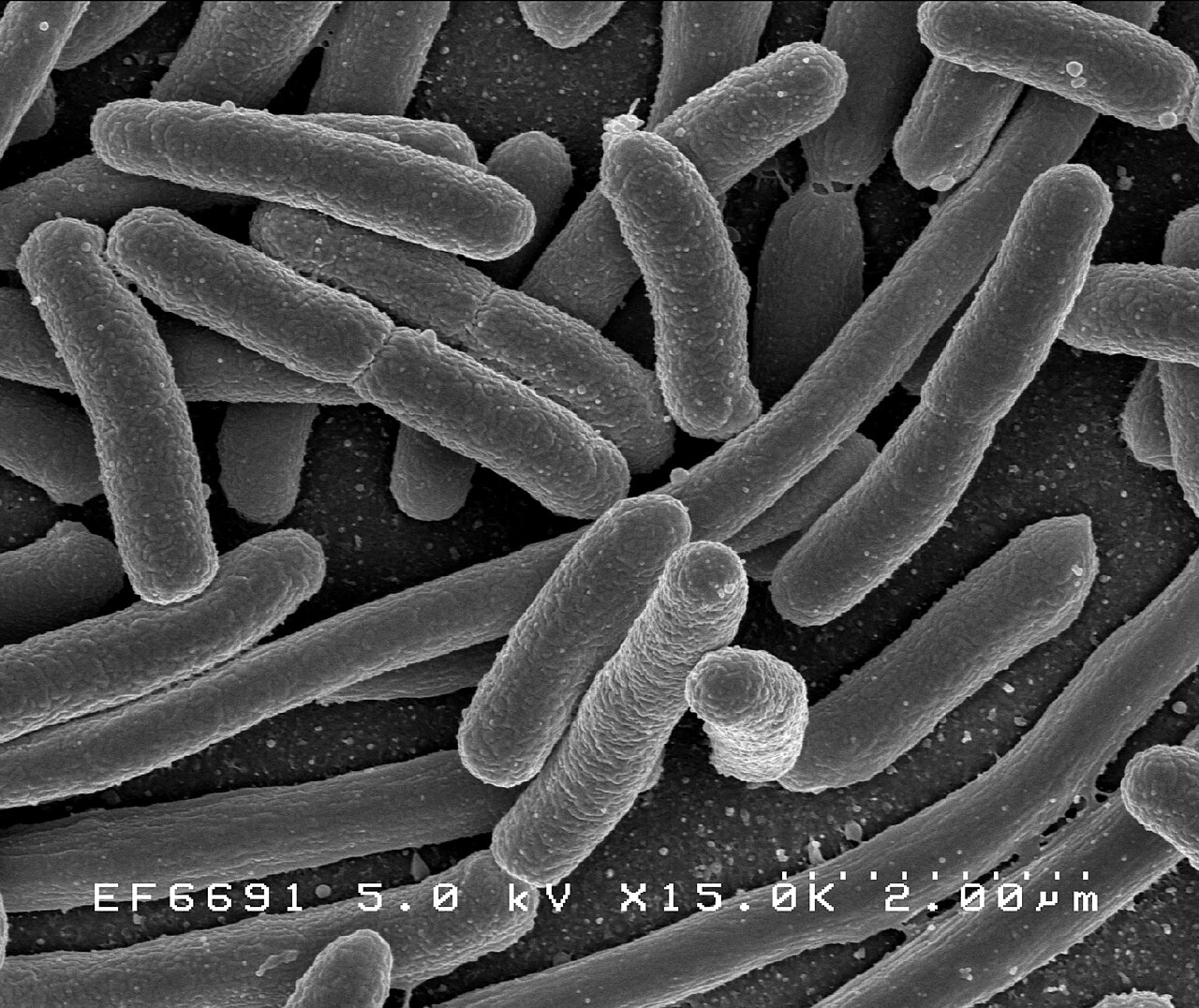
Image: Escherichia coli, scanning electron micrograph by NIAID, public domain, via Wikimedia Commons.
Comments