
For years, oncologists have been quietly bothered by a pattern buried in their own outcome data. Patients carrying more weight, measured by the blunt instrument of body mass index, have often responded better to immune checkpoint inhibitors than patients at a so-called normal weight. The observation is uncomfortable on its face. Obesity raises the risk of developing several of these cancers to begin with, and nothing about metabolic illness sounds like it ought to sharpen the immune system's aim. The pattern picked up a nickname, the obesity paradox, which was mostly a polite way of admitting that nobody could explain it.
A study published in Nature on 8 July offers an explanation that has surprisingly little to do with body fat and a great deal to do with what fattening diets build in the gut. Working through 12 different mouse diets chosen to span a range of obesity biology, the researchers found that the immunotherapy advantage did not track with how metabolically sick an animal was. It tracked with the microbial community that the animal's diet had assembled.
Why it matters: Checkpoint inhibitors transform outcomes for some cancer patients and do nothing at all for many others, and no one can reliably predict which group a given person falls into. If part of the answer lives in a diet-shaped bacterial community rather than in a patient's body weight, it is the kind of thing that can in principle be moved from one gut to another.
The work comes from Desharnais et al. at the Rosalind and Morris Goodman Cancer Institute at McGill University in Montreal, with colleagues at the research centre of the Centre hospitalier de l'Universite de Montreal. Rather than compare lean mice with obese mice, the standard and rather crude setup, the team built out a spectrum: a dozen diets producing different combinations of weight gain, metabolic damage and gut microbial composition. Then they measured how tumours in those animals responded to checkpoint blockade.
Twelve diets, one clean separation
That spread is what made the result legible. In a simple fat-versus-lean comparison, body weight, metabolic dysfunction and the microbiome all move together, so there is no way to tell which one is doing the work. Across twelve diets they come apart, and when they did, the metabolic markers stopped predicting anything useful. We find that obesity-associated ICI responses are poorly correlated with metabolic dysfunction and are instead dependent on the diet-gut axis, the authors write. What mattered was the diet and the bacteria it fed, not the damage the diet had done elsewhere in the body.
A community that can be moved
The obesogenic diets, the researchers report, promoted a gut microbial ecosystem that was robust, persistent and, more to the point, portable. Switching animals onto a different diet for a short stretch did not erase the benefit, because the established community restored sensitivity to checkpoint inhibitors anyway. So did faecal microbiota transplants, the transfer of gut contents from one animal into another, even when the donors were mice whose own tumours had not responded.
The team then went smaller. They took germ-free mice, animals raised with no microbiome at all, and colonised them with a single favourable species, Lactobacillus johnsonii. On its own, that was not the story. Paired with an obesogenic diet, the combination worked synergistically to drive tumour regression, and the researchers traced the effect to an enrichment of aromatic amino acid metabolites made by the microbes themselves. Diet and bacterium were not two competing explanations. They were two halves of one.
From human stool to mouse tumours
The last step reached toward people, carefully. The researchers transplanted stool from human donors into mice, and found that material from donors with a high body mass index enhanced checkpoint inhibitor efficacy compared with material from donors with a normal one. In a further test, an obesogenic diet restored sensitivity in mice that had received a transplant from a patient whose own cancer had not responded to treatment. That is a striking result, and it is worth being precise about what it actually is: human bacteria, mouse immune systems, mouse tumours.
What the study can't say yet
Nearly all of this is mouse work. Humans appear in it as stool donors, not as patients who were treated and followed, and nobody in the study changed their weight or their diet to see what happened to their cancer. The authors position the findings as insight into the epidemiological associations between body mass index and checkpoint inhibitor efficacy, and suggest that the synergy between diet and gut microbiota could be leveraged to improve outcomes. "Could" is doing real work in that sentence. Which bacteria matter most in a human gut, whether those aromatic amino acid metabolites carry the same weight in people, and whether any of it survives contact with a clinical trial are all still open questions.
Quick questions
Does this mean a higher body weight helps immunotherapy work? Not as advice, and not as a demonstrated cause in people. In these mice the benefit tracked the diet-shaped microbial community rather than the metabolic dysfunction that usually accompanies obesity.
Could someone simply take Lactobacillus johnsonii? The study does not support that. The bacterium promoted tumour regression in germ-free mice only in combination with an obesogenic diet, and a germ-free mouse is not a stand-in for a human gut.
What is the one-line takeaway? A puzzling link between body mass index and immunotherapy response looks, in mice, less like a story about body fat and more like a story about the bacterial community that certain diets build.
Desharnais et al. "Diet-microbiome synergy underlies obesity-associated immunotherapy efficacy." Nature, 2026. doi.org/10.1038/s41586-026-10750-x
PubMed PMID: 42420462.
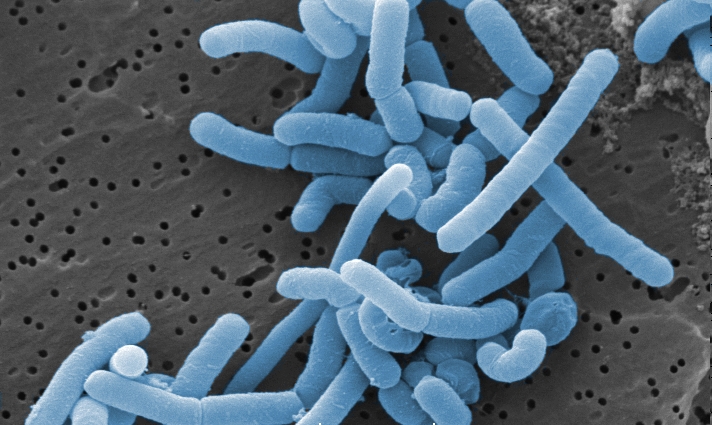
Image: Colourised scanning electron micrograph of Lactobacillus paracasei. Dr. Horst Neve, Max Rubner-Institut, CC BY-SA 3.0 DE, via Wikimedia Commons.
Comments