
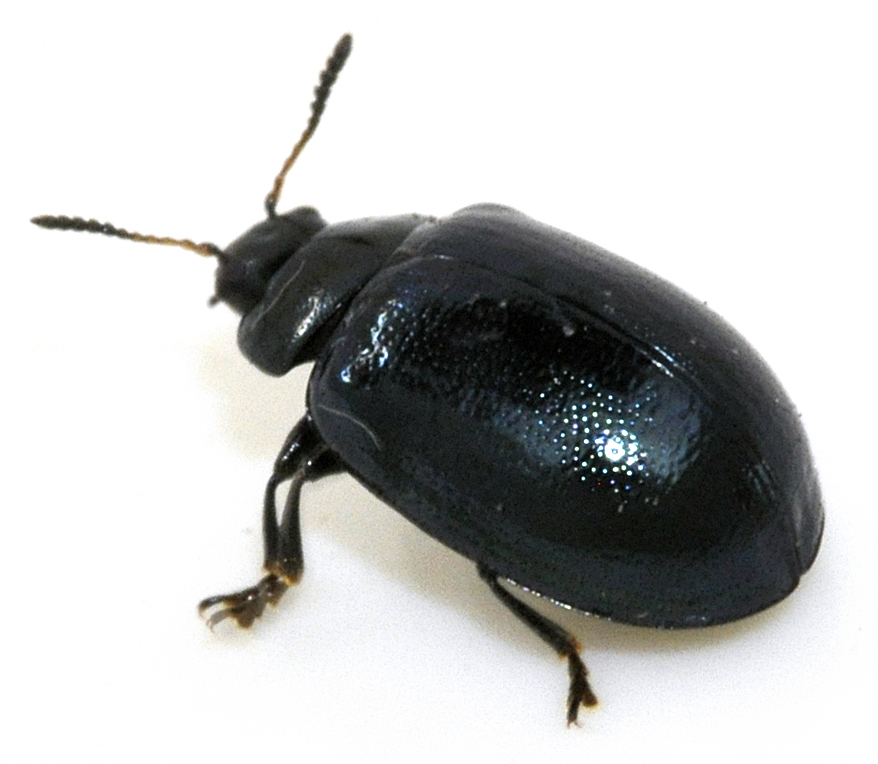
The willow leaf beetle Plagiodera versicolora lives a slightly contradictory life. The adults chew on tender new leaves, which are softer and more nutritious. But when a female is ready to lay eggs, she does something odd: she walks past the young growth and deposits them on older, tougher, mature leaves. Why put your offspring somewhere you would not choose to eat yourself?
A team led by Chong Li at Nature Communications reports that the beetle is not really the one making the call. A bacterium in its gut is. And the way that bacterium enforces its preference runs straight through the plant the beetle is standing on.
Take the bacteria away and the preference vanishes
The first clue was simple. When the researchers cleared out the beetles' gut microbiota, the mature-leaf egg-laying preference disappeared. Females stopped discriminating. Transplant the microbiota back in, and the behavior returned. That is a clean before-and-after: no microbes, no preference.
Narrowing it down, one species stood out. Levels of Pseudomonas putida in the gut tracked closely with how strongly a female favored mature leaves. More of this bacterium meant a stronger pull toward the old growth. It was not the whole community doing the work. It was mostly one member.
To close the loop, the team gave germ-free females P. putida on its own. That was enough to restore the mature-leaf preference in beetles that otherwise had no microbes at all. A single bacterial species could reinstate a behavior that shapes where the next generation begins its life.
Using the plant as a courier
The mechanism is where it gets strange. When a beetle feeds, the damage triggers a spike in indole-3-acetic acid, a plant growth hormone better known as auxin. That IAA surge helps the gut bacteria translocate out of the feeding sites and spread onto the new leaves. So the beetle's own chewing becomes a delivery service, moving P. putida from its gut onto fresh plant tissue.
There is a cost buried in that arrangement. The bacterial spread onto new leaves reduced the fitness of the F1 generation during larval feeding. In other words, larvae that ended up on the bacteria-laden new growth did worse. That helps explain the puzzle we started with. By steering egg-laying toward mature leaves, the system keeps the young away from tissue that the bacteria have already colonized.
On the beetle's side, the behavior traces back to a specific gene. Comparative transcriptomics pointed to a gene called takeout (TO1). Knock it down, and the mature-leaf preference collapses. Supplementing germ-free females with P. putida restored TO1 expression and brought the preference back. So the bacterium appears to act, at least in part, by tuning a host gene that governs the choice.
What this does and does not show
Put together, the pieces describe an insect-microbe-plant feedback loop: the beetle feeds, the plant responds with IAA, the bacteria ride that response onto new leaves, and the female's egg-laying shifts toward mature foliage where her larvae fare better. Each partner nudges the others.
Some caution is in order. This is one beetle species in a controlled setting, and behaviors that look tidy in the lab can be messier in a real willow canopy full of competing plants, predators, and weather. The correlation between P. putida abundance and preference is strong, but the full causal chain from a translocating bacterium to a firing takeout gene is not yet mapped molecule by molecule. And whether closely related leaf beetles run the same playbook is an open question.
Still, the study lands a pointed idea. We tend to picture animals choosing their nurseries. Here, much of the choosing was outsourced to a gut microbe that manipulates its host through the plant they both depend on. The beetle thinks it is picking a leaf. Its bacteria have already voted.
Li, C. et al. "Gut bacteria prime and reinforce mature leaf oviposition preference in beetles via plant mediated feedback." Nature Communications, 2026. doi.org/10.1038/s41467-026-73654-4
PubMed PMID: 42191716.
Photograph: Francisco Welter-Schultes, CC0, via Wikimedia Commons.
Comments