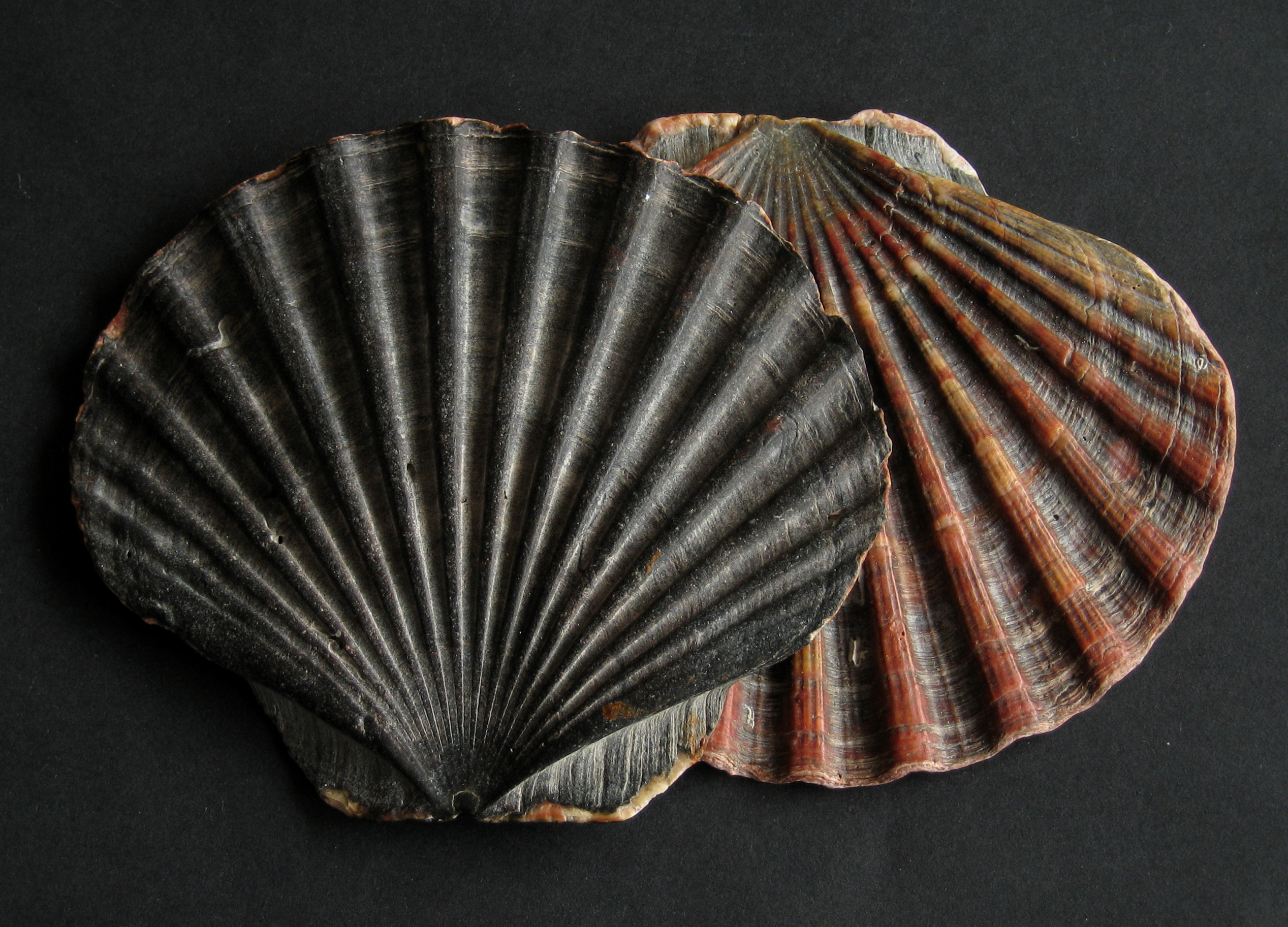
Most scallops are grazers and filter feeders that drift near the seafloor, snapping their shells to swim. The glass scallop, Catillopecten margaritatus, does something no other known scallop does. It carries a lawn of sulphur-oxidising bacteria on its gills and lets those microbes help feed it. A new chromosome-level genome, published in Nature Communications, lays out the genetic bargain behind that arrangement and traces how an ordinary scallop lineage ended up in one of the ocean's harshest neighbourhoods.
Chemosynthetic partnerships like this one are what make deep-sea vents and seeps livable for animals. Instead of relying on sunlight and the food chains it powers, the bacteria pull energy from hydrogen sulphide, a gas that would poison most animals. Tube worms and vent mussels are famous for keeping such microbes inside their tissues. The glass scallop keeps them outside, on the gill surface, which is why researchers call the relationship ectosymbiosis. Until now the genomic side of that outdoor arrangement in bivalves was largely a blank.
An old lineage that found a new job
The team assembled a genome built around 19 chromosomes, the same conserved set that common scallops carry. That shared architecture places the glass scallop firmly among familiar relatives rather than out on some strange evolutionary limb. But the timing is the surprise. Their evolutionary analyses put the split of this lineage back in the Early Devonian, hundreds of millions of years ago, well before the scallop took up its bacterial partners. In other words, the ancestor was a normal scallop long before it became a symbiotic one. The partnership was bolted onto an old body plan, not baked in from the start.
That framing matters because it lets biologists ask a specific question. What has to change in a genome for an animal to go from living alone to living with microbes? The glass scallop offers a natural experiment for exactly that transition.
What the deep sea rewrote
By combining the genome with gene-expression data and shell chemistry, the researchers pieced together a set of adaptations that read like a renovation for life in the dark. The animal has lost its vision, unsurprising where no light reaches. Its mantle, the tissue lining the shell, shows enhanced sensing, apparently compensating for the missing eyes. Shell calcification is reduced, which fits the "glass" nickname and the chemistry of deep water.
The symbiosis leaves its own marks. The scallop carries immune mechanisms that recognise its bacterial tenants and accommodate them rather than attacking, a delicate trick since the same immune system has to fend off genuine threats. It also has robust machinery for detoxifying sulphide, the very compound its microbes depend on. And the host provisions metabolites to the bacteria, feeding the partners that in turn feed it. The exchange runs both ways.
One more detail complicates the tidy picture of a scallop that outsourced its diet. The genome shows the animal kept its predatory feeding ability. That makes it a mixotroph, drawing on both its bacterial partners and captured food. It did not abandon one lifestyle for another. It stacked them.
Reading the fine print
This is a genome paper, so its strengths and limits track that. The adaptations are inferred from gene content, expression patterns, and shell composition, which is a solid way to generate hypotheses but not the same as watching the biology work in a live animal. Deep-sea species are notoriously hard to keep and study, so functional tests of, say, how the immune system tolerates the symbionts will take separate effort. The evolutionary dates rest on molecular clock analyses, which carry their own uncertainty. And the findings describe one species; how far they generalise to other chemosynthetic bivalves is an open question the authors frame as future work.
What the genome does provide is a reference point. It broadens the known range of symbiotic strategies in bivalves and, more usefully, gives researchers a concrete genomic framework for testing how animals cross the line from going it alone to hosting microbes. The glass scallop is one small window into a shift that has happened again and again across the tree of life, usually without leaving a record this legible.
Lin, Y. et al. "Glass scallop genome reveals key adaptations to deep-sea environments and ectosymbiosis." Nature Communications, 2026. doi.org/10.1038/s41467-026-71169-6
PubMed PMID: 41922329.
Photograph: Manfred Heyde, CC BY-SA 3.0, via Wikimedia Commons.
Comments