
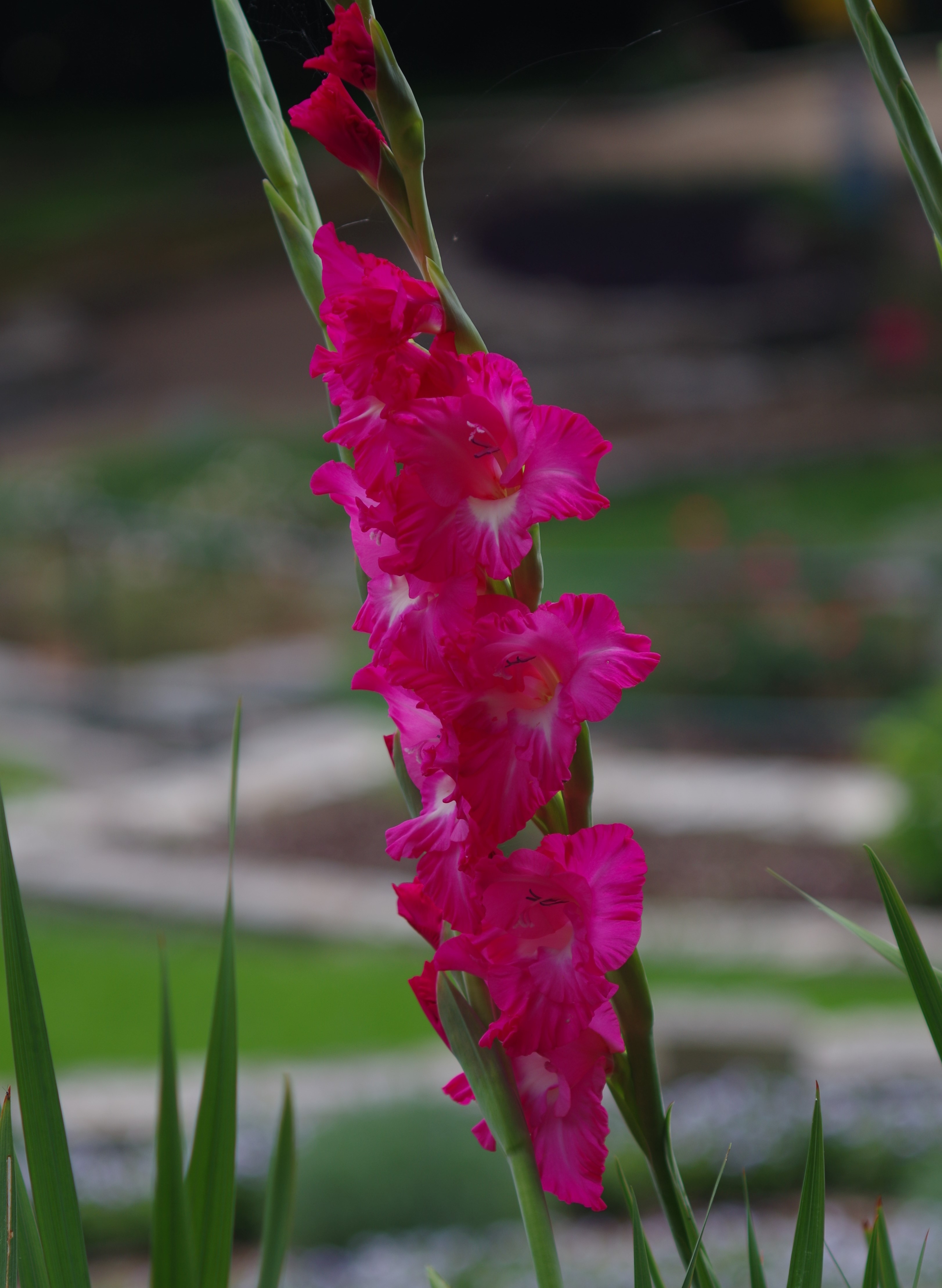
Gardeners who grow gladioli, garlic, or onions know these plants store next season in an underground swelling. The bulb or corm sits dormant, waiting. Slice one in half and you might expect it to rot. Instead, in a new study, the cut pieces sprouted faster than intact ones. Injury, it turns out, is a wake-up call.
A team led by Jingru Li, publishing in Nature Plants, set out to explain why. The plants they worked with are geophytes, species that survive dry or cold seasons underground and then flush new growth from buds tucked on the corm. That switch from sleeping bud to growing shoot is what horticulturists call the bud-growth transition. The researchers found that wounding dramatically speeds it up, not only in gladiolus but also in Allium sativum (garlic) and Allium cepa (onion).
A wound sends a hormone, and the hormone sends sugar
The signal starts with jasmonic acid, a hormone plants release when tissue is damaged. Cutting the gladiolus corm caused jasmonic acid to build up at the injury. That accumulation did something specific: it pushed sucrose toward the dormant buds through the apoplastic pathway, the route that moves sugar through the spaces around cells rather than cell-to-cell.
Sugar is fuel. A bud that has been idle needs energy to start dividing cells and building a shoot. By redirecting sucrose to the bud, the wound essentially handed it the resources to grow. The shoot apical meristem, the tiny dome of cells at the growing tip, got both the raw material and the go-ahead.
Between the hormone and the sugar sits a gene the team pinned down as central to the whole response. It is a zinc finger transcription factor with the somewhat unwieldy name ZINC FINGER OF ARABIDOPSIS THALIANA 11, or GhZAT11. It responds to wounding and to jasmonic acid, and once active it turns on two downstream genes. One, GhSUT4, is a sucrose transporter that moves sugar into the bud. The other, GhCYCD2;1, is a cyclin that drives cell division. So the same factor coordinates the delivery and the spending.
From lab curiosity to something you could measure in a field
What makes this more than a molecular story is that the three players, ZAT11, SUT4, and CYCD2;1, can serve as markers. Their activity tracks wound-induced bud growth across geophytes, which means a grower or breeder could in principle read them to tell whether a bud is committed to sprouting. For crops like garlic and onion, where uniform, well-timed sprouting matters for planting and storage, that is a practical handle on a process that has been hard to observe directly.
The finding also reframes jasmonic acid. It is best known as a defense hormone, the chemical that ramps up when a caterpillar chews a leaf or a pathogen breaks in. Here it does something constructive. The same damage signal that mounts a defense also reallocates resources and pushes a dormant bud into growth. Injury and regrowth are linked through one hormone doing double duty.
What the work does not yet settle
This is a mechanism worked out in specific plants under specific conditions, and a few things stay open. The study establishes the jasmonic-acid-to-sugar-to-GhZAT11 chain, but the fine timing of how these steps line up in an intact corm versus a cut one is not fully mapped. Whether the same module governs sprouting when there is no wound, during a normal seasonal transition, is a separate question the abstract does not resolve. And translating markers into a reliable field tool for garlic or onion crops would take testing beyond what a mechanistic paper covers.
Still, the core observation is clean and a little counterintuitive. Damage that looks like harm can be the thing that starts new growth. For plants that spend part of every year hidden underground, waiting for a reason to wake, a cut is one such reason.
Li, J. et al. "GhZAT11 triggers wound-activated bud growth by accelerating sugar transport and cell division." Nature Plants, 2026. doi.org/10.1038/s41477-025-02206-3
PubMed PMID: 41526693.
Photograph: Leonard (Lenny) Blumberg, CC BY-SA 4.0, via Wikimedia Commons.
Comments