
Chop a hole in a forest and something happens to the trees that stay behind. The ones left standing along the new border get hit by wind they never used to feel, sun that dries out the soil, and heat that the canopy once buffered. Ecologists have known about this "edge effect" for decades. What they have argued about is whether, added up across every fragmented forest on Earth, it makes a real dent in how much carbon forests hold. A new study says it does, and the number is large.
Researchers led by Gayoung Yang at ETH Zurich examined eight million forested locations worldwide to measure how biomass changes as you move from the deep interior of a forest out toward its ragged edge. The reason this matters at a global scale is a statistic that is easy to skim past: roughly 70 percent of the world's forest area now sits within one kilometer of an edge. Very little forest is truly interior anymore. Most of it lives close to a road, a field, a pasture, or a clear-cut.
Sixteen percent thinner at the border
The pattern was strikingly one-directional. Across 97 percent of the areas they looked at, edges held less aboveground biomass than interiors. On average, biomass density near an edge ran about 16 percent lower than in the forest core. That is not trees dying outright in most cases. It is forests that grow shorter, thinner, and less dense along their margins, storing less wood and therefore less carbon than the same forest would if it were buffered by more trees around it.
Scale that penalty up and the accounting gets uncomfortable. The team estimated that edge effects have reduced the total aboveground biomass of the world's forests by about 9 percent. In absolute terms that is a loss of roughly 58 petagrams. A petagram is a billion metric tons, so this is carbon on a scale that matters for the climate math, and it is carbon that standard forest inventories tend to miss because they treat a hectare of edge forest the same as a hectare of interior forest.
Why some edges bite harder
Not every edge behaves the same, and the study pinned down some of what drives the variation. Edges were more strongly degraded where temperatures were higher, where precipitation was higher, and where the surrounding land was more agricultural. Hotter, wetter forests bordered by farmland lost the most. That combination points to the tropics, where fragmentation is expanding fastest and where the carbon stakes are highest.
The finding also helps explain why earlier studies disagreed so sharply, some reporting biomass gains at edges and others reporting losses. Part of the discrepancy came down to the spatial scale of the analysis. When you zoom in or out, the apparent sign of the edge effect can flip. By working at a consistent global resolution across eight million sites, this analysis smooths out that noise and lands on a clear direction: negative, almost everywhere.
What the number does and does not settle
A few caveats are worth keeping in view. This is a correlational snapshot built from remote-sensing and mapped biomass data, not a controlled experiment tracking the same forest before and after it was cut. The 58-petagram figure is an estimate with real uncertainty attached, and it depends on how you define an edge and where you draw the interior boundary. The study also focuses on aboveground biomass, so it does not directly speak to roots, soil carbon, or how these edge-thinned forests will fare over the coming decades as the climate shifts under them.
Still, the practical message is hard to dodge. When a country tallies the carbon stored in its forests, or when a project sells credits for keeping trees standing, the assumption is usually that a forest is a forest. This work says the shape of that forest matters. A block of woodland sliced into fragments stores measurably less carbon than the same area kept whole, and right now most carbon bookkeeping does not subtract for all the edge it has created. Fragmentation is not only a biodiversity problem. It quietly erodes the climate service that forests are supposed to provide.
Yang, G. et al. "A globally consistent negative effect of edge on aboveground forest biomass." Nature Ecology & Evolution, 2025. doi.org/10.1038/s41559-025-02840-2
PubMed PMID: 40954283.
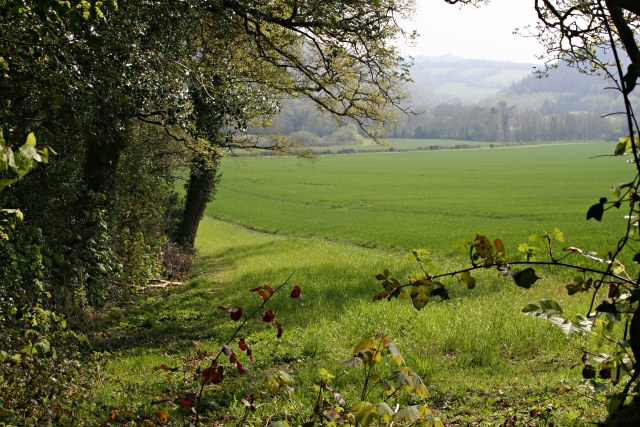
Photograph: Tony Atkin, CC BY-SA 2.0, via Wikimedia Commons.
Comments