
Nicotine is one of the most consequential molecules a plant has ever made. It hooks smokers, kills insects that try to eat tobacco leaves, and has been bred, taxed, and fought over for centuries. And yet, until now, nobody could write down the full chemical recipe the plant uses to build it. Several of the enzymes were missing, and the trickiest bond-forming step was a mystery.
A team led by Lijing Chang at the Chinese Academy of Sciences has closed that gap. Writing in Cell, the researchers lay out the complete biosynthesis of nicotine in tobacco, enzyme by enzyme, and show that the whole process runs inside a small protein machine anchored to the surface of the plant cell's vacuole.
A five-step route with a chemical twist
Nicotine is stitched together from two ring-shaped building blocks. Joining them cleanly turned out to be the hard part, and the plant solves it with a sequence the authors reconstructed step by step.
First, a UDP-glycosyltransferase attaches a sugar group that stabilizes the coupling reaction. An enzyme called A622 then reduces and activates one of the partners. The two pieces are joined through a stereoselective intermolecular Mannich-like reaction, a type of carbon-carbon bond formation that had not been pinned down for this pathway before. After that, a berberine bridge enzyme-like protein, or BBL, runs a series of oxidation steps. Finally a beta-glucosidase strips the sugar back off, and what is left is nicotine.
That Mannich-like coupling matters beyond tobacco. The authors note it is a fundamental mechanism plants use to build the scaffolds of many alkaloids, the large family of nitrogen-containing compounds that includes caffeine, morphine, and countless plant defense chemicals. Understanding how tobacco does it gives chemists a clearer template for the rest.
An assembly line bolted to the vacuole
The more surprising finding is where all this happens. The five enzymes do not float loose in the cell. They come together into a single cluster, a metabolon, that assembles on the vacuolar membrane. That location lets the plant channel the reactions and hand the finished nicotine straight into transport, rather than letting reactive intermediates drift around the cell.
To prove the pathway was complete, the team rebuilt it two ways. They reconstituted the reactions in a test tube, and they ran them inside living plants that do not normally make nicotine. Knock out any one of the components and nicotine production collapses, which confirms that each piece is doing real work rather than sitting in as a bystander.
One extra part proved essential for the engineering to succeed. A MATE transporter, a pump that moves small molecules across membranes, was needed to make heterologous plant species produce nicotine efficiently. And here the story loops back to why the plant bothers making the compound at all: those engineered plants gained resistance to pests. The same molecule that defends tobacco in the wild can be installed elsewhere as a built-in insecticide.
What this does and does not settle
The work is a metabolic map, not an agricultural product. Making a crop resistant to insects by having it manufacture nicotine raises obvious questions about food safety, regulatory approval, and whether pests would adapt, none of which this paper addresses. The experiments were done in tobacco and in model plants under controlled conditions, so field performance is untested. The findings also describe the chemistry of one alkaloid; whether the same metabolon logic governs other plant defense compounds remains to be checked case by case.
Still, finishing a pathway that resisted description for so long is a real milestone for plant biochemistry. Nicotine biosynthesis is now something researchers can move, tune, and switch on and off deliberately. For breeders chasing pest resistance without heavy pesticide use, and for chemists trying to produce valuable plant alkaloids in engineered organisms, having the full parts list changes what is possible.
Chang, L. et al. "Complete biosynthesis of nicotine." Cell, 2026. doi.org/10.1016/j.cell.2026.03.034
PubMed PMID: 41928514.
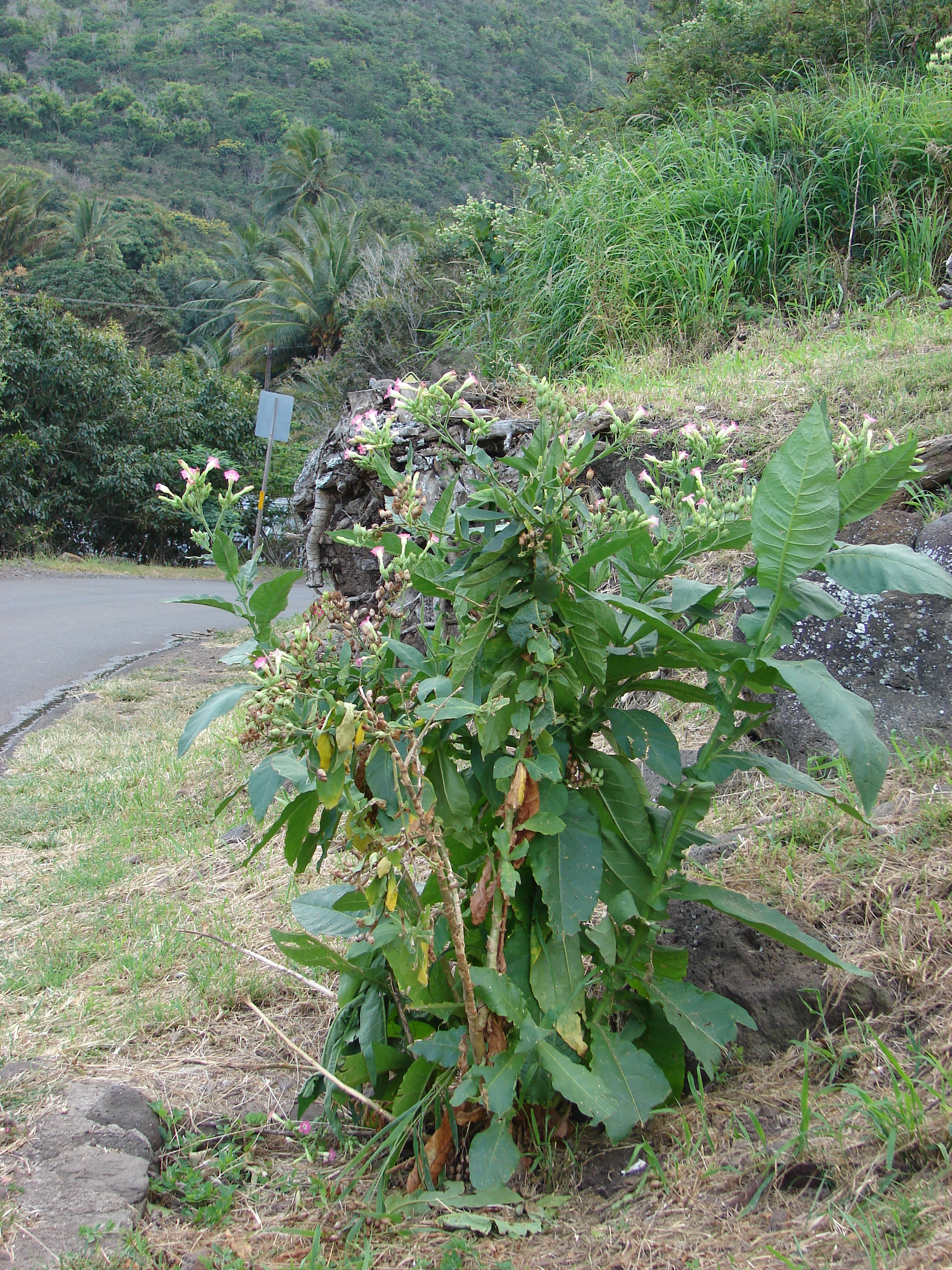
Photograph: Forest & Kim Starr, CC BY 3.0, via Wikimedia Commons.
Comments