A national average is only informative when the thing being averaged moves in one direction. If half the sites are rising and half are falling, the mean sits near zero and reports stability that exists nowhere. Freshwater biodiversity monitoring has this problem structurally, because streams differ in the one variable that governs which fish can live in them, and that variable is temperature.
A group led from the US Environmental Protection Agency harmonised federal biomonitoring records covering 389 species at 2,992 sites over 27 years, from 1993 to 2019, and split them by past summer water temperature rather than pooling them. The split produces two opposite results. In cold streams, below 15.4 degrees Celsius, fish abundance fell 53.4% and species richness fell 32%. In warm streams, above 23.8 degrees, abundance rose 70.5% and richness rose 15.6%. Between those bands, in the streams that represent the national average, almost nothing appeared to happen.
Why it matters: More than 18,000 freshwater fish species exist worldwide, and the aggregate statistics used to track them can register calm while the cold and warm ends of the range reorganise in opposite directions. This is a measurement problem before it is an ecological one.
The study, by Rumschlag et al., appears in Nature. Its central methodological point is stated plainly: Intermediate streams (stream temperatures 15.4-23.8 degrees C), representing the average stream, had minimal changes in fish biodiversity through time. The average stream is not a summary of the others. It is its own category, and it happens to be the quietest one.
Two reorganisations, running opposite
The compositional changes are more informative than the counts, because they invert as well. Ecologists sort fish by life-history strategy. Periodic species are large-bodied and late-maturing, investing in many offspring at long intervals. Opportunists are small, short-lived and fast-reproducing, the classic r-selected profile that recovers quickly from disturbance.
In cold streams, periodic fishes increased and opportunists declined. In warm streams, the reverse: small opportunists replaced large periodic fishes. The same two categories moved in opposite directions at the two ends of the temperature range, which is not what a single shared driver acting uniformly would produce.
Beta diversity, the difference between communities at different sites, also split. Cold-stream communities became more distinct from one another, described here as increased uniqueness. Warm-stream communities homogenised, converging on a similar set of species. Losing fish and becoming more distinctive, or gaining fish and becoming more alike, are both degradations in the sense that matters for conservation, but they are not the same phenomenon and a richness count alone cannot tell them apart. A warm stream that gained 15.6% more species while converging on its neighbours may be worse off than the number suggests.
The authors attribute the cold-stream pattern cautiously, to the proliferation of native or introduced game fishes, and they mark it as a possibility rather than a finding. Stocking large predatory sport fish into cold water would plausibly suppress small-bodied opportunists, which fits, but fitting is not the same as demonstrating.
Where warming and introductions meet
The interaction is the part with the most direct management implication. Warming and introduced fish did not simply add together; where both occurred, local biodiversity degraded faster than either alone would predict. As the authors put it, Interactions between warming and introduced fish were associated with increased rates of degradation to local fish biodiversity.
The reading that follows is that warming does part of its damage indirectly, by moving the thermal window so that introduced species which previously could not establish now can. On that account, stocking decisions and temperature are not independent stressors to be managed separately. Of the two, one is a local policy choice with a shorter lever than global temperature.
What the study can't say yet
This is observational monitoring, not experiment. Nothing here assigns cause. Warming, introductions, land use, flow alteration and chemical inputs all covary across a continent, and cold streams differ from warm ones in elevation, catchment and human use as well as in temperature. Temperature bands are labels for sets of places that differ in many correlated ways, and the analysis cannot separate the temperature itself from the rest of what a cold headwater is.
The thresholds are also analytic choices. The 15.4 and 23.8 degree cut points define the bands, and results reported per band inherit that framing. Nothing in the abstract indicates that the pattern is a step change at those temperatures rather than a gradient the bands have sliced.
Harmonisation carries its own cost. Federal biomonitoring programmes run different gear, effort and site-selection rules, and merging them across 27 years requires assuming those differences are either stable or corrected. Sites are also not a random sample of American streams; biomonitoring networks target places chosen for reasons that often relate to condition.
Finally, abundance and richness are counts, and the trait analysis rests on assigning species to broad life-history categories. The direction of these results is hard to dismiss given the magnitude and the 27-year span. The mechanism behind them is not established here.
Quick questions
Why would warming add species to a stream? Warm-adapted fish expand into water that was previously too cold, and small opportunists tolerate disturbance well. Richness can rise while the community becomes more generic and loses the species specific to that place.
Is a 53% fall in cold-stream abundance unusual? Over 27 years it is steep, and it appears in the stream type with the least room to retreat. Cold-water species in headwaters have nowhere cooler to move to.
What's the one-line takeaway? Splitting 2,992 US stream sites by temperature reveals cold-water fish communities losing half their abundance while warm-water communities gain and homogenise, a pair of opposite trends that the national average hides almost completely.
Rumschlag SL, Gallagher B, Hill R, et al. "Diverging fish biodiversity trends in cold and warm rivers and streams." Nature, 2025;647(8090):656-662. doi.org/10.1038/s41586-025-09556-0
PubMed PMID: 40993390.
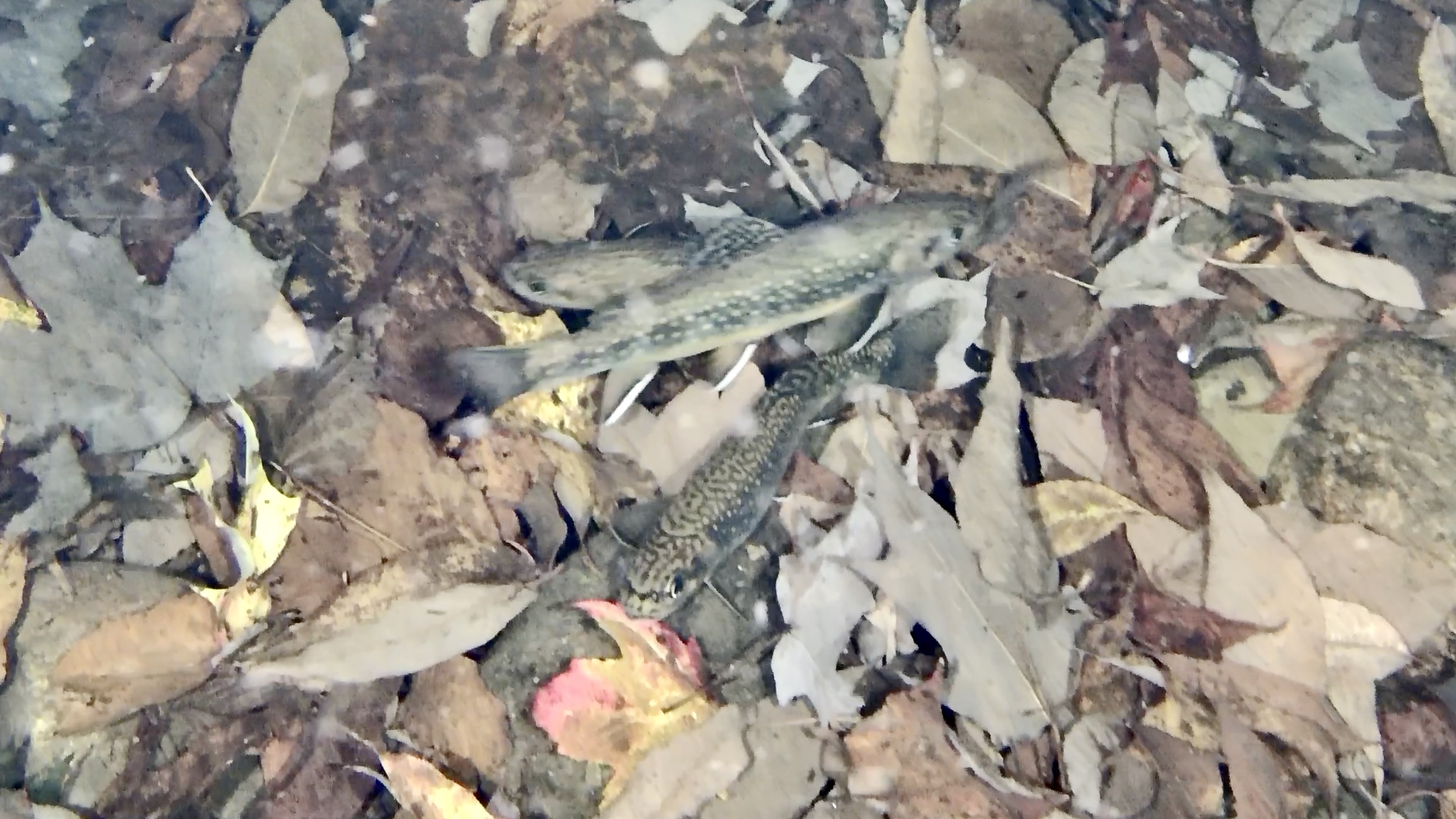
Image: wild brown trout. Via Wikimedia Commons.
Comments