
Sit under a bright lamp for a while and you probably will not notice your appetite fading. But in mice, that is roughly what happens. A team reporting in Nature Neuroscience found that strong light exposure cuts how much mice eat and slows the weight they put on. And they did something people have wanted to do for years with light therapy: they followed the signal from the eye to the exact brain cells that carry out the effect.
Light does far more than let us see. The retina feeds information to brain regions that set circadian rhythm, mood, and hormone release, often without any conscious image forming at all. Bright light therapy, the kind used for seasonal depression, has hinted at an anti-obesity effect for a while. What was missing was the wiring. If light can turn down feeding, which cells sense it, and which cells downstream actually pull the brake?
Tracing one wire at a time
The researchers followed the path through three stops. It starts with a specific subset of retinal ganglion cells, the output neurons of the eye, marked by a protein called SMI-32 and tuned to respond when light switches on. These cells send projections to the ventral lateral geniculate nucleus, a visual relay station. There they connect to inhibitory neurons that use the neurotransmitter GABA.
Those relay neurons in turn reach into the lateral hypothalamic area, a region long tied to hunger and the drive to eat. The hypothalamic target is itself made of GABA-releasing neurons, and the incoming signal shuts them down. So the chain runs from the retina, to the visual relay, to the appetite hub: retina to vLGN to lateral hypothalamus. Bright light activates the front of the line and quiets the end of it.
To check that this was the pathway doing the work, the team turned it on directly. Activating the light-sensing retinal cells that project to the relay, or activating the relay-to-hypothalamus connection on its own, was enough to suppress food consumption and blunt weight gain. When they interfered with the pathway, the appetite-suppressing effect of bright light went away. That last step matters. It moves the circuit from something that merely correlates with less eating to something the effect actually depends on.
Why a visual detour to the feeding center?
It seems odd that a hunger circuit would take its orders from the visual system. But the retina is the body's main light meter, and light is one of the most reliable signals about time of day and environment. Routing that information into feeding control lets an animal tie eating to the light cycle. The lateral hypothalamus has been studied for decades as a place where motivation and appetite meet. Finding a dedicated line running into it from light-sensing cells adds a sense the field had not fully mapped onto that region.
It also gives a plausible mechanism for something clinicians have observed loosely. If bright light nudges this pathway in people the way it does in mice, that would help explain why light exposure has shown up as a lever on body weight, and it points at specific cells rather than a vague whole-body effect.
What this does and does not show
This is mouse work, and mice are nocturnal, so their relationship with daytime light is not ours. The circuit was dissected with genetic and optical tools that let researchers switch defined cells on and off, techniques that do not carry over to humans. The study shows the pathway can suppress feeding and slow weight gain under experimental conditions. It does not show that shining a lamp at a person produces meaningful, lasting weight change, and it does not measure long-term health outcomes. The size and durability of any effect in people remain open.
Still, the appeal here is the specificity. Instead of "light affects appetite somehow," there is now a named set of cells and a traceable route from eye to feeding center. That is the kind of map you need before anyone can ask whether a carefully dosed light exposure could ever sit alongside diet and exercise as a nudge on eating. For now the result is a clean piece of circuit biology, showing that a signal we usually think of as purely visual can reach in and turn a dial on hunger.
Li, W. et al. "Bright light exposure suppresses feeding and weight gain via a visual circuit linked to the lateral hypothalamus." Nature Neuroscience, 2025. doi.org/10.1038/s41593-025-02156-1
PubMed PMID: 41387574.
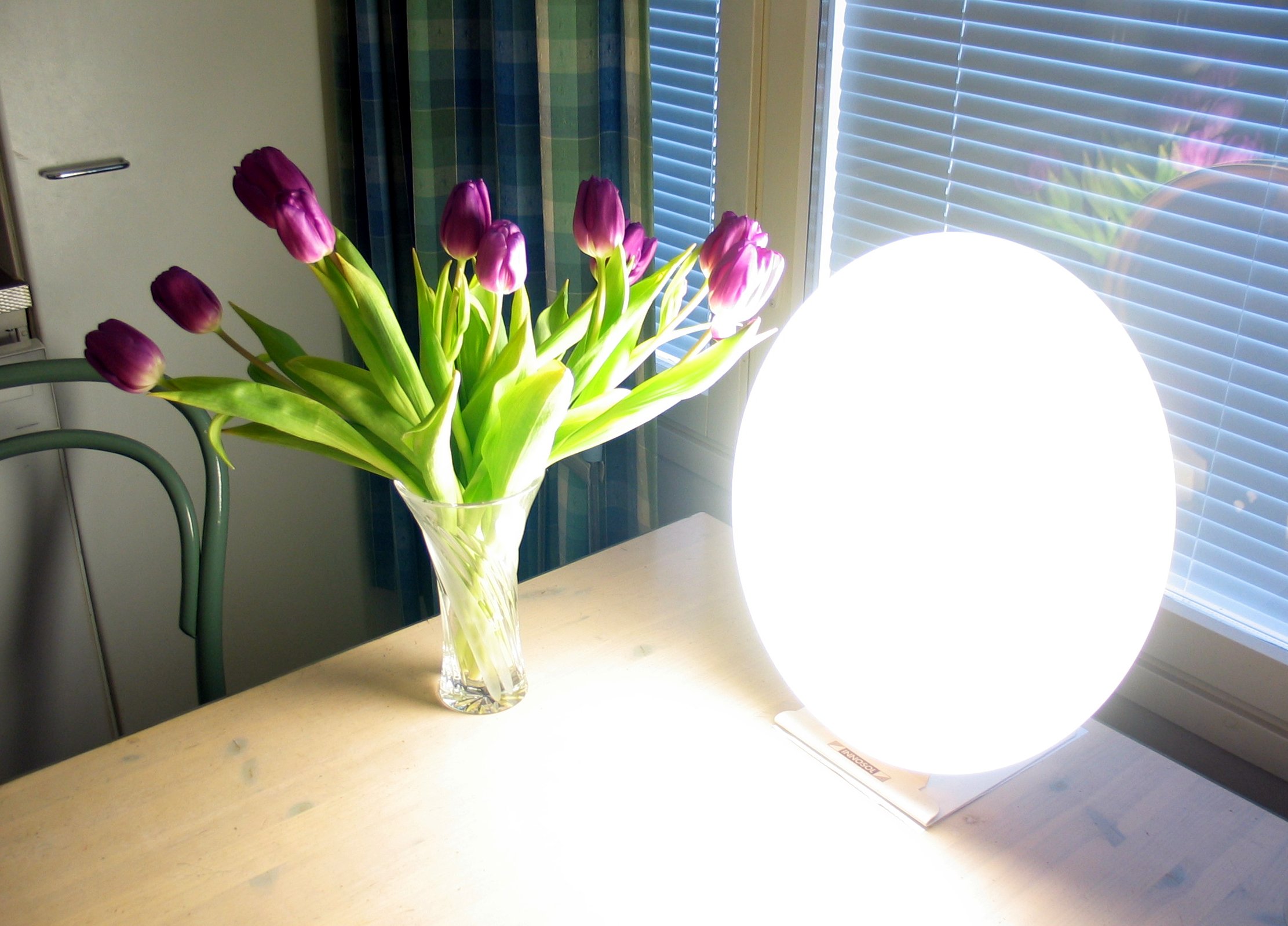
Photograph: User:Mysid, Public domain, via Wikimedia Commons.
Comments