


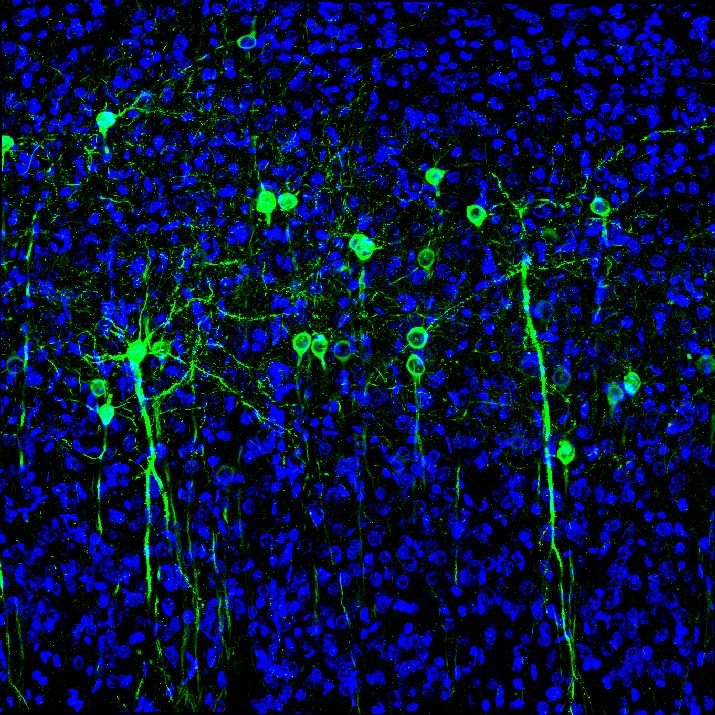
Your brain is not bolted down. It floats in fluid, and it moves. Every time a mouse in a Penn State lab took a step, its cortex shifted inside its skull. The surprise was not that the brain moved. It was what pushed it. Not the heartbeat. Not breathing. The animal's abdominal muscles.
The study, published in Nature Neuroscience, comes from the lab of Patrick Drew and colleagues, who wanted to know why the brain drifts within its bony case and whether that drift matters. To find out, they built an imaging setup fast and precise enough to catch the motion as it happened.
Filming a cortex that will not hold still
The team used high-speed two-photon microscopy across multiple focal planes to track the dorsal cortex of awake, head-fixed mice relative to the skull. Head-fixed is the key detail. The skull was clamped, so any movement they saw was the brain sliding beneath it, not the whole head bobbing.
The motion had a consistent direction. The cortex moved mainly toward the front of the head and off to the side, and it did so in tight lockstep with locomotion. When the mouse ran, the brain moved. When they checked whether the rhythm of breathing or the beat of the heart could account for it, neither lined up. Those are the usual suspects for anything that jostles the brain, and here they were bystanders.
A hydraulic line from belly to brain
So what was driving it? The researchers traced the force to contractions of the abdominal muscles. Their picture is a hydraulic one. Squeezing the abdomen changes pressure in a vascular connection that runs between the abdominal cavity and the nervous system, and that pressure change nudges the brain. They tested the idea the direct way. Pressing on a mouse's abdomen produced brain motion on its own, no running required.
That reframes the brain as part of a larger mechanical system rather than an isolated organ cushioned in fluid. The belly and the brain are, in a real physical sense, connected by plumbing.
The consequences may reach into how the brain cleans itself. Using model simulations, the team estimated that this movement could push interstitial fluid through brain tissue and out into the subarachnoid space, the fluid-filled layer around the brain. That direction is worth pausing on. It runs opposite to the fluid flow that other researchers have described during sleep, when fluid is thought to wash inward and help clear waste. Movement while awake, in this model, would move fluid the other way.
What the mouse data can and cannot say
The work was done entirely in mice, and the fluid-flow conclusion rests on simulation rather than direct measurement of moving fluid. So the claim that body movement flushes the brain remains a modeled prediction, not something the team watched unfold. Whether the same mechanical coupling operates in the much larger human head, with its different proportions and pressures, is an open question the paper does not settle.
Still, the core observation is hard to wave away. The researchers could induce brain motion by pressing on the abdomen, and they could rule out breathing and heartbeat as the cause. That combination points to a genuine mechanical link rather than a coincidence of timing.
If the fluid idea holds up, it suggests the brain has two complementary housekeeping modes. One runs during sleep, drawing fluid inward. The other would run during active movement, pushing it outward. Physical activity has long been tied to better brain health through vascular and metabolic routes. This adds a blunter possibility: that the simple mechanics of a moving body help stir the fluid around the brain. For now that is a hypothesis built on mice and math. It is a specific, testable one, and it starts from a fact you can see under a microscope. The brain moves, and the gut is helping to move it.
Garborg, C.S. et al. "Brain motion is driven by mechanical coupling with the abdomen." Nature Neuroscience, 2026. doi.org/10.1038/s41593-026-02279-z
PubMed PMID: 42045465.
Photograph: Cody Siciliano, CC BY-SA 4.0, via Wikimedia Commons.
Comments